
3C 279
3C 279 is a very special and bright object in space called an optically violent variable quasar. This means it changes its brightness a lot in different kinds of light, such as visible light, radio waves, and X-rays. Scientists have been watching 3C 279 since 1971, and it became especially exciting between 1987 and 1991 when it showed very strong activity.
In 1991, the Compton Gamma Ray Observatory found that 3C 279 was one of the brightest objects in the sky that gives off gamma rays, a very powerful type of energy from space. Today, it is still one of the brightest and most changing sources of gamma rays that the Fermi Gamma-ray Space Telescope watches.
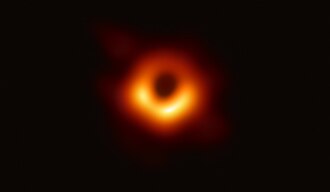
Because 3C 279 is so bright and changes quickly, it was used to help test and adjust the Event Horizon Telescope. This telescope was able to take the first-ever picture of a black hole, located in the galaxy M87. 3C 279 helped scientists make sure their measurements were correct for this amazing discovery.
Observations
Astronomers noticed something interesting in 1973: it looked like a jet of material shooting away from the quasar was moving faster than the speed of light. This is called superluminal motion, but it’s just an optical illusion. The jet isn’t actually moving faster than light; it just looks that way from our point of view.
On June 16, 2015, 3C 279 had a big burst of gamma rays. Scientists think this happened when fast-moving electrons were added to the dense area near the center of the quasar. In April 2017, more detailed observations showed the shape of the radio jet very clearly, revealing that it might be bent or spinning due to shock waves.
Pictures
Keep exploring

This article is a child-friendly adaptation of the Wikipedia article on 3C 279, available under CC BY-SA 4.0.
Images from Wikimedia Commons. Tap any image to view credits and license.