
Adams–Onís Treaty
The Adams–Onís Treaty was an important agreement made between Spain and the United States. It was signed on February 22, 1819, by two leaders named John Quincy Adams and Luis de Onís. Through this treaty, the United States gained control of Florida from Spain. In return, the United States gave up any claims it had to Spanish Texas.
This treaty helped set the first big boundary line that stretched across the country from the east to the west. However, the treaty stopped being used fully on August 24, 1821, when a new agreement called the Treaty of Córdoba recognized that Mexico had become independent from Spain. Later, in another treaty, the line set by the Adams–Onís Treaty was kept as the border between Mexico and the United States. The Adams–Onís Treaty was officially ended in 1902.
Background
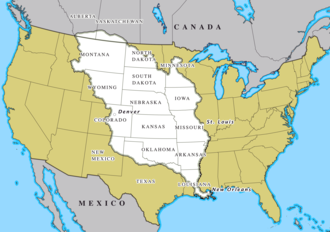
Pinckney's Treaty of 1795 set the borders between the United States and Spanish Florida, but American settlers moving into the area caused many arguments between the two countries. The Louisiana Purchase in 1803 made these arguments even worse, as people disagreed over where the new border should be—along the Sabine River or the Rio Grande.
When wars broke out in Spain and in areas trying to become independent from Spain, Spain could not control its American lands as well. Between 1810 and 1813, the United States took control of West Florida, stretching from the Mississippi River east to the Perdido River, which is now part of the border with Alabama.
During the first of the Seminole Wars from 1817 to 1818, the United States took the rest of Florida. This gave John Quincy Adams, who was the Secretary of State at the time, a chance to ask for good terms in a treaty. He wanted to make sure the United States became the strongest country in North America without getting involved in other countries' matters. This idea was later explained more in the 1823 Monroe Doctrine.
By 1819, Spain agreed to give up Florida if the United States set a clear border for Texas. Adams wanted to remove any Spanish claims in the western part of the United States and create the country's first border that went across the whole land. Even though Spain was struggling to keep control of its lands, the leaders in Madrid were willing to make this agreement, hoping to get those lands back later.
Provisions
Talks happened in Washington, D.C., with John Quincy Adams leading for the United States and Luis de Onís, the Spanish ambassador, leading for Spain. They agreed on 16 important points.
One big point was that Spain gave the United States both East and West Florida. Another point set the southern border between the two countries. Spain also stopped claiming land in the Oregon Country. The United States agreed to pay American settlers for losses they said Spain caused. They also agreed to keep Pinckney's Treaty and give special trading rights to Spanish merchants in Pensacola and St. Augustine for twelve years.
Implementation
The U.S. Senate approved the treaty with Spain on February 24, 1819, but Spain did not agree until October 1820. Because of the delay, the Senate had to vote again, and some leaders wanted the U.S. to also take Texas. This idea was rejected, and the treaty finally took effect on February 22, 1821.
Because of this treaty, the U.S. set up a group to handle claims from American citizens against Spain. This group gave out around $5 million before it ended in 1824. For the United States, this treaty helped the country grow its land from the Mississippi River all the way to the Pacific Ocean. For Spain, it meant keeping its colony of Texas and having a buffer zone between its colonies in California and New Mexico and U.S. lands. Many believe this treaty was a big success for the U.S. because it allowed the country to start trade across the Pacific Ocean.
Spain recognized Mexico’s independence with the Treaty of Córdoba on August 24, 1821. Although Mexico was not part of the original treaty, it later agreed to the same borders in 1831. The treaty also led to later disputes over borders, especially with Texas and between Oregon and California. These issues were not fully settled until many years later.
Pictures
Keep exploring




This article is a child-friendly adaptation of the Wikipedia article on Adams–Onís Treaty, available under CC BY-SA 4.0.
Images from Wikimedia Commons. Tap any image to view credits and license.