
Administrative divisions of Yugoslavia
Yugoslavia was a country in Southeast Europe that existed for 74 years. During that time, it had many different ways of organizing its regions and cities into smaller parts, which are called administrative divisions.
These divisions helped the government manage things like schools, hospitals, and roads in different parts of the country. The way Yugoslavia divided itself changed over time as the country grew and faced new challenges.
Understanding these divisions helps us learn about how Yugoslavia was organized and how it interacted with its neighbors and the rest of the world.
1918–1922
Main article: Subdivisions of the Kingdom of Yugoslavia
From 1918 to 1922, the Kingdom of Serbs, Croats, and Slovenes used the same areas it had before World War I. These areas came from places that used to be part of the Habsburg monarchy and from the countries of Serbia and Montenegro.
The big areas, called provinces, were:
- Slovenia
- Croatia and Slavonia
- Dalmatia
- Bosnia and Herzegovina
- Banat, Bačka, Baranja
- Serbia
- Northern Serbia
- Southern Serbia
- Montenegro
1922–1929
Main article: Subdivisions of the Kingdom of Yugoslavia
In 1922, the Vidovdan Constitution created the Kingdom of Serbs, Croats, and Slovenes as one country. It set up 33 new areas called oblasts (provinces). These provinces were managed from a central place. Some of these provinces included Vrbas Oblast, Belgrade Oblast, Bihać Oblast, Bitola Oblast, Zeta Oblast, Čačak Oblast, Ćuprija Oblast, Dubrovnik Oblast, Karlovec Oblast, Kragujevac Oblast, Kruševac Oblast, Ljubljana Oblast, Maribor Oblast, Mostar Oblast, Niš Oblast, Bačka Oblast, Osijek Oblast, Požarevac Oblast, Pristina Oblast, Sarajevo Oblast, Smederevo Oblast, Split Oblast, Skopje Oblast, Šabac Oblast, Štip Oblast, Travnik Oblast, Tuzla Oblast, Užice Oblast, Valjevo Oblast, Vranje Oblast, Syrmia Oblast, Zagreb Oblast, and Zaječar Oblast.
1929–1939
Main article: Subdivisions of the Kingdom of Yugoslavia
In 1929, the country known as the Kingdom of the Serbs, Croats and Slovenes changed its name to the Kingdom of Yugoslavia. It was divided into nine areas called banovinas. These areas were named after natural features like rivers. Their borders were not based on where different groups of people lived or old country lines from before World War I. Small changes to these borders happened in 1931. The banovinas included places like Drava Banovina with its capital in Ljubljana, Sava Banovina in Zagreb, and several others, each with their own main cities. The City Administration of Belgrade, together with Zemun and Pančevo, was also a special administrative area.
1939–1941
Main article: Banovina of Croatia
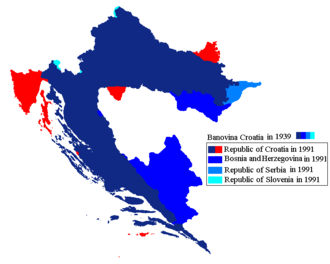
In 1939, to make things better for Yugoslav Croats, a new area called the Banovina of Croatia was created. It was formed by joining together parts called the Littoral and Sava Banovinas, plus some land from the Vrbas and Zeta Banovinas. The main city of this new area was Zagreb, just like before.
1941–1944
During World War II, the Kingdom of Yugoslavia was taken over and split into three areas controlled by the Axis powers:
- Independent State of Croatia
- Italian governorate of Montenegro (later German occupied territory of Montenegro)
- the Territory of the Military Commander in Serbia (including autonomous German-ruled Banat)
Other parts of the Kingdom of Yugoslavia were occupied by German, Italian, Hungarian, Bulgarian and Albanian troops.
1945–1992
The Socialist Federal Republic of Yugoslavia was made up of 6 republics and two special areas called autonomous provinces. These were:
- Serbia (which included the areas of Vojvodina and Kosovo)
- Croatia
- Bosnia and Herzegovina
- Macedonia
- Slovenia
- Montenegro
Each part of Yugoslavia had its own way of organizing smaller areas, like cities and towns. Over time, these smaller areas changed, with some being combined or removed.
SR Serbia
In Serbia, rules about how to organize areas were first set in 1945. These rules changed many times over the years. In the beginning, there were many small areas called municipalities and srezs. By 1955, srezs were removed, leaving mainly cities and municipalities.
Later, in 1963, municipalities became important local groups with rights given by laws. In 1974, municipalities could join together to handle shared tasks. Special rules applied to the city of Belgrade. Central Serbia was divided into eight groups of municipalities, each with its own number of member areas.
SR Croatia
In Croatia, areas were first organized into units called kotars in 1947. Over the years, these changed a lot. In 1952, new areas called municipalities were added. By 1955, there were 299 municipalities and 27 kotars. The number of municipalities went down over time, and kotars were removed in 1967.
In 1974, municipalities could choose to join together. After elections in 1990, new areas called counties were planned, but they were only fully set up in 1992.
SR Bosnia and Herzegovina
After World War II, areas in Bosnia and Herzegovina were organized into towns, cities, and other small groups. In 1946, there were 7 larger areas called okrugs, many srezs, and many smaller groups. By 1949, the country was divided into 4 oblasts, many srezs, cities, towns, and smaller groups. Over time, the number of these areas changed, with srezs being removed in 1966. By 1984, there were 109 municipalities, which stayed until 1992.
SR Macedonia
In 1953, Macedonia had 86 municipalities and 7 srezs. After a new constitution in 1963, srezs were no longer important, and the number of municipalities was reduced to 32.
SR Slovenia
In 1945, Slovenia was divided into counties, districts, and townships. By 1947, counties were removed, and the country was divided into districts and townships. In 1952, townships were removed, and the country was organized into towns, districts, and municipalities. Over the years, the number of districts and municipalities changed many times. By 1965, only four districts remained, and they were later removed. Municipalities became important local groups with their own governance.
Pictures
Keep exploring




This article is a child-friendly adaptation of the Wikipedia article on Administrative divisions of Yugoslavia, available under CC BY-SA 4.0.
Images from Wikimedia Commons. Tap any image to view credits and license.