 Safekipedia
Alan Guth
Adapted from Wikipedia · Discoverer experience
Alan Harvey Guth, born February 27, 1947, is an American theoretical physicist and cosmologist. He holds the position of the Victor Weisskopf Professor of Physics at the Massachusetts Institute of Technology. Guth’s important work helped us understand how the universe began.
Guth studied physics at MIT, where he earned his bachelor’s, master’s, and doctorate degrees. In 1979, while working at Cornell, he developed an idea called cosmic inflation. He shared this idea in a seminar in January 1980. Later, at the SLAC Theory Group at Stanford University, he formally proposed cosmic inflation in 1981. This theory suggests that very early in its life, the universe expanded extremely quickly because of a special kind of energy.
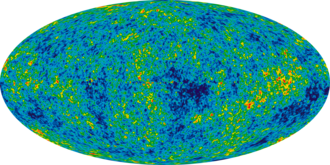
For this groundbreaking work, Guth, along with Alexei Starobinsky and Andrei Linde, received the 2014 Kavli Prize. Evidence from the WMAP mission in 2006 strongly supported the idea of cosmic inflation, showing how important Guth’s research was to our understanding of the early universe. His studies focus on how tiny particles of matter relate to the universe’s beginnings.
Early life and education
Alan Guth was born in New Brunswick, New Jersey in 1947 and grew up in Highland Park. He went to school there before joining the Massachusetts Institute of Technology for a special five-year program. He finished his bachelor's and master's degrees in 1969 and got his doctorate in 1972.
In 1971, he married Susan Tisch, his high school sweetheart, and they had two children. Early in his career, Guth studied small particles called quarks and later worked on theories about how the universe began.
Career
Inflationary theory
Main article: Cosmic inflation
Alan Guth began thinking about a big idea in 1978 when he heard a talk about a puzzle in the universe called the flatness problem. This puzzle showed that something important was missing from ideas about the Big Bang.
Later, in 1979, another talk helped Guth understand more. It explained how all forces in nature could be united under one idea when the universe was very hot, like right after the Big Bang. This also showed how the universe goes through changes, just like water can be ice, liquid, or steam.
Guth thought of a way to solve a big puzzle using a special kind of cooling in the very early universe. This idea led him to discover that the universe could expand very fast. This fast expansion would explain why the universe looks flat to us, just like Earth looks flat even though it is round.
Guth shared his ideas publicly in 1980 and kept working on them. Even when he found some problems with his early ideas, he believed that the universe did expand quickly in its very beginning.
Current interests
In the past, Guth studied many interesting ideas in physics, like special types of particles and time travel concepts. Today, his work focuses on understanding how the universe began and changed right after it was created.
Guth is a professor at the Massachusetts Institute of Technology (MIT), and he has written over 60 papers about his discoveries.
Honors and awards
Alan Guth has received many awards for his work. In 1996, he won the Eddington Medal, and in 2009, he was given the Isaac Newton Medal by the Institute of Physics. In 2012, he received the Breakthrough Prize in Fundamental Physics, created by Yuri Milner.
In 2014, Guth, along with Andrei Linde and Alexei Starobinsky, won the Kavli Prize for their work on cosmic inflation. That same year, he also received the Golden Plate Award from the American Academy of Achievement. Interestingly, in 2005, Guth won an award for having the messiest office in Boston, given by The Boston Globe. His colleagues entered him hoping it would encourage him to tidy up, but Guth was proud of the award.
Publications
Alan Guth has written books and articles about his work. One book is called The Inflationary Universe: The Quest for a New Theory of Cosmic Origins. He also wrote an article titled "Inflation and the New Era of High-Precision Cosmology".
Images
Related articles


This article is a child-friendly adaptation of the Wikipedia article on Alan Guth, available under CC BY-SA 4.0.
Images from Wikimedia Commons. Tap any image to view credits and license.