 Safekipedia
Aleuts
Adapted from Wikipedia · Discoverer experience
The Aleuts are the Indigenous people who have lived on the Aleutian Islands for thousands of years. These islands stretch between the North Pacific Ocean and the Bering Sea. Aleuts are known also as the Unangax̂ in their own language, Unangam Tunuu.
Today, Aleuts live in both the United States and Russia. In the U.S., they are mainly in Alaska, where there are 13 groups officially recognized by the government. In Russia, they live in a region called Kamchatka Krai and are recognized as one of the smaller groups of Indigenous people there.
The Aleut people have a rich culture and history, and they have kept many of their traditions alive despite big changes over time. Learning about the Aleuts helps us understand the diverse cultures that make up the world. For more about their language, you can read about the Aleut language.
Etymology
In their own language, the Aleuts call themselves Unangan (in the eastern area) and Unangas (in the western area). Both of these words mean "people". The name "Aleut" comes from Russian and was used for the Native people of the Aleutian Islands and also for their neighbors to the east in the Kodiak Archipelago.
Language
The Aleut people speak Unangam Tunuu, also called the Aleut language, along with English in the United States and Russian in Russia. Only about 150 people in the United States and five in Russia still speak Aleut today. This language is part of the Eskaleut language family and has three dialects: Eastern Aleut, Atkan, and the now-extinct Attuan.
The Pribilof Islands have the most speakers of Unangam Tunuu. Many Native elders can speak Aleut, but it is uncommon for most people to speak it well. Aleut was first written using the Cyrillic script in 1829 and later switched to the Latin script from 1870. An Aleut dictionary and grammar have been created, and some parts of the Bible were translated into Aleut.
Tribes
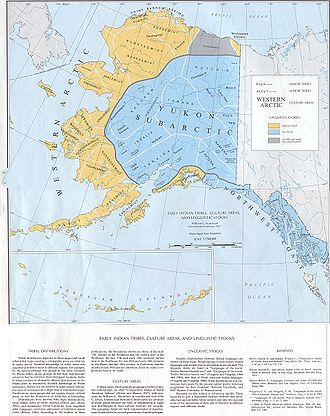
The Aleut people, also known as Unangan, have different groups based on where they live and the language they speak. These groups are spread across many islands between the North Pacific Ocean and the Bering Sea. Some groups live in the Near Islands like Attu, Agattu, and Semichi. Others live in the Commander Islands such as Bering and Medny. There are also groups in the Rat Islands, Delarof Islands, Andreanof Islands, and many more places. Each group has its own name and dialect, showing the rich diversity of the Aleut people.
Population and distribution
For specific tribal village names, see List of Alaska Native tribal entities.
Aleuts traditionally lived across the Aleutian Islands, the Shumagin Islands, and the far western part of the Alaska Peninsula. Before Europeans arrived, their population was around 25,000. In the 1820s, the Russian-American Company moved many Aleut families to the Commander Islands and the Pribilof Islands during the fur trade.
By the year 2000, about 11,941 people identified as Aleut, and around 17,000 had some Aleut ancestry. Sadly, many Aleut people became very sick from diseases brought by people from Eurasia, which they had never encountered before. This, along with changes to their way of life, affected their numbers. Over time, many Russian traders and Europeans married Aleut women and started families with them.
History
After contact with Russia
After Russian missionaries arrived in the late 1700s, many Aleuts became Christians. Most Russian Orthodox groups in Alaska today have many Aleut members.
Russian traders took Aleut women and children to force Aleut men to hunt animals for fur. They also made many Aleut men work without freedom.
Contact with Japanese and uprising against Russians
In the 1700s, Russian traders lived on the islands. Aleuts hunted animals for their fur, which was very popular. In 1783, a Japanese sailor named Daikokuya Kōdayū got stuck on Amchitka Island with his team. He met the Russians and Aleuts there. He stayed with them until 1792, when he returned to Japan. He brought back a Russian map showing the real size of Australia.
While Kōdayū was on Amchitka in 1784, the Aleuts there fought against the Russian traders. The Aleuts felt the Russians were not giving them enough goods for the fur they collected. A leader of the Russians ordered two of his men to hurt an Aleut leader’s daughter. After this, the Aleuts moved to nearby islands. The leader of the Russians was later put in jail.
Aleut massacre against the Nicoleño Tribe in California
In 1814, Russian traders took Aleut hunters to an island near California to collect valuable animal fur. The local Nicoleño people asked for payment for all the animals being hunted. This led to a fight. Some Aleuts and Nicoleños were hurt. In 1835, most Nicoleños were taken from the island. One woman, Juana Maria, was found alone in 1853. She might have been the last Nicoleño.
World War II
Japanese occupation
When World War II started, the Aleutian Islands were controlled by the United States. In 1942, Japanese forces took over two islands, Kiska and Attu. They forced 41 Aleut people from Attu to Japan, where they were kept in very hard conditions. Many became very sick and some died. The United States worked to take back these islands.
Internment
The U.S. government moved 800 Aleuts to camps in southeast Alaska because they were worried about Japanese attacks. Many Aleuts got very sick in these crowded camps. In 1988, the U.S. government tried to make things right for the survivors. In 2017, the government said it was sorry for how it treated the Aleut people.
Population's decline
Before outside groups changed their lives, about 25,000 Aleuts lived on the islands. Diseases from other people, hard treatment, and changes to their society caused their numbers to drop a lot. By 1885, about 3,000 Aleuts lived there. By 1910, there were about 1,500. By 2000, almost 12,000 people said they were Aleut, and about 17,000 said Aleuts were part of their family history.
Culture
Housing
Aleuts traditionally built special underground homes called barabara. These homes kept families dry from rain, warm, and safe from strong winds. They dug a small hole in the ground, covered it with a roof made from driftwood and grass, and then covered that with earth to keep it cozy. Inside, families had their own spaces, and they used lanterns for light instead of fires.
Subsistence
Aleut people lived by hunting and fishing. They caught salmon, crabs, shellfish, and cod, and hunted sea animals like seals, walruses, and whales. They prepared these foods in many ways, such as drying, smoking, or roasting. They also ate caribou, muskoxen, deer, moose, and whales. Berries were dried and mixed with fat and fish to make a special treat. Whale skin and blubber were also enjoyed as food.
Today, many Aleut people still enjoy traditional foods but also buy food from stores, which can be expensive.
Visual arts
Aleut artists were skilled in many areas, including making weapons, building special hunting boats called baidarkas, weaving, carving, and creating masks. Men and women carved from ivory and wood, and were famous for beautiful wooden hats with bright designs. Aleut women made waterproof parkas from seal skin and wove baskets from special grass. They also made jewelry and sewing tools from walrus ivory.
Aleut carvings often showed local animals like seals and whales, and sometimes people. They made masks to tell stories from their myths, using wood carved with natural paints and feathers.
Tattoos and piercings
Aleut people used body art to show their skills and beliefs. They believed body markings helped keep away bad spirits. Both men and women wore piercings, such as nose pins made from bone or feather shafts. Women often got tattoos when they became adults, and men after their first hunt. Tattoos showed family history or personal achievements.
Aleut clothing
Aleut people made warm clothes to protect themselves from harsh weather. Men and women wore long parkas that went below the knees. Women used seal skin, while men used bird skins. Hunters wore special waterproof parkas made from seal or sea-lion guts. Children wore parkas made from eagle skin. All clothes were decorated with feathers, fur, and other natural materials.
Gender
Early stories from Russian travelers talk about people who did not fit typical male or female roles, called ayagigux̂ and tayagigux̂. It is not clear if these were real people or spirits.
Hunting technologies
Boats
Aleut people were great sailors and hunters. They used small boats called baidarkas for hunting sea animals, and larger boats called baidara for traveling between islands and trading. The baidarka was a tiny, strong boat made from sea-lion skin, perfect for hunting.
Weapons
Aleut hunters used special tools like harpoons and throwing boards to catch sea animals. Harpoons had sharp points that could stick into an animal and not come out. There were different kinds of harpoons, including simple ones and toggle-head spears that could turn inside the animal. They also used throwing lances to kill large animals.
Burial practices
Aleut people buried their ancestors near villages in different ways. One common way was to build burial mounds called umqan on bluffs. They also buried people in caves, left sarcophagi above ground, or placed remains near communal houses. These burial methods showed respect for the dead and fit the local environment.
Notable Aleuts
The Aleut people have produced many important individuals across different fields. John Hoover was a well-known sculptor, while Carl E. Moses was a successful businessman and served in government for many years. Jacob Netsvetov and Olga (Arrsamquq) of Alaska were respected religious leaders, and Peter the Aleut is remembered as a martyr. Sergie Sovoroff was known for teaching and building traditional sea kayaks, and Eve Tuck is an academic who studies Indigenous cultures.
In popular culture
In the science fiction book Snow Crash by Neal Stephenson, there is a strong character named Raven who is an Aleut known for his toughness and hunting skills. The story involves revenge linked to how some people treated the Aleuts.
Another book, Island of the Blue Dolphins by Scott O’Dell, includes a part where Aleuts come into conflict with a group of Native Americans living on a small island near the coast of California.
Images
Related articles




This article is a child-friendly adaptation of the Wikipedia article on Aleuts, available under CC BY-SA 4.0.
Images from Wikimedia Commons. Tap any image to view credits and license.