 Safekipedia
Algorithmic art
Adapted from Wikipedia · Discoverer experience
Algorithmic art is a special kind of art where the design is made by following a set of rules called an algorithm. Most of this art is visual, like digital paintings or sculptures, but it can also include interactive installations and music. People who create this art are sometimes called algorists.
Algorithmic art is not a new idea. In the past, artists have always followed rules to make beautiful patterns. For example, Islamic art often uses rules to create lovely designs, and even the ancient practice of weaving has elements of this kind of art.
As computers became more advanced, artists began using them to make art in new ways. Algorithmic art lets artists try out new ideas and be very creative in the digital age. It helps them make very detailed patterns and designs that would be hard to make by hand. The artist decides what rules to use, but the final result depends on how the algorithm works.
Overview
Further information: Mathematics and art
Algorithmic art, also called computer-generated art, is a type of generative art made by machines. It is linked to systems art, which looks at how systems work. One example of algorithmic art is fractal art, which is both abstract and very interesting to look at.
Because even simple rules need a lot of work to create, this art is made using computers. The results can be shown on a screen, printed, or drawn by special machines. Artists sometimes use numbers that seem random to add more variety to their work. People don't all agree if art made by changing an existing picture with a rule should be called computer-generated art or just art helped by a computer.
History
Roman Verostko says that Islamic geometric patterns are made using steps that repeat in a set way, just like Italian Renaissance paintings that use mathematical techniques, especially linear perspective and balance.
Some of the first known artworks made by computers were created by Georg Nees, Frieder Nake, A. Michael Noll, Manfred Mohr and Vera Molnár in the early 1960s. These artworks were made by a machine called a plotter that followed computer commands. The creativity came from writing the program, which told the plotter what to do. Sonia Landy Sheridan started Generative Systems at the School of the Art Institute of Chicago in 1970. Her early work explored how a machine could change art.
Besides the work of Roman Verostko and others, later examples include fractal artworks from the 1980s. These are special because they create pictures directly in computer memory. Unlike the earliest computer art, which was "drawn" by a plotter, fractal art exists as digital images. However, strict definitions may not call fractal art "algorithmic art" because the steps are not made by the artist.
As these developments continued, artist Ernest Edmonds showed how art helps us understand important ideas. He traced the link between art and computers from the 1960s to today, when steps and patterns are key ideas for everyone.
Rational approaches to art
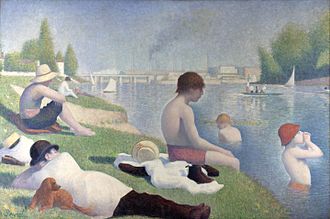
Art is not just about feelings; it also uses careful, logical methods. Artists must learn to use different tools, theories, and methods to make great artwork. Throughout history, many art methods were created to make special visual effects. For example, Georges-Pierre Seurat created pointillism, a way of painting by placing small dots of color next to each other. Cubism and Color Theory also changed art. Cubism shows objects from many angles on a flat surface. Color Theory explains that all colors come from mixing red, green, and blue. Humans have always found patterns and steps to make art. These tools helped artists create beautiful artworks more efficiently, making art more organized over time.
Creating perspective through algorithms
Another big part of how art developed is perspective. Perspective helps an artist show a 3D object on a flat surface. Muslim artists in the Islamic Golden Age used linear perspective in their designs. Italian artists rediscovered this during the Renaissance. The Golden Ratio, a special math number, was used by many Renaissance artists in their drawings. Most famously, Leonardo DaVinci used this in his Mona Lisa and other paintings like Salvator Mundi. This is a way of using steps and patterns in art. By looking at old artworks from the Renaissance and the Islamic Golden Age, we can see how math, shapes, and nature were used to create art.
Role of the algorithm
For a piece to be called algorithmic art, it must be created using a special set of rules made by the artist. These rules act like a detailed recipe that decides how the artwork looks. The artist can also choose settings and help guide the creation as it happens. The rules might be written as computer code, functions, or expressions, and they can use mathematical or computational ideas.
Because these rules usually work the same way each time, artists often add something unpredictable, like random numbers or data from the world around us. Some artists even use natural movements that the rules then change. Artist Kerry Mitchell explained that true fractal art needs the artist’s guidance, even when using a computer.
Algorists
"Algorist" is a special name for digital artists who create art using special rules called algorithms. Some famous early algorists are Vera Molnár, Dóra Maurer, and Gizella Rákóczy.
These artists started talking and building their group in 1995 after a talk called "Art and Algorithms" at SIGGRAPH. The group was started by Jean-Pierre Hébert and Roman Verostko. Hébert made up the word "algorist" to describe these artists.
Artists can use computer code to make complex and moving pictures. They can also use special patterns called cellular automata to create art that looks random or to change photos in interesting ways. Another type of art uses fractals, which are beautiful shapes made by computers using fractal-generating software. Artists can also use genetic algorithms to slowly build images step by step.
Some artists make algorithmic art without computers. For example, Jack Ox used rules to create paintings that show music, like pieces by Anton Bruckner and Kurt Schwitters. Since 1996, there have also been tools that can automatically create special designs called ambigrams.
Images
Related articles



This article is a child-friendly adaptation of the Wikipedia article on Algorithmic art, available under CC BY-SA 4.0.
Images from Wikimedia Commons. Tap any image to view credits and license.