
Ancient Roman technology
Ancient Roman technology is the collection of techniques, skills, methods, processes, and engineering practices which supported Roman civilization and made possible the expansion of the economy and military of ancient Rome (753 BC – 476 AD).
The Roman Empire was one of the most technologically advanced civilizations of antiquity, with some of the more advanced concepts and inventions forgotten during the turbulent eras of Late Antiquity and the early Middle Ages. Gradually, some of the technological feats of the Romans were rediscovered and/or improved upon during the Middle Ages and the beginning of the Modern Era; with some in areas such as civil engineering, construction materials, transport technology, and certain inventions such as the mechanical reaper, not improved upon until the 19th century. The Romans achieved high levels of technology in large part because they borrowed technologies from the Greeks, Etruscans, Celts, and others.
With limited sources of power, the Romans managed to build impressive structures, some of which survive to this day. The durability of Roman structures, such as roads, dams, and buildings, is accounted for in the building techniques and practices they utilized in their construction projects. Rome and its surrounding area contained various types of volcanic materials, which Romans experimented with in the creation of building materials, particularly cements and mortars. Along with concrete, the Romans used stone, wood, and marble as building materials. They used these materials to construct civil engineering projects for their cities and transportation devices for land and sea travel.
Warfare was an essential aspect of Roman society and culture. The military was not only used for territorial acquisition and defense, but also as a tool for civilian administrators to use to help staff provincial governments and assist in construction projects. The Romans adopted, improved, and developed military technologies for foot soldiers, cavalry, and siege weapons for land and sea environments.
In addition to military engineering, the Romans also made significant contributions to medical technologies.
Types of power
The ancient Romans used many sources of power to help them do work. The easiest sources were people and animals. They made tools like the windlass, which used ropes and pulleys, so several people could move very heavy objects. On ships, rowers helped move warships especially in battles, even though most ships used wind-filled sails to travel.
Animals were also important. Oxen were used for farming and moving heavy goods because they were strong and not costly to care for. Horses were used when speed was needed, like in battles. Donkeys and mules pulled carriages because they were faster than oxen but cheaper to feed than horses. Animals were also used to turn mills that ground grain. There was even an idea for a ship that used oxen walking in circles to turn paddle wheels, but this was probably too hard to manage on a real ship.
Water power came from water wheels. These wheels had two designs: one where water pushed the wheel from below, and another where water poured down from above. The second design was better but cost too much to build, so the first design was used more often. Water wheels were mainly used to grind grain or lift water higher.
The wind was used to move ships with sails, but windmills were not made in ancient times. The Sun was also used to heat buildings like bath houses by placing large windows to catch the sunlight.
The idea of using steam to create power existed only as a theory. A device made by Hero of Alexandria could spin a ball using steam, but it was too hard to use for big tasks because it needed too much work to keep running.
Technology as a craft
Roman technology relied on skilled craftspeople, like stonemasons, who learned their trades from masters. Knowledge was often kept secret and passed down from one tradesman to another. Only a few writers, such as Vitruvius, Pliny the Elder, and Frontinus, wrote about these skills. Books on math and science by writers like Archimedes, Ctesibius, Heron (a.k.a. Hero of Alexandria), and Euclid existed, but many have been lost over time.
Engineering and construction
The Romans were very skilled at building and engineering. They made special kinds of wood that could not catch fire by coating it with a substance called alum. They also knew how to cut large blocks of stone very precisely by using wooden pegs that expanded when wet, splitting the stone cleanly.
They mixed different things to make strong building materials called mortars. One special mix they used, called pozzolana, could harden even underwater and was very strong. They used machines called cranes to lift heavy loads while building.
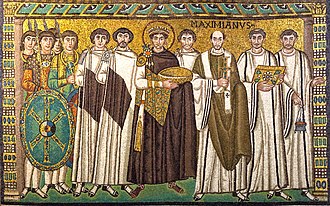
One of their most famous buildings is the Pantheon. They designed it with beautiful shapes and used a special kind of concrete to build its big dome. Another important building later in history, called the Hagia Sophia, also used these strong Roman building methods.
The Romans built many systems to bring water to cities. These systems, called aqueducts, used gravity to move water long distances. Some aqueducts were very long, stretching over 100 miles! They also built dams to store water and baths where people could wash.
Roman roads were very well built and lasted for many years after the Roman Empire ended. They made bridges to cross rivers and used carts to carry goods. Some carts even had special wheels and brakes to make travel smoother.
In mining, the Romans used water to find and collect gold. They directed streams of water to wash away soil and reveal gold deposits, showing great ingenuity in using natural resources.
Military technology
Further information: Technological history of the Roman military and Roman military engineering
The Roman army used many clever tools and tactics in battle. Soldiers carried special throwing spears called pilum that could only be used once, stopping enemies from taking them back. They also wore strong armor made from metal plates or linked rings to stay safe in fights.
Roman soldiers had a smart trick called Testudo, where they held their shields over their heads like a tortoise shell to protect themselves from enemy attacks. This took great teamwork and practice. They also used big machines like ballistas and scorpions to throw heavy stones at enemies from far away. One huge machine called the helepolis had walls to protect soldiers as they moved toward enemy walls, and could even move by itself using ropes and weights.
The Romans also fought on ships using a special bridge called the corvus (boarding device) that let them climb onto enemy boats. They even used a fiery liquid called Greek fire in naval battles, which was very hard to put out and a big secret in war.
Medical technology
Further information: Military medicine and Medicine in ancient Rome
Surgery
The ancient Romans developed many important medical tools and methods that doctors still use today. They made special tools to stop bleeding quickly and clamps to help with surgery on arteries. They were the first to create a special team for surgery on battlefields, which helped their soldiers stay healthy and strong. Romans also used early ways to keep wounds clean long before these methods became common in later times. They had very skilled doctors who knew a lot about helping people stay well.
Technologies developed or invented by the Romans
The ancient Romans were very skilled at creating new ways to build and solve problems. They developed many tools and methods that helped their cities grow and their armies move around easily. Some of these ideas were so good that people didn’t find better ways to do the same things until many hundreds of years later. Their work in building roads, making strong materials, and designing machines showed how clever they were.
| Technology | Comment | |
|---|---|---|
| Abacus, hand | Portable | |
| Alum | The production of alum (KAl(SO4)2.12H2O) from alunite (KAl3(SO4)2.(OH)6) is archaeologically attested on the island Lesbos. This site was abandoned in the 7th century but dates back at least to the 2nd century AD. | |
| Amphitheatre | See e.g. Colosseum. | |
| Apartment building | See e.g. Insula. | |
| Aqueduct, true arch | Pont du Gard, Segovia etc. | |
| Arch, monumental | ||
| Bath, monumental public (thermae) | See e.g. Baths of Diocletian. | |
| Book (codex) | First mentioned by Martial in the 1st century AD. Held many advantages over the scroll. | |
| Brass | The Romans had enough understanding of zinc to produce a brass denomination coinage; see sestertius. | |
| Bridge, true arch | See e.g. Roman Bridge of Chaves or the Severan Bridge. | |
| Bridge, segmental arch | More than a dozen Roman bridges are known to feature segmental (flat) arches. A prominent example was Trajan's Bridge over the Danube, a lesser-known one the extant Limyra Bridge in Lycia. | |
| Bridge, pointed arch | Constructed in the early Byzantine era, the earliest known bridge featuring a pointed arch is the 5th or 6th century AD Karamagara Bridge. | |
| Camel harness | The harnessing of camels to ploughs is attested in North Africa by the 3rd century AD. | |
| Cameo | Probably a Hellenistic innovation, e.g. Cup of the Ptolemies, but taken up by the Emperors, e.g. Gemma Augustea, Gemma Claudia etc. | |
| Cast iron | Recently archaeologically detected in the Val Gabbia in northern Lombardy from the 5th and 6th centuries AD. This technically interesting innovation appears to have had little economic impact. But archaeologists may have failed to recognize the distinctive slag, so the date and location of this innovation may be revised. | |
| Cement, concrete | Pozzolana variety | |
| Crank handle | A Roman iron crank handle was excavated in Augusta Raurica, Switzerland. The 82.5 cm long piece with a 15 cm long handle is of yet-unknown purpose and dates to no later than c. 250 AD. | |
| Crank and connecting rod | Found in several water-powered saw mills dating from the late 3rd (Hierapolis sawmill) to 6th century AD (at Ephesus and Gerasa respectively). | |
| Crane, treadwheel | ||
| Dam, arch | Currently best attested for the dam at Glanum, France, dated c. 20 BC. The structure has entirely disappeared. Its existence is attested by the cuts into the rock on either side to key in the dam wall, which was 14.7 m high, 3.9 m thick at base narrowing to 2.96 m at the top. Earliest description of arch action in such types of dam by Procopius around 560 AD, the Dara Dam. | |
| Dam, arch-gravity | Examples include curved dams at Orükaya, Çavdarhisar, both Turkey (and 2nd century), Kasserine Dam in Tunisia, and Puy Foradado Dam in Spain (2nd–3rd century) | |
| Dam, bridge | The Band-i-Kaisar, constructed by Roman prisoners of war in Shustar, Persia, in the 3rd century AD, featured a weir combined with an arch bridge, a multifunctional hydraulic structure which subsequently spread throughout Iran. | |
| Dam, buttress | Attested in a number of Roman dams in Spain, like the 600 m long Consuegra Dam | |
| Dam, multiple arch buttress | Esparragalejo Dam, Spain (1st century AD), earliest known | |
| Dental fillings | First mentioned by Cornelius Celsus in the 1st century AD. | |
| Dome, monumental | See e.g. Pantheon. | |
| Flos Salis | A product of salt evaporation ponds Dunaliella salina used in the perfume industry (Pliny Nat. Hist. 31,90) | |
| Force pump used in fire engine | See image of pointable nozzle | |
| Glass blowing | This led to a number of innovations in the use of glass. Window glass is attested at Pompeii in AD 79. In the 2nd century AD hanging glass oil lamps were introduced. These used floating wicks and by reducing self-shading gave more lumens in a downwards direction. Cage cups (see photograph) are hypothesised as oil lamps. | |
| Dichroic glass | E.g. Lycurgus Cup. This material attests otherwise unknown chemistry (or other way?) to generate nano-scale gold–silver particles. | |
| Glass mirrors | Attested by Pliny the Elder, Naturalis Historia 33,130 | |
| Greenhouse cold frames | Attested by Pliny the Elder, Naturalis Historia 19.64; Columella on Ag. 11.3.52 | |
| Hydraulis | A water organ. Later also the pneumatic organ. | |
| Hushing | Described by Pliny the Elder and confirmed at Dolaucothi and Las Médulas | |
| Hydraulic mining | Described by Pliny the Elder and confirmed at Dolaucothi and Las Médulas | |
| Hydrometer | Mentioned in a letter of Synesius | |
| Hypocaust | A floor and also wall heating system. Described by Vitruvius. | |
| Knife, multifunctional | ||
| Lighthouses | The best surviving examples are those at Dover Castle and the Tower of Hercules at A Coruña. | |
| Leather, tanned | The preservation of skins with vegetable tannins was a pre-Roman invention but not of the antiquity once supposed. (Tawing was far more ancient.) The Romans were responsible for spreading this technology into areas where it was previously unknown, such as Britain and Qasr Ibrim on the Nile. In both places this technology was lost when the Romans withdrew. | |
| Mills | M. J. T. Lewis presents good evidence that water-powered vertical pounding machines came in by the middle of the 1st century AD for fulling, grain hulling (Pliny Nat. Hist. 18,97) and ore crushing (archaeological evidence at Dolaucothi Gold Mines and Spain). | |
| Grainmill, rotary | According to Moritz (p. 57) rotary grainmills were not known to the ancient Greeks but date from before 160 BC. Unlike reciprocating mills, rotary mills could be easily adapted to animal or water power. Lewis (1997) argues that the rotary grainmill dates to the 5th century BC in the western Mediterranean. Animal and water powered rotary mills came in the 3rd century BC. | |
| Sawmill, water-powered | Recorded by 370 AD. Attested in Ausonius's poem "Mosella": "the Ruwer sends mill-stones swiftly round to grind the corn, And drives shrill saw-blades through smooth marble blocks". Recent archaeological evidence from Phrygia, Anatolia, now pushes the date back to the 3rd century AD and confirms the use of a crank in the sawmill. | |
| Shipmill | Though small, the conventional term is shipmill, not boat mill, probably because there was always a deck, and usually an enclosed superstructure, to keep the flour away from the damp where water wheels were attached to boats. First recorded at Rome in 547 AD in Procopius of Caesarea's Gothic Wars (1.19.8–29) when Belisaurius was besieged there. | |
| Essentials of the steam engine | By the late 3rd century AD, all essential elements for constructing a steam engine were known by Roman engineers: steam power (in Hero's aeolipile), the crank and connecting-rod mechanism (in the Hierapolis sawmill), the cylinder and piston (in metal force pumps), non-return valves (in water pumps) and gearing (in water mills and clocks). | |
| Watermill | Improvements upon earlier models. For the largest mill complex known see Barbegal. | |
| Mercury gilding | As in the Horses of San Marco | |
| Newspaper, rudimentary | See Acta Diurna. | |
| Odometer | ||
| Paddle wheel boats | In De Rebus Bellicis (possibly only a paper invention) | |
| Pewter | Mentioned by Pliny the Elder (Naturalis Historia 34, 160–61). Surviving examples are mainly Romano-British of the 3rd and 4th centuries. Roman pewter had a wide range of proportions of tin but proportions of 50%, 75% and 95% predominate (Beagrie 1989). | |
| Pleasure lake | An artificial reservoir, highly unusual in that it was meant for recreational rather than utilitarian purposes, was created at Subiaco, Italy, for emperor Nero (54–68 AD). The dam remained the highest in the Roman Empire (50 m), and in the world until its destruction in 1305. | |
| Plough, iron-bladed | A much older innovation (e.g. Bible; I Samuel 13, 20–21) that became much more common in the Roman period | |
| Plough, wheeled | Pliny the Elder Naturalis Historia 18. 171–173 (more important for the Middle Ages than this era) | |
| Pottery, glossed | Samian ware | |
| Reaper | An early harvesting machine: vallus (Pliny the Elder, Naturalis Historia 18,296, Palladius Sails, fore-and-aft rig | Introduction of fore-and-aft rigs, both the lateen sail and the spritsail, the latter already attested in 2nd century BC in the northern Aegean Sea. There is however no evidence of any combination of fore-and-aft rigs with square sails on the same Roman ship. |
| Sails, lateen | Representations show lateen sails in the Mediterranean as early as the 2nd century AD. Both the quadrilateral and the triangular type were employed. | |
| Roller bearings | Archaeologically attested in the Lake Nemi ships | |
| Rudder, stern-mounted | See image for something very close to being a sternpost rudder. | |
| Sausage, fermented dry (probably) | See salami. | |
| Screw press | An innovation of about the mid-1st century AD | |
| Sewers | See for example Cloaca Maxima | |
| Soap, hard (sodium) | First mentioned by Galen (earlier, potassium soap being Celtic) | |
| Spiral staircase | Though first attested as early as the 5th century BC in Greek Selinunte, spiral staircases only became more widespread after their adoption in Trajan's Column and the Column of Marcus Aurelius. | |
| Stenography | See Tironian notes. | |
| Street map | See Forma Urbis Romae (Severan Marble Plan), a carved marble ground plan of every architectural feature in ancient Rome. | |
| Sundial, portable | See Theodosius of Bithynia | |
| Surgical instruments, various | ||
| Tooth implants, iron | From archaeological evidence in Gaul | |
| Towpath | E.g. beside the Danube, see the "road" in Trajan's Bridge | |
| Tunnels | Excavated from both ends simultaneously. The longest known is the 5.6-kilometre (3.5 mi) drain of the Fucine Lake. | |
| Vehicles, one-wheeled | Solely attested by a Latin word in the 4th century AD Scriptores Historiae Augustae, Heliogabalus 29. As this is fiction, the evidence dates to its time of writing. |
Pictures
Keep exploring



This article is a child-friendly adaptation of the Wikipedia article on Ancient Roman technology, available under CC BY-SA 4.0.
Images from Wikimedia Commons. Tap any image to view credits and license.