 Safekipedia
Apostolic Palace
Adapted from Wikipedia · Discoverer experience
The Apostolic Palace is the official residence of the Pope, the head of the Catholic Church, located in Vatican City. It is also called the Papal Palace, the Palace of the Vatican, and the Vatican Palace. The Vatican calls it the Palace of Sixtus V, after Pope Sixtus V, who built most of the palace as it looks today.
The building holds many important places, such as the papal apartments, offices for the Catholic Church and the Holy See, private and public chapels, the Vatican Museums, and the Vatican Library. Famous parts of the library include the Sistine Chapel, the Raphael Rooms, and the Borgia Apartments. Many visitors can tour these areas, though some parts like the Sala Regia and Cappella Paolina are usually closed to the public. The Scala Regia, or Regal Staircase, can be seen from one end and was once used to reach the Sala Regia. The Cappella Paolina stays closed to tourists.
History
In the 5th century, Pope Symmachus built a papal palace near Old St. Peter's Basilica as another home besides the Lateran Palace. Later, Pope Eugene III started building a stronger palace, and Pope Innocent III changed it a lot in the 1100s.
After a time when leaders lived far away, they came back to Rome in 1377 and stayed in different churches before moving to the Vatican Palace. By 1447, Pope Nicholas V tore down the old palace and built a new one, which is the Apostolic Palace we know today.
Starting in 1589, Pope Sixtus V began building the palace we see now, and other popes added more parts over the next 150 years. Today, the palace covers a huge area and includes special rooms, offices, libraries, museums, and art galleries.
Structure
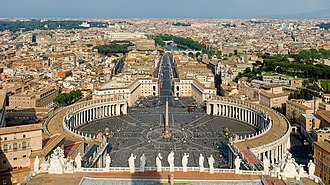
The Apostolic Palace is managed by the Prefecture of the Pontifical Household. It is actually a group of buildings inside a big outer shape, centered around the Courtyard of Sixtus V. The palace sits northeast of St Peter's Basilica, close to the Bastion of Nicholas V and the Palace of Gregory XIII.
The palace includes both living spaces and offices that support the work of the Pope and the Catholic Church.
Sistine Chapel
Main article: Sistine Chapel
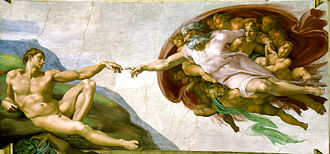
The Sistine Chapel is one of the most famous parts of the palace. It is named after Sixtus IV and is known for its beautiful wall paintings by Renaissance artists, including Michelangelo, Sandro Botticelli, Pietro Perugino, Pinturicchio, and Domenico Ghirlandaio. One key role of the chapel is to hold special meetings where leaders of the church choose the next Pope.
Raphael Rooms
Main article: Raphael Rooms
These rooms are famous for their wall paintings created by artists led by Raphael. They were originally meant to be living spaces for Pope Julius II. He asked Raphael, a young artist from Urbino, to decorate them in 1508 or 1509. The rooms include the Sala di Constantino, Stanza di Eliodoro, Stanza della Segnatura, and Stanza dell'Incendio del Borgo.
Borgia Apartments
Main article: Borgia Apartments
These rooms were used by Pope Alexander VI. He asked the artist Pinturicchio to decorate them with detailed paintings between 1492 and 1494. Today, some of these rooms are part of the Vatican Library and Vatican Museums, and others show modern religious art.
Papal apartments
Main article: Papal apartments
Since the 1600s, these rooms on the top floor have been the official home of the Pope. All Popes lived here until 2013, when Pope Francis chose to stay elsewhere. On March 14, 2026, Pope Leo XIV moved into these apartments after they were renovated.
Clementine Hall
Main article: Clementine Hall
This hall was created in the 1500s by Pope Clement VIII to honor Pope Clement I. It features many beautiful wall paintings and artworks.
Loggias
Main article: Vatican loggias
The loggias are special walkways designed by Donato Bramante and painted by Raphael. They show 52 events from the Bible and inspired another famous design in the Hermitage Museum.
Images
Related articles



This article is a child-friendly adaptation of the Wikipedia article on Apostolic Palace, available under CC BY-SA 4.0.
Images from Wikimedia Commons. Tap any image to view credits and license.