 Safekipedia
Aristotle's biology
Adapted from Wikipedia · Discoverer experience
Aristotle's biology is the study of living things, based on careful watching and collecting information, mainly about animals. Aristotle wrote many books about this science, and many of his ideas came from his time on the island of Lesbos, where he studied sea life in a place called the Pyrrha lagoon, now known as the Gulf of Kalloni. His work looked at how animals grow, stay healthy, and pass on traits to their young.
Aristotle described five important processes in living things: how they use energy, control their temperature, learn and remember, develop from eggs or seeds, and how parents pass traits to their children. He looked at over 500 kinds of birds, mammals, and fish, and even studied tiny insects. He also looked inside more than a hundred animals to learn about their body parts.
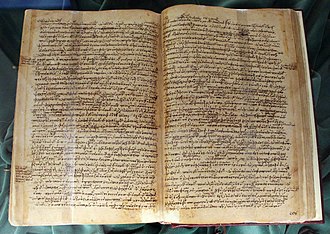
His books on biology, like History of Animals, Generation of Animals, and Parts of Animals, were some of the first ever written about science. Even though people later found mistakes in his ideas, modern scientists still respect much of what he observed, especially about sea animals.
Context
Aristotle's background
Aristotle (384–322 BC) studied at Plato's Academy in Athens, staying there for about 20 years. He looked for general ideas in his philosophy, but he also used careful observation, especially of the natural history of the island of Lesbos. He spent about two years there, studying the marine life around it, including the Pyrrha lagoon. His work is the earliest detailed science writing that still exists today. No one wrote such detailed books about zoology until the sixteenth century, so Aristotle's ideas were very important for a long time. He later returned to Athens and started his own school, the Lycaeum, where he taught for many years. About a quarter of his surviving writings are about animals. His student Theophrastus also wrote a book about botany, called Enquiry into Plants.
Aristotelian forms
Main article: Hylomorphism
Aristotle's biology is based on his theory of form. This idea comes from Plato's theory of Forms, but it is different. Plato thought Forms were perfect and unchanging, like designs in the mind of a creator. Aristotle used the same Greek word, εἶδος (eidos), to describe the visible features that make an animal special. For example, all birds have feathers, a beak, wings, a hard-shelled egg, and warm blood.
Aristotle noticed that there are many different kinds of birds, such as cranes, eagles, crows, bustards, and sparrows, just as there are many kinds of fishes. He called these different kinds atoma eidē, meaning indivisible forms. Human beings are one of these forms—all people are different, but we all share the human form. Aristotle also observed that children receive their form from their parents' seeds, which combine. He compared this to a woodcarving, which gets its shape from the wood, the tools used, and the design planned for it. He believed that form carries information, much like how letters come together to make words.
System
Main articles: Soul § Aristotle, and On the Soul
Aristotle studied how living things grow, stay healthy, and develop. He looked at animals and their bodies, trying to understand the basic processes that keep them alive. He thought of these processes as a system, which he called the soul. This wasn’t a spiritual idea, but a way to describe how animals function.
Aristotle described five main processes in living things. First, animals take in food and change it to give them energy and build their bodies. Second, animals keep a steady temperature, but this can fail as they get older. Third, animals sense the world around them and use that information to move and act. Fourth, parents pass traits to their children. Finally, young animals develop from embryos into full-grown creatures. These processes together make up what Aristotle called the soul, and they differ among plants, animals, and humans.
Method
Further information: History of scientific method
Aristotle studied biology by watching and recording many animals. He did not do modern-style experiments but instead gathered information carefully. He looked for patterns among different animals and used these patterns to explain how animals lived.
Aristotle made many smart guesses based on what he saw. For example, he noticed that bigger animals usually have fewer babies, and that animals like elephants live longer than smaller animals like mice. He also described how bees live and work together in hives. He wrote about many sea creatures and land animals, showing how each one was different and special.
| Group | Examples (given by Aristotle) | Blood | Legs | Soul (Rational, Sensitive, Vegetative) | Qualities (Hot–Cold, Wet–Dry) |
|---|---|---|---|---|---|
| Man | Man | with blood | 2 legs | R, S, V | Hot, Wet |
| Live-bearing tetrapods | Cat, hare | with blood | 4 legs | S, V | Hot, Wet |
| Cetaceans | Dolphin, whale | with blood | none | S, V | Hot, Wet |
| Birds | Bee-eater, nightjar | with blood | 2 legs | S, V | Hot, Wet, except Dry eggs |
| Egg-laying tetrapods | Chameleon, crocodile | with blood | 4 legs | S, V | Cold, Wet except scales, eggs |
| Snakes | Water snake, Ottoman viper | with blood | none | S, V | Cold, Wet except scales, eggs |
| Egg-laying fishes | Sea bass, parrotfish | with blood | none | S, V | Cold, Wet, including eggs |
| (Among egg-laying fishes): placental selachians | Shark, skate | with blood | none | S, V | Cold, Wet, but placenta like tetrapods |
| Crustaceans | Shrimp, crab | without | Several legs | S, V | Cold, Wet except shell |
| Cephalopods | Squid, octopus | without | tentacles | S, V | Cold, Wet |
| Hard-shelled animals | Cockle, trumpet snail | without | none | S, V | Cold, Dry (mineral shell) |
| Larva-bearing insects | Ant, cicada | without | 6 legs | S, V | Cold, Dry |
| Spontaneously generating | Sponges, worms | without | none | S, V | Cold, Wet or Dry, from earth |
| Plants | Fig | without | none | V | Cold, Dry |
| Minerals | Iron | without | none | none | Cold, Dry |
Influence
On Theophrastus
Main article: Historia Plantarum (Theophrastus book)
Aristotle taught a student named Theophrastus, who later wrote the first book about plants. While Aristotle focused on big ideas, Theophrastus carefully studied how plants actually work. He even suggested that one type of plant could change into another, like a field of wheat turning into a weed.
On Hellenistic medicine
Further information: Medicine in ancient Greece
Later, doctors in a place called Alexandria learned from Aristotle but also made new discoveries. One doctor named Herophilus figured out that the brain, not the heart, controls our thoughts and movements. He also studied how our nerves, veins, and arteries work together in our bodies.
On Islamic zoology
Further information: Kitāb al-Hayawān and Science in the medieval Islamic world
Aristotle's ideas traveled from Greece to the Islamic world, where they were translated into Arabic. A book called the Kitāb al-Hayawān shared many of Aristotle's observations about animals with people across the Middle East.
Many famous thinkers in the Islamic world, such as Al-Kindī, Avicenna, Avempace, and Averroes, read and talked about Aristotle's work, helping to keep his ideas alive.
On medieval science
Further information: Medieval science
When a king named Alfonso VI brought Aristotle's ideas to Europe, they became very important in schools and universities. Teachers like Michael Scot and Albertus Magnus helped translate and explain Aristotle's work for Christian scholars.
On Renaissance science
During the Renaissance, some scientists in Italy studied Aristotle's ideas closely, while others used them along with their own observations to write new books about animals. One famous book, Historia Animalium by Konrad Gessner, followed Aristotle's style but included many new discoveries.
Early Modern rejection
In later years, some scientists thought Aristotle's ideas were old and wrong. For example, a scientist named William Harvey showed that blood moves in a circle through our bodies, which was different from what Aristotle had thought.
19th century revival
Scientists in the 1800s, like Georges Cuvier and Charles Darwin, respected Aristotle's careful observations of animals. Darwin even said that Aristotle was one of the most important early thinkers about living things.
20th and 21st century interest
Even today, scientists appreciate Aristotle's smart observations. For example, they have found that octopuses can hide using colors and patterns, just as Aristotle described long ago. Many consider Aristotle to be the "father of biology" because he was one of the first to study and write about animals in detail.
Works
Aristotle did not write a single book about biology like we do today. Instead, he wrote many smaller books that together show his ideas about animals and nature. Some of these books refer to each other, and some drawings he mentioned are unfortunately lost.
His main biology books are often grouped together as On Animals. These five books are:
- History of Animals, or Inquiries into Animals (HA)
- Generation of Animals (GA)
- Movement of Animals (DM)
- Parts of Animals (PA)
- Progression of Animals or On the Gait of Animals (IA)
He also wrote On the Soul (DA).
In addition, there are seven shorter works called the Parva Naturalia, which also discuss nature:
- Sense and Sensibilia (Sense)
- On Memory_
- On Sleep_
- On Dreams_
- On Divination in Sleep
- On Length and Shortness of Life
- On Youth, Old Age, Life and Death, and Respiration
Images
Related articles



This article is a child-friendly adaptation of the Wikipedia article on Aristotle's biology, available under CC BY-SA 4.0.
Images from Wikimedia Commons. Tap any image to view credits and license.