 Safekipedia
Artiodactyla
Adapted from Wikipedia · Discoverer experience
Artiodactyla is a group of mammals known as even-toed ungulates. These animals have weight balanced on two of their toes, usually ending in hooves, unlike odd-toed ungulates which balance on three toes. Many artiodactyls can break down tough plant material in special stomach chambers.
There are about 270 species of land-based artiodactyls, including pigs, hippos, antelopes, deer, giraffes, camels, llamas, sheep, goats, and cattle. Some, like pigs, eat both plants and animals, while whales and dolphins only eat other animals.
Artiodactyls have been very important to humans for food, work, and culture. They have also had many groups that are no longer alive today, adding to our understanding of nature's history.
Evolutionary history
See also: Evolution of cetaceans
The oldest fossils of even-toed ungulates date back to the early Eocene (about 53 million years ago). These early fossils were found almost at the same time in Europe, Asia, and North America, making it hard to know exactly where they first appeared. The earliest even-toed ungulates did not change the way other ungulates moved in North America much, suggesting they did not take over by being better competitors. These ancient animals were small, about the size of a hare, with slim bodies, long legs, and tails. Their back legs were longer than their front legs.
Two groups of even-toed ungulates that no longer exist were Entelodontidae and Anthracotheriidae. Entelodonts lived from the middle Eocene to the early Miocene in Eurasia and North America. They had strong bodies with short legs and big heads. Anthracotheres looked like pigs, with short legs and long faces. They lived from the middle Eocene to the Pliocene and spread across Eurasia, Africa, and North America. Anthracotheres are thought to be related to modern hippos. Hippos appeared in the late Miocene and lived in Africa and Asia.
Camels were mostly found in North America during much of the Cenozoic. Some early camels lived in Europe. One group of North American camels had short legs and bodies. They first appeared in the late Eocene and many different kinds lived in North America. Later, around the late Miocene or early Pliocene, they moved to Eurasia. The North American camels disappeared about 10,000 years ago.
Pigs and their relatives have been around since the Eocene. By the late Eocene or Oligocene, some groups stayed in Eurasia and Africa, while peccaries lived only in the Americas.
South America got its even-toed ungulates only in the Pliocene, after a land bridge formed at the Isthmus of Panama about three million years ago. Today, South America has fewer kinds of these animals compared to other places, with only peccaries, lamoids (or llamas), and some types of capreoline deer.
Taxonomy and phylogeny
The classification of artiodactyls was debated because ocean-dwelling cetaceans evolved from land-dwelling even-toed ungulates. Some semiaquatic even-toed ungulates, like hippopotamuses, are more closely related to ocean-dwelling cetaceans than to other even-toed ungulates.
Phylogenetic classification recognizes groups that descend from a common ancestor and include all of its descendants. To address this, the traditional order Artiodactyla and infraorder Cetacea are sometimes combined into a more inclusive group called Cetartiodactyla. Another approach is to include both land-dwelling even-toed ungulates and ocean-dwelling cetaceans in a revised Artiodactyla group.
Classification
Main article: List of artiodactyls
Order Artiodactyla/Clade Cetartiodactyla
The four main groups of artiodactyls are:
- Tylopoda: Includes camels, llamas, alpacas, vicuñas, and guanacos.
- Suina: Includes pigs and peccaries.
- Ruminantia: Includes mouse deer, giraffes, musk deer, pronghorns, deer, and bovids like cattle, goats, sheep, and antelopes.
- Whippomorpha: Includes hippos and cetaceans (whales).
These groups show the diverse evolutionary paths of artiodactyls, from land animals to highly adapted sea creatures.
Research history
In the 1990s, scientists used DNA and RNA to classify organisms. This research showed that whales and hippopotamuses are closely related to even-toed ungulates.
Fossil discoveries in the early 2000s, such as Pakicetus and Ichthyolestes, helped scientists understand that early whales were more land-based than previously thought. These findings also highlighted a special ankle bone structure shared by early cetaceans and even-toed ungulates.
Historical classification of Artiodactyla
In the mid-1700s, scientists like Linnaeus suggested a link between camels and ruminants. By the end of the 20th century, the accepted classification grouped animals based on stomach and tooth features. Suines and hippos were grouped together, while other even-toed ungulates were grouped based on their ability to ruminate.
Historical classification of Cetacea
Modern whales are highly adapted to sea life but evolved from land mammals. Their ancestors were once thought to be mesonychians, carnivorous animals with hooves.
Inner systematics
Research suggests that artiodactyls, as traditionally defined, are not a complete group because cetaceans are deeply nested within them. Together, they form a group called Cetartiodactyla. Modern classification divides artiodactyls into four main groups: Tylopoda, Suina, Ruminantia, and Whippomorpha.
The four groups can be summarized in a family tree.
The ten existing families of artiodactyls include:
- Camelidae: Camels, llamas, alpacas, vicuñas, and guanacos.
- Suidae: Pigs.
- Tayassuidae: Peccaries.
- Tragulidae: Mouse deer.
- Giraffidae: Giraffes and okapi.
- Moschidae: Musk deer.
- Antilocapridae: Pronghorn.
- Cervidae: Deer.
- Bovidae: Cattle, sheep, goats, and antelopes.
- Hippopotamidae: Hippos.
- Cetaceans: Whales, including toothed whales and baleen whales.
Anatomy
Even-toed ungulates, or artiodactyls, are mostly animals that walk on two of their toes. They come in many shapes and sizes. Some, like pigs and hippos, are stocky with short legs, while others, like camels and deer, are slimmer with longer legs. The smallest, like the mouse deer, are about half a meter long, and the largest, like the hippopotamus, can be over five meters long.
Most of these animals have fur, though hippos are nearly hairless. Their fur can be different colors, like yellow, gray, or brown, and helps them blend into their surroundings. Some animals, like deer, grow antlers only on males, while others, like cows, may have small horns or none at all on females.
Artiodactyls have two or four toes on each foot, with the main weight on the third and fourth toes. In some species, like pigs, the extra toes point backward. Camels have just two toes, with tough nails instead of claws. Their legs are built for speed and stability, helping them run quickly.
Their heads are often large, with long skulls. Some have special bone growths on their heads, like horns or antlers, used for defense or showing off. They have strong senses of smell and hearing but see better when objects are moving.
Many artiodactyls, like cows and deer, have special stomachs that help them break down tough plant food by chewing it again and again. This process lets them eat plants that other animals cannot digest. Their bodies are built to help them escape danger quickly, with strong legs and flexible bodies.
| Dental formula | I | C | P | M | |
|---|---|---|---|---|---|
| 30–44 | = | 0–3 | 0–1 | 2–4 | 3 |
| 1–3 | 1 | 2–4 | 3 | ||
Lifestyle
Artiodactyls, or even-toed ungulates, live nearly everywhere except Oceania and Antarctica. They can be found in many types of places, from tropical rainforests and steppes to deserts and high mountain regions. They are most common in open areas like grasslands and open forests.
Their social lives differ by species. Some prefer to stay in large groups, while others live alone or in pairs. Group-living species often have a hierarchy, and some form harem groups with one male, several females, and their young. During mating season, males may seek out females. Many mark their area with glandular secretions or urine, and some migrate depending on the season. They can be active during the day, dusk, or night.
Most artiodactyls have long pregnancies and give birth to well-developed babies. Pigs, deer, and similar animals have gestation periods of four to five months, while giraffes can take up to fifteen months. Most have one or two babies, though pigs can have up to ten. The young are usually born with their eyes open and hair, except for hippos. Some babies have striped or spotted coats that fade as they grow. Lifespans range from twenty to thirty years, but larger animals like hippos and camels can live up to fifty years.
Artiodactyls face different natural predators depending on their size and home. Large carnivores such as lions, tigers, and bears hunt them, along with crocodiles, wolves, and dogs. Smaller species and young may be preyed on by large snakes and raptors. Some face threats from sharks, polar bears, or other sea animals. They also deal with parasites like nematodes, botflies, fleas, lice, and flukes, though these usually only cause problems if there are too many.
Interactions with humans
Domestication
See also: Domestication of animals
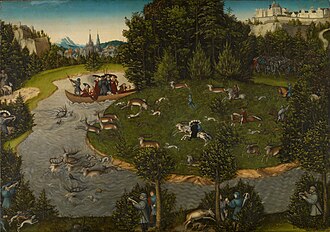
People have hunted even-toed animals for many years for food, fur, and to use their bones and teeth for tools. These animals were first tamed around 8000 BCE. Today, we have tamed goats, sheep, cattle, camels, llamas, alpacas, and pigs. At first, these animals were used for food, but later they also helped with work. Evidence shows that people ate antelope over 2 million years ago. Some ancient people relied mostly on reindeer for food, skins, tools, and weapons.
Now, we keep these animals mainly for their meat, milk, and wool. Some, like cattle, water buffalo, yak, and camels, also help with work, carrying things, or as rides.
Threats
Different even-toed animals face different challenges. Some, like wild boar, are found in many places because people brought them there. Others have lost many of their natural enemies, which helps them survive.
However, many even-toed animals are in danger because of hunting and loss of their homes. Some species have disappeared completely, such as several types of gazelles, the aurochs, and the bluebuck. One deer found only in zoos is gone from the wild. Many others are at risk, including the addax and the kouprey, which might also be gone. Others, like the wild Bactrian camel and Przewalski's gazelle, are endangered.
Images
Related articles


This article is a child-friendly adaptation of the Wikipedia article on Artiodactyla, available under CC BY-SA 4.0.
Images from Wikimedia Commons. Tap any image to view credits and license.