 Safekipedia
Berbers
Adapted from Wikipedia · Discoverer experience
Berbers, also known as Amazigh or Imazighen, are an ethnic group indigenous to North Africa. They are primarily connected by their use of Berber languages, which are part of the Afroasiatic language family.
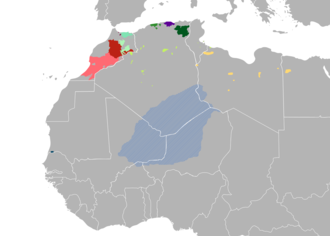
They are indigenous to the Maghreb region of North Africa, where they live in communities across parts of Morocco, Algeria, Libya, and to a lesser extent Tunisia, Mauritania, northern Mali and northern Niger (Azawagh). Smaller Berber communities are also found in Burkina Faso and Egypt's Siwa Oasis.
Descended from Stone Age cultures indigenous to North Africa, accounts of the Imazighen were first mentioned in Ancient Egyptian writings. Berbers are divided into several ethnic groups, such as Kabyles, Chaouis and Rifians. Historically they did not refer to themselves as Berbers but had their own terms to refer to their own groups and communities. The use of the endonym Amazigh dates back to antiquity, as attested by groups such as the Mazices, and it remains in use today.
Names and etymology
Main article: Names of the Berber people
The indigenous populations of the Maghreb region of North Africa are called Berbers or Amazigh in English. Historically, they did not use the term "Berber" to describe themselves but had their own names for their groups.
Today, many prefer the term "Amazigh" instead of "Berber" because of the complex history behind the word "Berber." This change is part of a movement to celebrate their shared ethnic identity and to seek more recognition for their languages and culture.
History
The areas of North Africa that have kept the Berber language and traditions best are Algeria, Libya, Morocco, and Tunisia. Much of Berber culture is still celebrated among the cultural elite in Morocco and Algeria, especially in Kabylia, Aurès, and the Atlas Mountains. The Kabyles were one of the few peoples in North Africa who remained independent during successive rule by the Carthaginians, Romans, Byzantines, Vandals, and Ottoman Turks. Even after the Arab conquest of North Africa, the Kabyle people still kept their mountains.
The Maghreb region in northwestern Africa is believed to have been inhabited by Berbers from at least 10,000 BC. Cave paintings dated to twelve millennia before present have been found in the Tassili n'Ajjer region of southeastern Algeria. Other rock art has been discovered at Tadrart Acacus in the Libyan desert. A Neolithic society developed and predominated in the Saharan and Mediterranean region of northern Africa between 6000 and 2000 BC.
During the pre-Roman era, several independent states existed before King Masinissa unified the people of Numidia. According to the Roman historian Gaius Sallustius Crispus, the original people of North Africa were the Gaetulians and the Libyans. They were prehistoric peoples who crossed to Africa from the Iberian Peninsula. Later, Hercules and his army crossed from Iberia to North Africa, where his army intermarried with the local people and settled the region permanently.
Arabization
Main article: Arabized Berber
The Berbers, who are the original people of North Africa, began to change their culture and language over many centuries because of Arab groups moving into the area. This started in the 7th century and continued for hundreds of years.
During this time, many Berbers started speaking the Arabic language and adopting Arab culture. Arab groups, especially the Banu Hilal and Banu Sulaym, moved into areas where Berbers lived. They brought their own way of life, which included moving between places for grazing animals, instead of farming. This way of life spread to many parts of the land, changing the culture there. Because of this, many Berbers moved to the mountains, while the flat areas became more like Arab areas. By the 15th century, much of what is now Tunisia had changed a lot.
Contemporary demographics
Ethnic groups
Main article: Maghreb § Ethnic groups
Berbers are a smaller part of the people living in North Africa. In Algeria, they make up about 15% to 25% of the population, in Libya about 10%, in Morocco around 31% to 35%, and in Tunisia about 1%. Many people in Morocco and Algeria also speak Berber languages, with around 14 million to 16 million speakers in total across Africa.
Some well-known Berber groups include the Kabyles from Algeria, the Shilha from Morocco, the Riffians from northern Morocco, and the Tuareg who live in the Sahara Desert in countries like Mali and Niger.
Genetics
Main article: Maghreb § Genetics
Berbers are one of the original groups from North Africa. Studies show that their ancestors mixed with people from the Middle East and Europe over thousands of years. This mixing shaped the genetic makeup of modern Berbers.
| Ethnic group | Country | Regions | Ethnic population | Linguistic population |
|---|---|---|---|---|
| Chaouis |  ALG ALG | Aurès Mountains, eastern Algeria | 2,870,000 | Including 2,130,000 speakers of Shawiya |
| Chenouas | Mount Chenoua, western Algeria | 106,000 | Including 76,000 speakers of Shenwa | |
| Chleuhs |  MAR MAR | High Atlas, Anti-Atlas and the Sous valley, southern Morocco | 3,500,000 | |
| Djerbas |  TUN TUN | Djerba, southern Tunisia | 11,000 | |
| Ghomaras | MAR | Western Rif, northern Morocco | 12,000 | Including 10,000 speakers of Ghomara |
| Guezula |  MRT MRT | Southern Mauritania | Unknown | |
| Kabyles | ALG | Kabylia, northern Algeria | 6,000,000 | Including 3,000,000 speakers of Kabyle |
| Matmatas | TUN | Matmata, southern Tunisia | 3,700 | |
| Mozabites | ALG | M'zab Valley, central Algeria | 200,000 | Including 150,000 speakers of Mozabite |
| Nafusi |  LBY LBY | Jabal Nafusa, western Libya | 186,000 | Including 140,000 speakers of Nafusi |
| Riffians | MAR | Rif, northern Morocco | 1,500,000 | Including 1,271,000 speakers of Tarifit |
| Senhaja Srair | Central Rif, northern Morocco | 151,245 | Including 85,000 speakers of Senhaja de Srair | |
| Siwi |  EGY EGY | Siwa Oasis, western Egypt | 24,000 | Including 20,000 speakers of Siwi |
| Tuareg | ALG MLI MLI NIG NIG | Sahara, northern Mali and Niger, and southern Algeria | 4,000,000 | |
| Central Atlas Amazigh | MAR | Middle Atlas, Morocco | 2,867,000 | Including 2,300,000 speakers of Central Atlas Tamazight |
| Zuwara | LBY | Zuwarah, northwestern Libya | 280,000 | 247,000 speakers of Zuwara |
Diaspora
See also: Berbers in France, Berber Canadians, Berbers in Belgium, Berbers in the Netherlands, and Berber Americans
Many Berbers have moved to live in Europe. In 2004, it was estimated that about 2.2 million Berber people lived as immigrants in places like Belgium, the Netherlands, and France. These included groups such as the Riffians and people from Kabyle and Chaoui backgrounds.
Politics
Berberism
Main article: Berberism
Since the 1970s, a political movement has grown among Berber people in North Africa to celebrate their shared identity. This movement, called Berberism or Amazighism, wants more rights for Berber languages and greater recognition for Berber culture. It brings together people from different areas, even though they live in different countries and come from different traditions.
Different countries have responded in different ways. In some places, the movement has been more active and sometimes faced challenges. In others, it has been quieter. Both governments and the Berber movement have tried to work together in some ways, especially because of other political issues in the region.
Political tensions
Over recent decades, some Berber groups have had disagreements with governments in North Africa, especially about language and culture. For example, some countries did not allow parents to give their children Berber names. In some places, the main language and culture were seen as more important than others.
One leader in Libya did not recognize Berbers as a separate group and said they were not really Libyans. Because of this, many Berbers opposed him during a big conflict in 2011. In other countries, some Berber people supported different political ideas instead of focusing only on Berber identity.
Languages
Main article: Berber languages
The Berber languages are part of the Afroasiatic language family, which also includes Semitic languages like Arabic and the Ancient Egyptian language.
Tamazight is a general name for all Berber languages. These languages have many similar varieties and dialects. Some of these include Riffian, Zuwara, Kabyle, Shilha, Siwi, Zenaga, Sanhaja, Tazayit, Tumẓabt, Nafusi, and Tamasheq, as well as the ancient Guanche language.
About 14 to 16 million people speak Berber languages in Africa. Most of these speakers live in Morocco and Algeria, with others in Mali, Niger, and Libya. Smaller groups can be found as far east as Egypt.
Religion
The Berber people share a strong identity based on their language, religion, and history. While many Berbers today follow Sunni Muslim beliefs, some groups, like the Mozabite Berbers in M'zab Valley and certain Berbers in Libya, follow Ibadi Islam.
Long before these beliefs, the Berbers had their own ancient ways of worship. These included honoring ancestors, believing in many spirits, and connecting with nature. Over time, their beliefs changed through contact with other cultures and new ideas. Today, some Berbers have also chosen to follow Christianity, both Protestant and Roman Catholic faiths.
Architecture
See also: Architecture of Tunisia, Architecture of Algeria, and Moroccan architecture
Some of the oldest buildings made by the Amazigh people, also known as Berbers, can be found in the Sahara Desert. These buildings date back thousands of years and show that people lived in small villages and towns long ago. The buildings were first made from dry stones and later from mudbrick.
In areas like Algeria, there are special tombs built a long time ago. These tombs show influences from nearby cultures but also have unique styles. Big cities like Carthage and Rome also left behind many buildings in North Africa, such as big theaters and old ruins.
After new rulers came to the area, new styles of building developed. In places where many Amazigh people lived, you can still see special kinds of buildings. For example, in Morocco, there are strong fortresses called kasbahs and villages called ksour. In Tunisia, there are tall granaries and mosques that look like small forts. In Algeria, buildings are often painted white and have rounded roofs. These buildings show the creativity and history of the Amazigh people.
-
_-_Ruinen_der_antiken_Stadt_Garma_02.jpg)
Remains of Germa, a capital of the Garamantes (first millennium BC)
Numidian tomb of [Medracen](/wiki/Madghacen) (c. 200–150 BC)
-
")
Numidian mausoleum of Dougga, example of a "tower tomb" (2nd century BC)
The [Kutubiyya Mosque](/wiki/Kutubiyya_Mosque) in [Marrakesh](/wiki/Marrakesh), built by the [Almohads](/wiki/Almohad_Caliphate) in the 12th century
-
.jpg)
The ksar of Aït Benhaddou in Morocco
[Ksar Ouled Soltane](/wiki/Ksar_Ouled_Soltane), an example of a multi-level _[ghorfa](/wiki/Ghorfa)_ in southern Tunisia
Subterranean house in [Matmata](/wiki/Matmata,_Tunisia) (Tunisia)
-
, an example of a traditional "fortified mosque"")
The Fadhloun Mosque in Djerba (Tunisia), an example of a traditional "fortified mosque"
The central mosque in [Ghardaïa](/wiki/Ghardaïa), an example of local architecture in the [M'zab](/wiki/M'zab) region (Algeria)
Culture and arts
The Berbers have a rich culture and many traditions. In the past, their communities were led by leaders chosen by the tribe. Women sometimes held important roles, like leading battles. Today, most tribes are led by men, but each group has its own way of making decisions.
Berber people are known for their beautiful crafts. They weave special carpets called kilims, each with unique patterns that show where the tribe comes from. They also make colorful jewelry from silver, often worn by women. These pieces are now sold as beautiful souvenirs around the world.
Berber food is tasty and includes dishes like couscous, a fluffy grain dish, and tajine, a slow-cooked stew. Other favorite foods are pastilla, a savory pie, and different types of pancakes. Music is also important, with many styles and instruments used in celebrations and dances.
In recent years, Berber culture has become popular with visitors to places like Morocco and Tunisia. Their traditions, crafts, and music are shown in many tourist spots and help bring people together.
Main article: Berber cuisine
Main articles: Berber music, music of Algeria, and music of Morocco
Images
Related articles




This article is a child-friendly adaptation of the Wikipedia article on Berbers, available under CC BY-SA 4.0.
Images from Wikimedia Commons. Tap any image to view credits and license.