 Safekipedia
Brønsted–Lowry acid–base theory
Adapted from Wikipedia · Discoverer experience
The Brønsted–Lowry theory, also known as the proton theory of acids and bases, is a way to understand how acids and bases work together. This theory was created separately in 1923 by two scientists: Johannes Nicolaus Brønsted from Denmark and Thomas Martin Lowry from the United Kingdom.
In simple terms, when an acid and a base react, the acid gives away a proton (a tiny part of an atom called a hydrogen cation, written as H+), and the base accepts it. After this exchange, the acid becomes its conjugate base, and the base becomes its conjugate acid.
This theory helps us understand acid–base reactions better than the older Arrhenius theory. It shows us that acids and bases are linked through the sharing of protons, which is important in many chemical processes.
Definitions of acids and bases
Johannes Nicolaus Brønsted and Thomas Martin Lowry came up with an idea about acids and bases. They said that acids give away tiny parts called protons (H+), and bases take those protons.
Before their idea, the Arrhenius theory said acids are things that break apart in water to make H+ (hydrogen cations or protons), and bases are things that break apart to make OH− (hydroxide ions).
Brønsted and Lowry’s theory, made in 1923 by physical chemists, looks at how acids and bases react together. When they react, the acid becomes something called its conjugate base, and the base becomes its conjugate acid. This happens by sharing a proton. For example, if you have an acid called HA and a base called B, they can react like this:
HA + B ⇌ A− + HB+
The double arrow (⇌) shows the reaction can go both ways. The acid HA gives away a proton to become A−, and the base B takes the proton to become HB+. Most of these reactions happen quickly and the substances stay balanced with each other.
Aqueous solutions
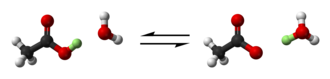
Acids and bases can react with each other by sharing a tiny part called a proton. For example, acetic acid, written as CH3COOH, gives a proton to water, H2O. After this, acetic acid becomes something called its conjugate base, the acetate ion (CH3COO−). Water becomes its conjugate acid, the hydronium ion (H3O+).
The reverse can also happen. The hydronium ion can give a proton back to the acetate ion, and they return to acetic acid and water. This shows that acids and bases can work in both directions.
Amphoteric substances
In Brønsted–Lowry theory, an acid only works as an acid when it meets a base, and a base only works as a base when it meets an acid. Water is special because it can act like either an acid or a base. For example, in a reaction, one water molecule can accept a hydrogen ion (H+) to become H3O+, while another water molecule can donate a hydrogen ion to become OH−.
Another example is aluminium hydroxide, Al(OH)3. It can act as an acid or a base depending on what it meets.
Comparison with Lewis acid–base theory
See also: Lewis acids and bases
In 1923, the same year Brønsted and Lowry shared their ideas about acids and bases, another scientist named G. N. Lewis offered a different way to understand these reactions. Lewis looked at how tiny parts of atoms, called electrons, behave. In his idea, a base is something that can share a pair of electrons, and an acid is something that can accept that pair.
Lewis’s idea helps explain Brønsted and Lowry’s work by looking at electrons. For example, when certain chemicals mix, they can form new combinations through sharing electrons, which fits both theories. This shows that even though the two theories describe acids and bases differently, they often agree on what happens in reactions.
Comparison with the Lux–Flood theory
The Brønsted–Lowry theory does not include reactions between solids or liquids, such as oxides. For example, it does not explain why two parts magnesium oxide and one part silicon dioxide form a new compound.
However, magnesium oxide can act like a base when mixed with an acid in water. In this case, the reaction can be viewed using a different idea called Lewis acid-base reactions.
Dissolved silicon dioxide can act like a weak acid under the Brønsted–Lowry theory. According to the Lux–Flood theory, oxides like magnesium oxide and silicon dioxide in solid form can be called acids or bases. For instance, the mineral olivine is made from magnesium oxide, which acts like a base, and silicon dioxide, which acts like an acid. This idea is useful in the study of Earth’s chemistry.
Images
Related articles




This article is a child-friendly adaptation of the Wikipedia article on Brønsted–Lowry acid–base theory, available under CC BY-SA 4.0.
Images from Wikimedia Commons. Tap any image to view credits and license.