 Safekipedia
Calabria
Adapted from Wikipedia · Discoverer experience
Calabria is a beautiful region in Southern Italy. It is located on a peninsula surrounded by the Ionian Sea to the east, the Strait of Messina to the southwest—which connects it to Sicily—and the Tyrrhenian Sea to the west. As of 2025, Calabria is home to about 1.8 million people across an area of 15,222 km2.
The region has a rich history, dating back to the time of the Ancient Greeks. They began settling in Calabria around the 8th century BCE, establishing coastal cities and naming the land "Italia," which later became the name of the whole country. During this period, Calabria was the center of Magna Graecia and was home to important figures such as Pythagoras, Herodotus, and Milo.
Throughout history, Calabria has been influenced by many cultures. In Roman times, it was known as Regio III Lucania et Bruttii. Later, it became part of the Byzantine Empire for five centuries, during which time many churches, hermitages, and monasteries were built. The Byzantines also brought the art of silk production to Calabria, making it an important center in Europe.
Today, Calabria is known for its stunning coastlines, clear blue waters, and many historical sites including ancient villages, castles, and archaeological parks. The region is also home to three national parks: the Pollino National Park, the largest in Italy, the Sila National Park, and the Aspromonte National Park.
Etymology
The name "Calabria" began over 2,000 years ago. At first, it was used for a part of the land called Salento in a place now known as Apulia. Later, a Roman leader named Augustus included all of Salento in a region he called Regio II Apulia et Calabria. The land we now call Calabria was known as Bruttium back then.
The ancient Greeks called the people living in this area Italoi, named after a legendary king named Italus. Eventually, the name Italoi was used for all of southern Italy and even farther north.
Geography
Calabria is a region in southern Italy. It is shaped like the toe of the Italian Peninsula. This area stretches about 248 kilometres (154 mi) from north to south and is up to 110 kilometres (68 mi) wide. Much of Calabria is covered in mountains and hills. About 42% of the land, or 15,080 square kilometres (5,820 sq mi), is mountainous, while 49% is hilly. Only 9% of the land is flat.
Calabria is bordered by the Ionian Sea to the east and the Tyrrhenian Sea to the west. It is separated from Sicily by the Strait of Messina, which is very narrow—only 3.2 kilometres (2.0 mi) across at its smallest point.
The region has three main mountain ranges: Pollino, La Sila, and Aspromonte. The Pollino Mountains in the north help separate Calabria from the rest of Italy. La Sila is a large, high plateau covered in forests and home to some of Italy’s tallest trees. Aspromonte is at the southern tip of Italy and has wide terraces that slope down to the sea.
Climate
The weather in Calabria is shaped by its seas and mountains. Coastal areas have a warm Mediterranean climate, with cooler winters around 8 °C (46 °F) and hot summers around 30 °C (86 °F). In the mountains, winter often brings snow. The west side of Calabria gets more rain, especially in winter and autumn, while the east side stays drier and warmer, influenced by winds from Africa. The mountains also help control the region’s temperature and weather patterns.
Geology
Calabria is part of the "Calabrian Arc," a curved land area that stretches from southern Basilicata to the northeast of Sicily, including the Peloritano Mountains. The rocks in Calabria are very old, from the Paleozoic time and younger, covered by layers of Neogene sediments.
The land in Calabria moves because of forces deep in the Earth. It is part of a system where parts of Africa are moving under parts of Europe. This activity makes Calabria prone to earthquakes as the land adjusts after past movements. Scientists continue to study these processes to understand how they shape the region.
History
Calabria has a long history, with signs of human life dating back to around 700,000 BCE. Ancient peoples like the Greeks settled here, founding many towns along the coast. Over time, different groups, including the Romans, ruled the area.
During the Roman era, Calabria became part of a larger region called Lucania et Bruttii. Later, the Byzantine Empire controlled the area, and many monasteries were built. In the Middle Ages, the region faced invasions and changes in rule, including periods under the Normans and the Spanish.
In more recent times, Calabria has seen periods of economic difficulty and social change. The region has also been affected by natural disasters, such as earthquakes. Despite challenges, Calabria has remained an important part of Italy, with its own unique culture and history.
Economy
The economy of Calabria is divided into different parts. About 29% comes from services, 21% from finance and real estate, and 19% from trade, tourism, and transportation. Agriculture is still a big part of the economy.
Calabria is rich in farming. It has many organic farms and grows special foods like red onions from Tropea, olive oil, and citrus fruits such as clementines. The region also produces fruits like figs, porcini mushrooms, peaches, and licorice.
In manufacturing, food and textile industries are strong. There are also factories for chemicals and engineering.
Tourism is growing in Calabria. People visit for its beautiful coastline with clear water and sandy beaches, as well as its mountains. Popular places to visit include Reggio Calabria, Cosenza, Tropea, and many other towns with historic sites and natural beauty.
The unemployment rate in Calabria was 20.1% in 2020, which was the highest in Italy.
| Year | 2006 | 2007 | 2008 | 2009 | 2010 | 2011 | 2012 | 2013 | 2014 | 2015 | 2016 | 2017 | 2018 | 2019 | 2020 |
|---|---|---|---|---|---|---|---|---|---|---|---|---|---|---|---|
| unemployment rate (in %) | 12.8% | 11.1% | 12.0% | 11.3% | 11.9% | 12.6% | 19.4% | 22.3% | 23.4% | 22.9% | 23.2% | 21.6% | 21.6% | 21.0% | 20.1% |
Infrastructure and transport
The region has three main roads that are often used. Two of these roads run along the coast, and the third, a motorway, connects several important towns. There are also fast trains along the coast and many ferries that travel between Calabria and Sicily.
The biggest ports are in Gioia Tauro and Reggio Calabria. Gioia Tauro is one of the largest ports in Europe. There are also three main airports in Calabria.
Calabria is home to the two highest bridges in Italy. There are also plans for a new bridge that would connect Calabria to Sicily, and building it will begin soon.
| Number | Name and length | Start | End | Toll | Services |
|---|---|---|---|---|---|
 | Autostrada A2 del Mediterraneo (278+400 km su 432+600 km) | Start from A30 near Fisciano | Reggio Calabria | Free |  Yes Yes |
 | Strada statale 106 Jonica (415,000 km su 491+000km) | Taranto | Reggio Calabria | Free | Yes |
 | Strada statale 18 Tirrena Inferiore (535,132 km) | Naples | Reggio Calabria | Free | Yes |
Demographics
Calabria is home to several towns with populations larger than 20,000. The biggest of these is Reggio Calabria, with over 168,000 people. Other large towns include Catanzaro with about 83,000 people, and Corigliano-Rossano with roughly 74,000. There are several more towns in Calabria that have populations above 20,000, each with its own unique character and history.
| Year | Pop. | ±% |
|---|---|---|
| 1861 | 1,154,840 | — |
| 1871 | 1,218,842 | +5.5% |
| 1881 | 1,281,799 | +5.2% |
| 1901 | 1,439,329 | +12.3% |
| 1911 | 1,525,745 | +6.0% |
| 1921 | 1,627,117 | +6.6% |
| 1931 | 1,723,428 | +5.9% |
| 1936 | 1,771,651 | +2.8% |
| 1951 | 2,044,287 | +15.4% |
| 1961 | 2,045,047 | +0.0% |
| 1971 | 1,988,051 | −2.8% |
| 1981 | 2,061,182 | +3.7% |
| 1991 | 2,070,203 | +0.4% |
| 2001 | 2,011,466 | −2.8% |
| 2011 | 1,959,050 | −2.6% |
| 2021 | 1,855,454 | −5.3% |
| Source: ISTAT | ||
Government and politics
Main article: Politics of Calabria
Sister jurisdictions
- Burwood, Australia
- West Virginia, United States
Administrative divisions
Calabria is divided into five provinces.
| Coat of arms | Province | Municipalities | Inhabitants | Area (km2) | Map |
|---|---|---|---|---|---|
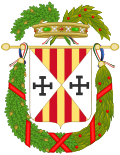 | Catanzaro | 80 | 340,679 | 2,415.45 | |
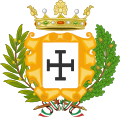 | Cosenza | 150 | 668,992 | 6,709.75 | |
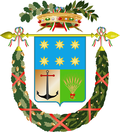 | Crotone | 27 | 160,775 | 1,735.68 | |
 | Reggio Calabria | 97 | 516,601 | 3,210.37 | |
| Vibo Valentia | 50 | 149,899 | 1,150.64 | ||
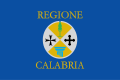 | Calabria | 404 | 1,836,946 | 15,221.90 |
Language
Main article: Languages of Calabria
The main language spoken in Calabria is Standard Italian, which has been the official language since before 1861. However, Calabria also has many dialects that have been spoken there for centuries. These dialects come from Latin and are split into two main groups. In the northern part of Calabria, the dialects are related to the Neapolitan language and are called Northern Calabrian. In the central and southern parts, the dialects are related to the Sicilian language and are called Central and Southern Calabrian. Some areas, like Guardia Piemontese and parts of Reggio Calabria, also speak a type of Occitan language called Gardiol. Because Calabria was once ruled by the French and Spanish, some dialects also show influences from these languages. In nine towns of Bovesìa in Reggio Calabria, people also speak Grecanico, a version of ancient Greek that remains from the time when the area was ruled by the Byzantines and was part of Magna Graecia.
Most people in Calabria are Roman Catholic. Historically, they were Greek Orthodox, and in 732, the dioceses of southern Italy were under the Patriarch of Constantinople. There are also smaller communities of Evangelicals in the region. Calabria is known as "The Land of Saints" because many saints were born there over almost 2,000 years. The most famous saint and patron saint of Calabria is St. Francis of Paola. Another important patron saint is Saint Bruno of Cologne, who founded the Carthusian Order and built the charterhouse of Serra San Bruno in 1095, where he later died in 1101.
There has also been a long history of Jews in Calabria, with a presence dating back at least 1,600 years, possibly even 2,300 years. Though the Jewish community is now very small, it has had notable influence on Jewish life and culture. Calabrian Jews are considered distinct from Sicilian Jews due to historical and geographic reasons. Today, there is a small group of Italian Anusim who have returned to the Jewish faith.
Calabrians played an important role in the Renaissance humanism period, especially in the study of Ancient Greek, which had almost been forgotten. Calabrian humanists and refugees from Constantinople were key in this rediscovery. Two monks from the monastery of Seminara, Barlaam, bishop of Gerace, and his disciple Leonzio Pilato, were especially important. Pilato, born near Reggio Calabria, was a teacher of Ancient Greek and helped Giovanni Boccaccio translate Homer’s works.
Cuisine
See also: Calabrian wine and U cumbitu
Calabria's food is a mix of meat, vegetables, and fish, just like other parts of southern Italy. You’ll find tasty pork, lamb, and goat, along with lots of vegetables such as eggplant. Fish is also popular, especially along the coast where it is often cured. Pasta is a big part of meals here too.
Local dishes include special cheeses, fried pork, and sweet treats like honey-sweetened pastries. Calabria is also known for its wines, with some vineyards dating back to ancient times. The region produces famous wines such as Cirò and Donnici, made from local grapes like Gaglioppo and Greco.
Sport
The most popular sport in Calabria is football. During the 2023–24 Serie B season, two teams from Calabria played: Cosenza Calcio and Catanzaro. Other important teams in the region are Crotone and Vibonese, who played in the 2023–24 Serie C.
Viola Reggio Calabria is a professional basketball team based in Reggio Calabria, Calabria.
Universities
Calabria has three public universities. They are the University of Calabria in Cosenza, the Magna Graecia University in Catanzaro, and the Mediterranea University of Reggio Calabria. There is also a private university called the University for Foreigners "Dante Alighieri" in Reggio Calabria.
Health
Calabria has four main public hospitals and thirty smaller ones, along with many private hospitals. Since 2009, these hospitals have been managed by a special administrator because of debt issues. The goal is to return to normal management at the regional level, as allowed by the Italian Constitution.
The four main public hospitals are:
- Azienda Ospedaliera "Pugliese-Ciaccio", Catanzaro
- Azienda Ospedaliera "Mater Domini", Catanzaro
- Azienda Ospedaliera di Cosenza, Cosenza
- Ospedali Riuniti di Reggio Calabria, Reggio Calabria
Notable people
Main article: List of people from Calabria
Calabria, a beautiful region in Southern Italy, has been home to many famous people throughout history. Some well-known individuals come from this area, though many details about them are shared in a separate list.
Images
Related articles


This article is a child-friendly adaptation of the Wikipedia article on Calabria, available under CC BY-SA 4.0.
Images from Wikimedia Commons. Tap any image to view credits and license.