 Safekipedia
Castile (historical region)
Adapted from Wikipedia · Discoverer experience
Castile, or Castille, is a historical area in Spain. Its exact borders are not always clear, but it is usually thought to include Old Castile and New Castile, as defined in the 1833 territorial division of Spain.
The name Castile likely comes from the word for "land of castles." Many castles were built there during a long time when Christian groups were taking back land from the Moors. This period is known as the Reconquest. These castles helped protect the people and the land as it changed hands over many years.
History
Originally an eastern part of the kingdom of León, Castile became its own kingdom in the 1100s, with its main city at Burgos. It grew by taking back land from the Moorish rulers who had controlled much of Spain since the 700s.
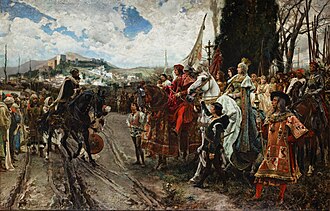
Big moments include capturing Toledo in 1085, which added more land. The battle of Las Navas de Tolosa in 1212 marked more wins against the Moors. Over time, Castile joined with Aragon in 1469 through marriage, leading to the creation of Spain in 1516. In 1492, the last Muslim area, Granada, was taken, adding to Castile’s lands.
Geography
Castile is a region in Spain without clear borders today. Historically, it started as the Kingdom of Castile. Over time, this area grew and joined with other places to form the Crown of Castile and later the Kingdom of Spain. Today, people often think of Castile as including Castile and León and Castile–La Mancha, with Madrid as the central city.
Since 1982, Spain has two areas called autonomous communities that include "Castile" in their names: Castile and León and Castile-La Mancha. Madrid is also seen as part of Castile because it is surrounded by these areas and its laws support this idea.
Language
The language of Castile became the main language of Spain, often called castellano by its speakers and sometimes known as Castilian in English, but generally just Spanish. The people and kingdom of Castile played a big role in shaping Spain through expansion and uniting with nearby regions. For a long time, only the Castilian language had official status in Spain, from the time of the Bourbon Monarchy until democratic government began in 1977.
Main article: Names given to the Spanish language
Main articles: Castilian Kingdom, people
See also: Moors, War of the Spanish Succession
Maps
Here are some maps showing the area known as Castile through history.
- Kingdom of Castile in 1210
- The kingdoms of the Crown of Castile in 1400. Note how Old Castile was called Kingdom of Castile and New Castile was called the Kingdom of Toledo.
- Castile and other Iberian regions in 1770
- The regions of Old Castile and New Castile (1833 until the early 1980s).
- Federal states proposed in the 1st Spanish Republic according to Constitution in 1873. There is an Old and New Castile.
- Autonomous communities that use "Castile" in their names (since the 1980s), plus the community of Madrid. The Leonese region joined with Old Castile, Albacete region joined with New Castile, while Cantabria, La Rioja and Madrid became administrative regions of their own.
Images
Related articles



This article is a child-friendly adaptation of the Wikipedia article on Castile (historical region), available under CC BY-SA 4.0.
Images from Wikimedia Commons. Tap any image to view credits and license.