 Safekipedia
Central Pangean Mountains
Adapted from Wikipedia · Discoverer experience
The Central Pangean Mountains were an extensive northeast–southwest trending mountain range in the central portion of the supercontinent Pangaea during the Carboniferous, Permian and Triassic periods. They formed when the large landmasses of Euramerica (also known as Laurussia) and Gondwana collided during the creation of Pangaea.
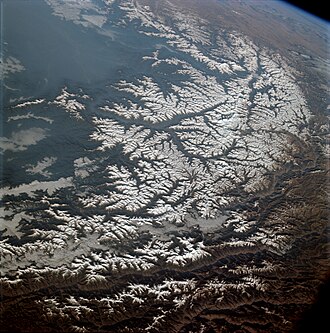
At its greatest height during the early part of the Permian period, the Central Pangean Mountains were as tall as the present-day Himalayas. Today, pieces of these ancient mountains can be seen in several places around the world, including the Appalachian Mountains and Ouachita Mountains of North America, the Atlas Mountains and Anti-Atlas Mountains of Africa, as well as the Bohemian Massif and Massif Central in Europe.
Many mountain-building events helped create the Central Pangean Mountains, including the Acadian, Caledonian, Alleghenian, Mauritanide and Variscan orogenies. The eastern parts of this range were also known as the Variscan Mountains. These mountains tell us a lot about how Earth’s continents have moved and changed over millions of years.
Formation and decline
The Central Pangean Mountains were formed when two large landmasses, Euramerica and northern Gondwana, collided. This collision began during the Carboniferous period about 340 million years ago and finished by the start of the Permian period around 295 million years ago. At their tallest, these mountains were as high as the Himalayas today.
During the Permian period, weather and erosion wore down the mountains, shrinking their peaks to about half their original height and creating deep valleys. By the time of the Middle Triassic period, the mountains had become much smaller. By the early Jurassic period, around 200 million years ago, what remained of these mountains in Western Europe were just a few high areas surrounded by deep ocean basins.
Climate
The Central Pangean Mountains helped create conditions that allowed large amounts of coal to form in the late Carboniferous period. The mountains caused heavy rain all year, which is important for preserving the peat that turns into coal.
Later, during the early-mid Permian period, these mountains sat under the path of heavy rains. Evidence from loess in France shows that parts of these mountains might have had glaciers, even though they were near the equator. As the landmass of Pangaea moved north, the mountains blocked rains from reaching the areas to their north, changing the landscape from wet coal swamps to drier areas and helping form large salt deposits in Europe.
Images
Related articles




This article is a child-friendly adaptation of the Wikipedia article on Central Pangean Mountains, available under CC BY-SA 4.0.
Images from Wikimedia Commons. Tap any image to view credits and license.