 Safekipedia
Ciphertext
Adapted from Wikipedia · Discoverer experience
Ciphertext is the result of turning regular information, called plaintext, into a secret form using a special process known as encryption. This is done using an algorithm, which is like a set of steps or a recipe, called a cipher. When information is turned into ciphertext, it looks like a mix of symbols that no one can read without the right key to unlock it.
The purpose of ciphertext is to keep important information safe from people who might try to look at it without permission. By changing the original information into something unreadable, it helps prevent hacking and the loss of sensitive data.
To get the original information back from ciphertext, a process called decryption is used. This is the opposite of encryption and requires the correct key or method to turn the secret symbols back into readable text. It’s important to know that ciphertext is different from codetext, which comes from a code system rather than a cipher.
Conceptual underpinnings
Imagine Alice wants to send a secret message to her friend Bob. She starts with her original message, called plaintext. To keep it safe, she uses a special method called an encryption cipher and a secret code called a key. This changes her message into something called ciphertext, which looks like random symbols and can’t be read by anyone else.
When Bob gets the ciphertext, he uses another special method and the same secret key to change it back into the original message. This way, only Bob can read what Alice sent, keeping their conversation private.
Types of ciphers
Main article: Cipher
The history of cryptography goes back thousands of years. Cryptography uses many kinds of encryption methods. Old ways of hiding messages were done by hand, but today machines are used.
Historical ciphers
Old ways of hiding messages, called classical ciphers, include:
- Substitution cipher: where letters in the original message are swapped with other letters (for example, Caesar cipher and one-time pad)
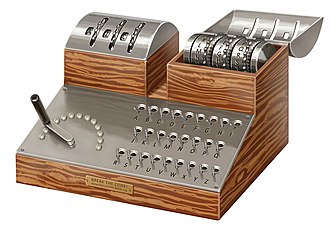
- Polyalphabetic substitution cipher: using many different letter swaps (for example, Vigenère cipher and Enigma machine)
- Polygraphic substitution cipher: swapping groups of letters together (for example, Playfair cipher)
- Transposition cipher: moving the letters of the message around in a new order (for example, rail fence cipher)
These old methods are not used alone today because they are easy to figure out.
Modern ciphers
Newer ways of hiding messages are much safer. They are made to stop anyone from finding the secret key, even if they know some parts of the hidden message. Modern methods can be split into two groups:
- Private-key cryptography (symmetric key algorithm): one shared secret key is used for hiding and uncovering the message
- Public-key cryptography (asymmetric key algorithm): two different keys are used, one for hiding and one for uncovering
With a symmetric key algorithm (like DES and AES), the same key is shared between the sender and receiver. The sender uses it to hide the message, and the receiver uses it to uncover it. These can work on blocks of data or on a stream of data.
With an asymmetric key algorithm (like RSA), there are two keys: a public key that anyone can use to hide a message, and a private key that only the receiver keeps secret to uncover it.
Cryptanalysis
Main article: Cryptanalysis
Cryptanalysis is the study of figuring out hidden messages without knowing the special key used to lock them. It involves understanding how the locking system works and finding ways to unlock the message.
There are different ways someone might try to unlock these messages, depending on what information they have. The locked message itself, called ciphertext, is usually the easiest part to get and is very important in these attempts.
Famous ciphertexts
Main article: List of ciphertexts
- The Babington Plot ciphers
- The Shugborough inscription
- The Zimmermann Telegram
- The Magic Words are Squeamish Ossifrage
- The cryptogram in "The Gold-Bug"
- Beale ciphers
- Kryptos
- Zodiac Killer ciphers
Images
Related articles


This article is a child-friendly adaptation of the Wikipedia article on Ciphertext, available under CC BY-SA 4.0.
Images from Wikimedia Commons. Tap any image to view credits and license.