 Safekipedia
City of London
Adapted from Wikipedia · Discoverer experience
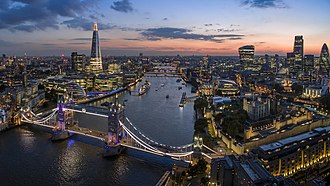
The City of London, often called the City or the Square Mile, is a special area in England. It was first set up by the Romans around 47 AD as Londinium. Even though it is very small—it covers just 1.12 square miles—it is very important. It is the historic heart of the much bigger city of London.
Even with only 8,583 people living there, over 500,000 people work in the City. It is one of the world's main places for money and business. Big buildings like the Bank of England and the London Stock Exchange are located here. Many important jobs, like insurance and law, also have their offices here, especially near the Inns of Court.
The City of London has many famous old spots, such as St Paul's Cathedral, the Royal Exchange, and Smithfield Market. It remained the main part of London from Roman times through the Middle Ages, and parts of the old London Wall can still be seen.
History
Main article: History of London
Origins
Main article: Londinium
The Romans built a settlement called "Londinium" around the year 43 AD on the place where the City of London stands today. They made a bridge over the River Thames, which helped the city become an important place for roads and trade. It was a busy commercial center in what was called Roman Britain until it was left behind in the 5th century.
At its peak, about 45,000 to 60,000 people lived there. Londinium was a mix of people from many parts of the Roman Empire, including Britannia, continental Europe, the Middle East, and North Africa. The Romans built a wall around the city between 190 and 225 AD. The city’s borders were much like today’s City of London, though the river was wider back then.
Decline
As time went on, the city faced problems like sickness and fires. The Roman Empire began to weaken, and attacks from groups like the Picts, Scots, and Saxons made things harder. By AD 410, the Romans left Britain, and many buildings were left in ruins. The city became almost empty, and trade and people moved to a place called Lundenwic to the west.
Anglo-Saxon restoration
Main article: Anglo-Saxon London
Later, leaders like Alfred the Great helped bring people back to the old Roman walls. They rebuilt the city and made it safe again. This became known as London Fort. Alfred’s work helped unite parts of England and protect it from Viking attacks. By the 10th century, London became a wealthy place with many places to make money, like mints.
Medieval era
See also: Norman and Medieval London
After the Battle of Hastings in 1066, William the Conqueror wanted to control London but faced strong resistance. He built castles around the city to keep control. Over time, London’s leaders gained more power, and by the 12th century, they could choose their own leaders. The city was made up of 25 areas, each with its own leader.
In 1381, a group of people called the Peasants’ Revolt tried to take over London but were stopped. Fires also caused a lot of damage, especially a big one in 1666. Plans to redesign the city after the fire were not used, so the old streets stayed mostly the same.
Early modern period
In the 1600s, London became very important for banking and trade. A place called the Royal Exchange was built for merchants to meet. St Paul’s Cathedral, built by Christopher Wren, was finished in 1708 after the big fire.
Growth of London
The 1700s and 1800s saw London grow very fast. People and jobs moved outside the old City of London to places like the West End. New ways to travel, like trains and the Tube, helped the city spread even more.
19th and 20th centuries
In the 1800s, many people left the City of London for the suburbs. During World War II, many buildings were damaged by bombing, but St Paul’s Cathedral survived. After the war, new buildings were built, but some older parts of the city stayed the same.
Tall office buildings began appearing in the 1970s, like the NatWest Tower. Today, the main place where people live in the City is the Barbican Estate.
Governance
The City of London has a unique way of governing itself. It is run by the City of London Corporation, which is led by the Lord Mayor of London. This group is different from the Mayor of London, who was created much later in 2000. The Corporation has two main parts: the Court of Aldermen and the Court of Common Council.
The City is divided into 25 wards, which are old areas that help organize local government. Each ward has an Alderman and some Common Council members. These leaders help make decisions for the City. The City also has special groups called livery companies that protect trades and crafts.
The City has its own police force and owns important places like markets and parks. It also helps take care of important bridges and the Port of London. The City's flag shows its coat of arms, which includes a cross and a sword, with the motto "Lord, direct us."
| Census ward | % of the City of London | Residents | % of built-upon land | |
|---|---|---|---|---|
| Commercial | Residential | |||
| Cripplegate (east half of Barbican neighbourhood) | 10.0% | 2,782 | 79% | 21% |
| Aldersgate (west half of Barbican neighbourhood) | 4.5% | 1,465 | 81% | 19% |
| Farringdon Without (and much of Castle Baynard) | 22.1% | 1,099 | 90% | 10% |
| Portsoken (contains Aldgate Underground station) | 6.6% | 985 | 86% | 14% |
Geography
The City of London is the smallest ceremonial county in England by both area and population. It is also the fourth most crowded area, and it is the smallest city in the UK by population and area.
The land rises from sea level at the River Thames to about 21.6 metres at the meeting point of High Holborn and Chancery Lane. There are two small hills in the historic center, Ludgate Hill to the west and Cornhill to the east. Between these hills ran an old river called the Walbrook, one of many small rivers that used to flow through London.
The boundary of the City of London starts at the Victoria Embankment by the Thames and follows paths through areas such as Middle Temple, Temple Bar, and Chancery Lane. It marks the borders with places like Westminster, Camden, Islington, and Hackney, and includes places such as the Barbican Estate and Broadgate. The boundary also runs along the Thames, with Blackfriars Bridge fully inside the City. Special markers show where the boundary is.
Though the financial area sometimes stretches beyond these borders into nearby parts of London, many big offices are now being built in the eastern parts near Hackney and Tower Hamlets because there is more space there.
The City does not have large parks, but it has many small gardens and open spaces cared for by the local government. These include gardens like Finsbury Circus and churchyards such as St Olave Hart Street. There are also private gardens in some big buildings.
The nearby weather station at St. James Park shows that the City has an oceanic climate, which means its temperatures are a bit warmer at night than areas farther out because of the urban heat island effect.
Public services
Police and security
Further information: Crime in London
The city has its own police force called the City of London Police, which is different from the Metropolitan Police Service that covers most of Greater London. This police force is small, with only 735 officers, including detectives. They have special uniforms with black and gold badges and unique red and white stripes.
Because the city is an important financial area, it has faced threats in the past. Safety measures were put in place to protect against possible attacks.
Fire brigade
Main article: London Fire Brigade
The city has many old and tall buildings that can be risky in fires. There is one fire station in the city at Dowgate, and help comes quickly from nearby stations. The city had fewer fire incidents than any other area in Greater London in recent years.
Power
There is a power station in Charterhouse Street that also helps heat nearby buildings.
Demography
The Office for National Statistics counted 7,375 people living in the City of London in 2011. This was a bit more than in 2001, and by mid-2016, the number grew to about 9,401. In 2001, most people were White at 84.6%, with smaller groups including South Asian at 6.8%, Black at 2.6%, Mixed at 2.3%, Chinese at 2.0%, and 1.7% from other groups.
People who work in the city earn more each week than those in other parts of London and Great Britain. However, there are differences in earnings between men and women, mostly because of the types of jobs they have. The city stands out because it has many single-person households, highly educated people, and crowded living spaces. It also has fewer cars and smaller families compared to other areas.
Demographic Breakdown of the City of London (1981–2021)
| Year | Pop. | ±% |
|---|---|---|
| 1801 | 130,117 | — |
| 1811 | 122,924 | −5.5% |
| 1821 | 127,040 | +3.3% |
| 1831 | 125,353 | −1.3% |
| 1841 | 127,514 | +1.7% |
| 1851 | 132,734 | +4.1% |
| 1861 | 108,078 | −18.6% |
| 1871 | 83,421 | −22.8% |
| 1881 | 58,764 | −29.6% |
| 1891 | 43,882 | −25.3% |
| 1901 | 32,649 | −25.6% |
| 1911 | 24,292 | −25.6% |
| 1921 | 19,564 | −19.5% |
| 1931 | 15,758 | −19.5% |
| 1941 | 10,920 | −30.7% |
| 1951 | 7,568 | −30.7% |
| 1961 | 5,718 | −24.4% |
| 1971 | 4,325 | −24.4% |
| 1981 | 4,603 | +6.4% |
| 1991 | 3,861 | −16.1% |
| 2001 | 7,186 | +86.1% |
| 2011 | 7,375 | +2.6% |
| 2021 | 8,600 | +16.6% |
| 2024 estimate | 15,111 | +75.7% |
| Sources: Office for National Statistics 2024 estimate | ||
Economy
See also: Economy of London
The City of London is one of the world's most important financial centers, just like New York City's Lower Manhattan. Important places like the London Stock Exchange, Lloyd's of London for insurance, and the Bank of England are all located here. Over 500 banks have offices in the city. In 2009, the City of London contributed to 2.4% of the United Kingdom's total economy.
London is also a big player in the foreign exchange market, handling about half of all global trading. The pound sterling, the UK's currency, is one of the most traded currencies in the world. Canary Wharf, a few miles east, has also become a major financial center since 1991.
While finance is very important, the City of London has other activities too. Law firms have a strong presence, especially in the west and north. Retail used to be big here but has moved more toward the West End of London. However, there are still places to visit like the Barbican Centre and the Museum of London. The city also has many pubs, bars, and restaurants, especially around Bishopsgate near Shoreditch. Smithfield Market is one of London's main meat markets, and Leadenhall Market is a fresh food market and a place for visitors.
The City of London is changing, with more homes being built instead of just offices. There is a goal to add 90 new homes each year. Some older buildings are being turned into homes, and new buildings like "the Heron" and Heron Plaza are being developed. Since the 1990s, the city has added hotels and a department store. A shopping center called One New Change opened in 2010, but many places are still quiet on weekends.
Landmarks
Historic buildings
Fire, bombing, and rebuilding after World War II have left the city with fewer old buildings than you might expect. But there are still many beautiful buildings from the Victorian and Edwardian times, often built in historic and neoclassical style. Some famous ones are the Monument to the Great Fire of London ("the Monument"), St Paul's Cathedral, the Guildhall, the Royal Exchange, Dr. Johnson's House, Mansion House, and many churches, designed by Sir Christopher Wren, who also designed St Paul's.
Some old buildings that survived heavy bombing, like Prince Henry's Room and 2 King's Bench Walk in the Temple area, have been carefully restored. You can also see small parts of the old Roman London Wall near places like the Tower of London. Among modern protected buildings are Bracken House and the whole of the Barbican and Golden Lane Estate.
The Tower of London is not inside the city but is a popular place for visitors. Other important buildings include the Bank of England, the Old Bailey, the Custom House, Smithfield Market, Leadenhall Market, and St Bartholomew's Hospital. There are also many modern tall buildings, like the Lloyd's building.
Skyscrapers and tall buildings
See also: List of tallest buildings and structures in London
A lot of new tall buildings and skyscrapers have been built, mostly for the financial sector. They are mainly found on the eastern side around Bishopsgate, Leadenhall Street, and Fenchurch Street. In the north, there is a smaller group including the tall residential towers of the Barbican Estate and the commercial CityPoint tower. In 2007, the 100 m (328 ft) tall Drapers' Gardens building was torn down and replaced by a shorter tower.
The city's buildings that are at least 100 m (328 ft) tall include:
Timeline
The timeline of the tallest building in the city is as follows:
| Name | Years as tallest | Height to roof (m) | Height to roof (ft) | Floors |
|---|---|---|---|---|
| Twentytwo | 2019–present | 278 | 912 | 62 |
| Heron Tower | 2010–2019 | 230 | 754 | 46 |
| Tower 42 | 1980–2010 | 183 | 600 | 47 |
| CityPoint | 1967–1980 | 122 | 400 | 35 |
| St Paul's Cathedral | 1710–1967 | 111 | 365 | n/a |
| St Mary-le-Bow | 1683–1710 | 72 | 236 | n/a |
| Monument to the Great Fire of London | 1677–1683 | 62 | 202 | n/a |
| Old St Paul's Cathedral | 1310–1677 | 150 | 493 | n/a |
Transport
See also: Transport in London
Rail and Tube
The city is well connected by the London Underground ("tube") and National Rail networks.
Seven London Underground lines serve the city; the underground stations include:
- Aldgate
- Bank and Monument
- Barbican
- Blackfriars
- Cannon Street
- Chancery Lane
- Liverpool Street
- Mansion House
- Moorgate
- St. Paul's
In addition, Aldgate East, Farringdon, Temple and Tower Hill tube stations are all situated within metres of the City of London boundary.
The Docklands Light Railway (DLR) has two termini in the city: Bank and Tower Gateway. The DLR links the City directly to the East End. Destinations include Canary Wharf and London City Airport.
The Elizabeth line runs east–west underneath the City of London. The line serves two stations in or very near the City – Farringdon and Liverpool Street – which additionally serves the Barbican and Moorgate areas. Elizabeth line services link the City directly to destinations such as Canary Wharf, Heathrow Airport, and the M4 Corridor high-technology hub.
The city is served by a frequent Thameslink rail service which runs north–south through London. Thameslink services call at Farringdon, City Thameslink, and London Blackfriars. This provides the city with a direct link to key destinations across London, including Elephant & Castle, London Bridge, and St Pancras International. There are also regular, direct trains from these stations to major destinations across East Anglia and the South East.
There are several stations in the city:
All stations in the city are in London fare zone 1.
Road
The national A1, A10 A3, A4, and A40 road routes begin in the city. The city is in the London congestion charge zone. The following bridges cross the River Thames: Blackfriars Bridge, Blackfriars Railway Bridge, Millennium Bridge, Southwark Bridge, Cannon Street Railway Bridge and London Bridge; Tower Bridge is not in the city. The city is well served by buses.
Cycling
Cycling infrastructure in the city is maintained by the City of London Corporation and Transport for London (TfL).
- Cycle Superhighway 1 runs from Tottenham to the city.
- Cycle Superhighway 2 runs from Stratford to the city.
- Cycleway 3 is an east–west route through the city.
- Cycleway 6 runs north–south through the city.
- Cycle Superhighway 7 begins in the City at an interchange with Cycleway 3.
- Quietway 11 is a northbound continuation of Cycleway 7.
The Sandander Cycles and Beryl bike sharing systems operate in the City of London.
River
One London River Services pier is on the Thames in the city, Blackfriars Millennium Pier. Swan Lane Pier, just upstream of London Bridge, is proposed to be replaced and upgraded for regular passenger services. There is a public riverside walk along the river bank, part of the Thames Path, which opened in stages – the route within the city was completed by the opening of a stretch at Queenhithe in 2023.
Travel to work (by residents)
According to a survey conducted in March 2011, the methods by which employed residents 16–74 get to work varied widely: 48.4% go on foot; 19.5% via light rail; 9.2% work mainly from home; 5.8% take the train; 5.6% travel by bus; and 5.3% go by bicycle; with just 3.4% commuting by car or van.
Education
The City of London has many places for higher learning, including the Guildhall School of Music and Drama, the Cass Business School, and parts of several universities such as King's College London and London Metropolitan University.
There is only one primary school directly managed by the city, The Aldgate School, which children ages 4 to 11 can attend. Many families choose to send their children to schools in nearby areas like Tower Hamlets and Westminster.
The city also runs three independent schools, including the City of London School for Girls and the City of London Freemen's School in Ashtead, Surrey. There are also public libraries such as Barbican Library and Guildhall Library for people to use.
Money laundering
The City of London has sometimes been called names like "The Laundromat" and "Londongrad" because of its part in handling illegal money.
In May 2024, a senior UK official said that a large part of the world’s illegal money passes through London and some nearby areas.
Images
Related articles




This article is a child-friendly adaptation of the Wikipedia article on City of London, available under CC BY-SA 4.0.
Images from Wikimedia Commons. Tap any image to view credits and license.