
Coelurosauria
Coelurosauria, meaning "hollow-tailed lizards", is a group of theropod dinosaurs that are more closely related to birds than to carnosaurs. This special group includes many interesting dinosaurs like compsognathids, tyrannosauroids, ornithomimosaurs, and maniraptorans. Some scientists also think megaraptorans might belong here, but we are still learning more about where they fit.
One amazing fact about coelurosaurs is that most of the dinosaurs we know had feathers belong to this group. Scientists like Philip J. Currie believed that all coelurosaurs might have had feathers. But we also found some coelurosaurs that had pebbly, scaly skin instead, showing that not all of them looked the same.
Maniraptora, a part of Coelurosauria, includes the birds we see today, making them the only dinosaurs still alive. In the past, people used the name Coelurosauria for all small theropods, but now we know this group is much more specific and exciting.
Anatomy
Bodyplan
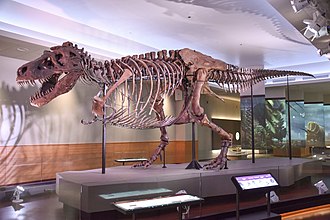
Studying the body features of coelurosaurs shows that their last common ancestor could eat and digest plants, which may have helped them succeed. Some later groups kept this ability, while others ate insects (Alvarezsauridae), plants (Therizinosauridae), or meat (Tyrannosauroidea and Dromaeosauridae). Coelurosaurs include some of the largest (Tyrannosaurus) and smallest (Microraptor, Parvicursor) meat-eating dinosaurs found. Special traits of coelurosaurs include:
- a sacrum (a row of bones attached to the hips) longer than in other dinosaurs
- a tail that stiffens at the end
- a bent ulna (a lower arm bone)
- a tibia (lower leg bone) longer than the femur (upper leg bone)
Integument
Main article: Feathered dinosaurs
Fossils show that even the earliest coelurosaurs had skin covered mostly in feathers. Feather traces are rare but found in most major groups. Most coelurosaurs also had scales or bony plates on parts of their bodies, especially their feet, though some early species had scales on their legs or tail. Some of these animals (Scansoriopteryx and possibly Juravenator) also had feathers elsewhere.
Feathers or feather-like structures were once thought to be only in coelurosaurs, but they have also been found in some ornithischian dinosaurs (like Tianyulong and Kulindadromeus_) and pterosaurs. It is unclear if these are true feathers, but studies suggest they may have developed separately. In 2018, two specimens were found with structures similar to early feathers. Analysis suggests these early feathers may share a common origin with avemetatarsalians.
Nervous system and senses
Rarely, complete brain shapes of theropods are known from fossils. Scientists can also create models of theropod brains using special scans without harming the fossils. These discoveries are important because they show how modern bird brains evolved from earlier reptiles. The part of the brain called the cerebrum grew larger in coelurosaurs and continued to grow in maniraptorans and early birds.
Fossil evidence and age
Some early fossils that might be from Coelurosauria go back to the late Triassic, but these are not very clear. The first certain Coelurosauria fossils come from the late Middle Jurassic, like Proceratosaurus and Kileskus. Many almost complete fossils from Coelurosauria are known from the Late Jurassic, such as Archaeopteryx from around 155–150 million years ago.
In the early Cretaceous, many well-preserved fossils of Coelurosauria, including early birds, were found in the Yixian Formation in Liaoning. Most groups of Coelurosauria went extinct around 66 million years ago during the Cretaceous–Paleogene extinction event, but birds, which are part of the Coelurosauria group, survived and evolved into the many types we see today.
Scientists agree that birds are descendants of Coelurosauria. Today, birds are considered the only living members of this group. In 2015, a small piece of a tail from a young Coelurosaur was found preserved in amber.
Classification
The way scientists group coelurosaurs has changed a lot over time. In the past, many small meat-eating dinosaurs were just thrown together in a group called Coelurosauria. But in the 1960s, scientists started to see that some of these dinosaurs looked very different from each other and began to sort them into new groups like Ornithomimosauria, Deinonychosauria, and Oviraptorosauria.
Today, scientists define Coelurosauria as all dinosaurs that are more closely related to birds than to another big meat-eater called Allosaurus. With this new definition, some big dinosaurs like the tyrannosaurids are now considered part of Coelurosauria too. Even some plant-eating dinosaurs, like the segnosaurs, are now known to be part of this group and are related to Therizinosaurus.
Scientists continue to study and name new groups within Coelurosauria. Some recent groups include Tyrannoraptora, which links tyrannosaurids and birds. Another group, Maniraptoromorpha, includes dinosaurs more closely related to birds than to tyrannosaurids. The most recent group, Maniraptoriformes, may be special because the dinosaurs in this group might have had bird-like feathers and wings. This group includes ornithomimosaurs and maniraptorans, which are closely related to birds.
Pictures
Keep exploring



This article is a child-friendly adaptation of the Wikipedia article on Coelurosauria, available under CC BY-SA 4.0.
Images from Wikimedia Commons. Tap any image to view credits and license.