 Safekipedia
Cosmic background radiation
Adapted from Wikipedia · Discoverer experience
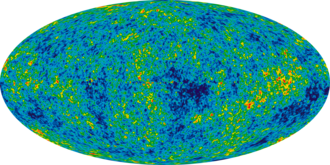
Cosmic background radiation is a special kind of electromagnetic radiation that fills all of space. It comes from different parts of the spectrum, with one important part being the cosmic microwave background. This microwave radiation is made from old photons that have traveled freely since the Universe became transparent to light for the first time. Finding this radiation and studying it helped scientists confirm the ideas about the Big Bang.
This background radiation is mostly the same everywhere, but there are tiny differences that match up with where galaxy filaments and empty spaces called voids are located. Discovering this radiation by accident in 1965 showed that the early universe was filled with a very hot and heavy field of radiation.
We can see background radiation in many different kinds of light, such as infrared and X-rays, but it is strongest in microwaves. These changes in the radiation help scientists understand how much normal matter is in the universe. There are also other types of background radiation, like the cosmic neutrino background and extragalactic background light. The Sunyaev–Zel'dovich effect shows how this radiation changes when it passes through clouds of electron particles.
Timeline of significant events
In 1896, a scientist named Charles Édouard Guillaume guessed that the heat from stars was about 5.6 K. Later, in 1926, another scientist, Arthur Eddington, thought that the light from stars in our galaxy had a temperature of about 3.2 K. In the 1930s, Erich Regener calculated that the energy from cosmic rays in our galaxy was around 2.8 K.
In 1931, the word "microwave" was first used in a book. In 1946, Robert Dicke predicted that microwave background radiation would have a temperature of about 20 K, but later changed his mind and thought it might be closer to 45 K. Around the same time, George Gamow guessed it might be 50 K.
By 1965, Arno Penzias and Robert Woodrow Wilson measured the temperature of this radiation to be about 3 K. This helped scientists understand more about the Big Bang, the beginning of our universe.
Images
Related articles



This article is a child-friendly adaptation of the Wikipedia article on Cosmic background radiation, available under CC BY-SA 4.0.
Images from Wikimedia Commons. Tap any image to view credits and license.