
Dakota Territory
The Territory of Dakota was an organized area that belonged to the United States. It existed from March 2, 1861, until November 2, 1889. During this time, many people lived there and built communities.
Eventually, the Dakota Territory was split into two new states. On November 2, 1889, it became North and South Dakota, which are still states today. This change allowed these areas to have their own governments and make their own laws, just like all other states in the country. The history of the Dakota Territory helps us understand how the United States grew and changed over time.
History
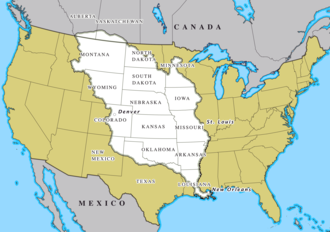
The Dakota Territory was made up of land from the Louisiana Purchase and part of Rupert's Land. It was named after the Dakota branch of the Sioux tribes who lived there.
It became an official U.S. territory on March 2, 1861. At first, it included parts of what are now Montana, Wyoming, North Dakota, South Dakota, and a small part of Nebraska. Over time, some of these areas were moved to other territories or states.
| Year | Pop. | ±% |
|---|---|---|
| 1860 | 4,837 | — |
| 1870 | 14,181 | +193.2% |
| 1880 | 158,724 | +1019.3% |
| Source: 1860–1880 (includes both North Dakota and South Dakota; | ||
American Civil War
The Dakota Territory was not directly involved in the American Civil War. However, after the Dakota War of 1862, the area raised troops to protect its settlements. Hostilities with the Sioux tribes led to military actions. The Department of the Northwest sent expeditions into the territory in 1863, 1864, and 1865. They also built forts to safeguard frontier settlements in Dakota Territory, Iowa, and Minnesota, as well as traffic along the Missouri River.
Before statehood
After the Civil War, there were still conflicts with the Sioux until the 1868 Treaty of Fort Laramie. By 1868, the Dakota Territory was reduced to the current size of the Dakotas. In 1872, the territorial counties were set up, including Bottineau County and Cass County.
The population grew slowly at first and then very quickly during the "Dakota Boom" from 1870 to 1880. The growth was helped by the Northern Pacific Railroad. Many settlers came from other western areas and from northern and western Europe, including many Norwegians, Germans, Swedes, and Canadians.
Commerce started with the fur trade. Furs were moved by steamboat along rivers to settlements. Gold was found in the Black Hills in 1874, which brought more settlers and led to the last Sioux War. The population growth led to more demand for meat, so cattle ranching expanded. With the railroad, farming grew, and wheat became the main crop. In the 1880s, the territory faced hard times because of lower wheat prices and a drought.
There are two main ideas about why the Dakota Territory was split into two states. One idea is that it was because of tensions between the northern and southern parts. The southern part had more people and felt the north was wild and controlled by ranchers and traders. The railroad connected the north to Minneapolis–Saint Paul and the south to Sioux City and Omaha.
The other idea is that it was a political move by Republicans who wanted more power in Congress. By splitting Dakota into two states, they would get four senators instead of two.
Statehood
On February 22, 1889, President Cleveland signed a bill that split the Territory of Dakota into two parts. North Dakota and South Dakota both became states on November 2, 1889. There was some confusion about which state was officially recognized first because the papers were mixed up.
The same bill allowed people in North Dakota, South Dakota, Montana, and Washington to create their state governments and write their state rules. These four areas were prepared to join the United States as states within nine months.
Keep exploring



This article is a child-friendly adaptation of the Wikipedia article on Dakota Territory, available under CC BY-SA 4.0.
Images from Wikimedia Commons. Tap any image to view credits and license.