 Safekipedia
Deserts of California
Adapted from Wikipedia · Discoverer experience
The deserts of California, also called the California deserts, are special dry lands with their own unique plants, animals, and places to live. These deserts have many interesting stories from the past, like tales from the "Old West," and they have towns and communities with their own history. People love to visit these deserts because of their amazing natural beauty and fun things to do outdoors. In fact, some people even thought this area should be its own county because it is so different from the busy cities nearby.
Geography
California has three main deserts: the Mojave Desert, the Colorado Desert, and the Great Basin Desert. The Mojave Desert is found in the southern part of the state, bordered by mountain ranges and reaching toward Arizona and Nevada. The Colorado Desert is in the southeast, close to the Colorado River, and stretches into Mexico and Arizona. The Great Basin Desert lies east of the Sierra Nevada and goes into Nevada.
These deserts cover many areas including parts of several counties such as Lassen, Plumas, Mono, Inyo, Imperial, Los Angeles, Kern, San Diego, Riverside, and San Bernardino. Some people have suggested making part of this area a new county because it feels different from the more crowded parts of California.
Mojave Desert
Main article: Mojave Desert
The Mojave Desert is bordered by the Tehachapi Mountains to the northwest and the San Gabriel and San Bernardino Mountains to the south. It is defined by two major faults in California – the San Andreas Fault and the Garlock Fault. The desert includes an area known as the High Desert. To the north lies the Great Basin shrub steppe, while warmer deserts lie to the south and east.
Colorado Desert
Main articles: Colorado Desert and Sonoran Desert
The Colorado Desert is part of the larger Sonoran Desert and covers about 7 million acres. It stretches from the border with Mexico in the south to the Mojave Desert in the north, and from the Colorado River in the east to the Laguna Mountains in the west. This area includes important valleys like Coachella, Palo Verde, and Imperial Valleys. The desert here is sometimes called the Low Desert.
Great Basin Desert
Main article: Great Basin Desert
The Great Basin Desert is special because it is a "cold" desert, where most of the rain falls as snow. It exists because of the "rainshadow effect" from the Sierra Nevada mountains in eastern California. When winds from the Pacific Ocean rise over the Sierra Nevada, they cool and drop their moisture as rain. By the time the winds reach the other side of the mountains, they are dry and take moisture from the land, creating the desert.
Ecology and climate
The desert region of California has very little rain because mountains to the west block the rain clouds. The Mojave Desert gets between 3 to 10 inches of rain each year, while the Colorado Desert gets even less, from 2 to 6 inches. The driest place in California is Death Valley, with only about 1.5 inches of rain per year. The soil in these deserts is often alkaline, making it hard for plants to grow.
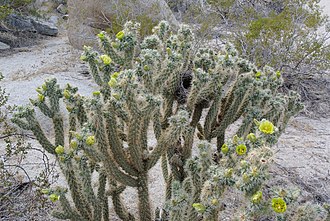
The Mojave Desert is a high desert, with heights up to 11,000 feet. It is famous for the Joshua Tree, a special plant that also grows into parts of Arizona. Other plants there include creosote bush and blackbrush. The Colorado Desert is lower, ranging from below sea level to 1,000 feet. It receives some rain during the summer from the North American Monsoon and is home to saguaro cactus. The Great Basin Desert, also reaching up to 11,000 feet, has plants like sagebrush and pinyon pine that are adapted to survive with little water. Animals that live in these deserts include desert bighorn sheep, kit foxes, coyotes, and desert tortoises.
History
Before Europeans came to North America, Native American tribes like the Mohave, Chemehuevi, and Quechan lived in the California deserts. They hunted and gathered food there.
In the 1700s, European explorers began to visit these deserts. Francisco Garcés, a priest, was the first to explore the Colorado and Mojave deserts in 1776. He learned about the people who already lived there.
Later, as Americans became interested in California, more explorers came. Jedediah Smith traveled through the Great Basin and Mojave deserts in 1826 and reached the San Gabriel Mission. John C. Frémont explored the Great Basin and made maps that helped people travel to California.
The California Gold Rush brought lots of new people to the deserts. Mining for silver, gold, and lead became important, and new roads and railroads, like the Tonopah and Tidewater Railroad, were built to help move goods and people.
Tourism
In 1994, laws were made to protect many areas in Death Valley, Joshua Tree National Parks, and the Mojave National Preserve. These special places let visitors see beautiful landscapes, unusual plants, and interesting animals. One spot, Badwater Basin, is the lowest point in the United States and can be found in Death Valley National Park.
List of towns
Here are some of the towns found in the deserts of California, along with their populations:
- Lancaster (pop. 173,516)
- Palmdale (pop. 169,450)
- Victorville (pop. 134,810)
- Hesperia (pop. 99,818)
- Indio (pop. 89,137)
- Apple Valley (pop. 75,791)
- Cathedral City (pop. 51,493)
- Palm Desert (pop. 51,163)
- Palm Springs (pop. 44,575)
- El Centro (pop. 44,322)
- Coachella (pop. 41,941)
- Calexico (pop. 38,633)
- Adelanto (pop. 38,046)
- La Quinta (pop. 37,558)
- Desert Hot Springs (pop. 32,512)
- Twentynine Palms (pop. 28,065)
- Ridgecrest (pop. 27,959)
- Brawley (pop. 26,416)
- Barstow (pop. 25,415)
- Yucca Valley (pop. 21,701)
- Imperial (pop. 18,631)
- Rancho Mirage (pop. 18,537)
- Blythe (pop. 18,317)
- California City (pop. 14,973)
- Tehachapi (pop. 12,939)
- Calipatria (pop. 7,260)
- Holtville (pop. 6,129)
- Indian Wells (pop. 5,463)
- Needles (pop. 4,931)
- Westmorland (pop. 2,680)
Images
Related articles



This article is a child-friendly adaptation of the Wikipedia article on Deserts of California, available under CC BY-SA 4.0.
Images from Wikimedia Commons. Tap any image to view credits and license.