
Dorsal fin
A dorsal fin is a fin on the back of most marine and freshwater vertebrates. These fins help fish and other water animals stay stable and move smoothly through the water. Dorsal fins have developed in many different animals over time, even though they are not the same in all species.
You can find dorsal fins in most fish, as well as in large mammals like whales. Some animals even had them long ago, such as ancient marine reptiles like ichthyosaurs. While many have just one dorsal fin, a few have two or even three.
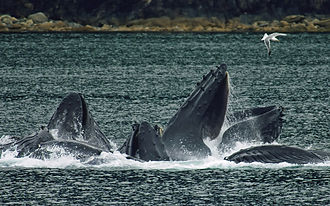
Scientists, called biologists, often look at the unique shapes and marks on whale dorsal fins to tell different whales apart. Inside the fins, special bones or cartilages called pterygiophores give the fin its support.
Functions
The main purpose of a dorsal fin is to help the animal stay balanced and make quick turns. Some fish have special uses for their dorsal fins. For example, the sunfish uses its dorsal fin and the anal fin to move forward. In anglerfish, the front part of the dorsal fin looks like a fishing pole with a lure to catch prey.
Some fish use their dorsal fins to stay safe from predators. They may have sharp spines or even venom, like many catfish, the spiny dogfish, and the Port Jackson shark.
Dorsal fins come in different numbers and shapes. Most fish, like the large goldfish, have one dorsal fin. Sharks, the yellowfin tuna, and haddocks usually have two. Some haddocks have three.
Billfish have very noticeable dorsal fins. When they swim, they can pull these fins into a groove in their body to move faster. The shape and size of the dorsal fin can help tell different kinds of billfish apart. For example, the white marlin has a curved front edge on its dorsal fin covered with black spots. The sailfish has a large dorsal fin, or sail, that it usually keeps folded. It raises this sail to guide small fish or to cool down after moving quickly. The great white shark’s dorsal fin has special fibers that help it stay steady when swimming fast.
Some fish have dorsal fins with special jobs. The Gymnarchus niloticus uses its long dorsal fin to move while keeping its back straight for sensing electric fields. Many catfish can lock their dorsal fin spines up and release a fluid to scare away predators. The large, fold-up dorsal fin of the Indo-Pacific sailfish may help control the fish’s temperature.
Dorsal fin shapes can differ even within the same kind of animal. Male and female orcas have dorsal fins that look different, showing their sex. Long ago, ichthyosaurs also had many different shaped dorsal fins.
Structure
A dorsal fin is a special fin on the back of many water animals. It helps them stay steady while they swim. In fish, this fin grows from skin folds and is supported by tiny bones and muscles that help the fish move through the water. The fin has two main parts: soft rays and a strong base with muscles.
Pictures
Keep exploring




This article is a child-friendly adaptation of the Wikipedia article on Dorsal fin, available under CC BY-SA 4.0.
Images from Wikimedia Commons. Tap any image to view credits and license.