 Safekipedia
Economy of the United Kingdom
Adapted from Wikipedia · Discoverer experience
The United Kingdom has a highly developed social market economy. In 2026, it is the fifth-largest national economy in the world by the value of all goods and services it produces, known as nominal gross domestic product (GDP). It is also the tenth-largest when measuring by the value of goods and services adjusted for cost of living, called purchasing power parity (PPP).
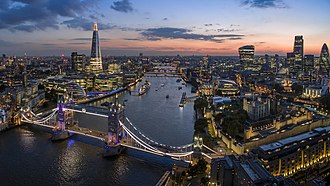
The economy includes England, Scotland, Wales, and Northern Ireland. It is very connected to the world, being the fifth-largest exporter and the fourth-largest importer of goods and services. The service sector, especially financial services industry, is very important, with London being the second-largest financial centre in the world.
The United Kingdom was the first country to industrialise in the 18th century and played a big role in the world economy for many years. However, challenges like the two World Wars, the Great Recession in 2008, and leaving the European Union in 2020 have affected its growth. Today, the government, through His Majesty's Treasury and the Bank of England, helps manage the economy.
History
Main article: Economic history of the United Kingdom
1945 to 1979
After World War II, the United Kingdom made big changes to its economy. The government took control of many important industries like banks, railways, and factories. This helped create jobs and improve life for many people in the 1950s and 1960s. However, by the 1970s, the economy faced problems like high prices and less manufacturing work.
1979 to 1997
In the late 1970s, new leaders changed the economy again. They sold some government-owned businesses back to private owners and made it easier for people to start their own companies. This helped the economy grow, but it also meant some factories closed, and jobs were lost.
1997 to 2009
In the late 1990s, a new government took over and tried to keep the economy strong. Things went well for a while, but in 2008, a big problem happened in the world’s banking system. This caused many jobs to disappear and made it harder for people to buy things.
2009 to 2020
After the banking problem, the government tried to help the economy by lowering interest rates and giving money to banks. Things slowly improved, but there were still challenges, like people not having enough money to spend.
2020 to present
In 2020, the world faced a big health problem called COVID-19, which shut down many businesses in the UK. The economy took a big drop, but governments around the world, including the UK, tried to help people and businesses stay open. Since then, prices for things like food and energy have gone up a lot, making it harder for families to afford everyday items.
Economic charts
This section shows several charts that help us understand the United Kingdom's economy over many years. The charts cover topics like how much the economy grew each year, where people worked, unemployment, how often tough economic times happened, how well people produced goods and services, interest rates, trade balances, and bonds. Each chart gives a visual way to see changes and patterns in the economy from the past up to recent years.
Government spending and economic management
Main article: Government spending in the United Kingdom
See also: Budget of the United Kingdom, United Kingdom national debt, and Taxation in the United Kingdom
The government in the United Kingdom helps manage the economy mainly through HM Treasury, led by the Chancellor of the Exchequer. In recent years, the UK has focused on keeping taxes and rules simple and low. Since 1997, the Bank of England’s Monetary Policy Committee, led by the Governor, has decided on interest rates to keep prices stable, as set each year by the Chancellor.
From 1986 to 2006, government spending was about 40% of the country’s total goods and services. After the 2008 financial crisis and the Great Recession, spending went up to around 48% of the economy in 2009–10, partly to help banks stay stable. By mid-2014, the UK’s government debt was a large part of the economy.
Taxes in the UK go to both local and central governments. Local governments get money from central funds, business taxes, and fees like parking charges. Central government gets most of its money from income tax, national insurance, sales tax, business taxes, and fuel taxes.
Public administration and defence spending
See also: Civil Service (United Kingdom), Defence Review, and State Pension (United Kingdom)
The Blue Book 2013 shows that public services and defence added £70.4 billion to the UK economy in 2011.
Sectors
The UK's economy is divided into 10 broad categories by the Office for National Statistics and the Blue Book. These categories help measure how different parts of the economy contribute to overall growth and jobs.
Agriculture, aquaculture and forestry
Agriculture in the UK is very advanced and efficient. It produces around 65% of the country’s food needs. In 2018, agriculture added £12.18 billion to the economy and employed around 467,000 people. Most of the farming focuses on animals, with crops making up the rest.
Construction
The construction industry employed around 2.3 million people and added £123.2 billion to the economy in 2019. One major project was Crossrail, a new railway line in London that cost around £19 billion and opened in 2022.
Production industries
Electricity, gas and water
This sector added £51.4 billion to the economy in 2018. The UK is building new nuclear reactors to improve its energy supplies.
Manufacturing
Manufacturing was worth £451.6 billion to the UK economy in 2023. It includes making cars, airplanes, medicines, and many other products. The UK is a leading place for making airplanes and medicines.
Mining, quarrying and hydrocarbons
This sector added £31.4 billion to the UK economy in 2011. The UK has resources like coal, oil, and natural gas, though production of these has been decreasing.
Service industries
The service sector is the biggest part of the UK economy, making up 82% of the country’s economy in 2023.
Creative industries
These industries, such as fashion and advertising, grew by 6% each year between 1997 and 2005 and were worth a lot to the economy.
Education, health and social work
The education sector added £84.6 billion in 2011, and health and social work added £104.0 billion. The National Health Service (NHS) is a major part of this, employing around 1.7 million people.
Financial, legal and business services
Financial services added £116.4 billion to the economy in 2011. London is a key place for international business and banking, with many major banks and companies based there.
Hospitality
This industry added £36.6 billion to the economy in 2011. Large hotel companies like InterContinental Hotels Group are based in the UK.
Real estate and renting activities
Real estate companies like British Land and Landsec are important in the UK. Property prices have gone up a lot over the years.
Tourism
Tourism brought in £28.5 billion in 2019, with many visitors coming to London. The COVID-19 pandemic had a big effect on tourism, with fewer people traveling.
Transport, storage and telecommunications
This sector added £59.2 billion from transport and £25.1 billion from telecommunications in 2011. The UK has many roads, railways, and airports, including busy places like London Heathrow Airport.
Wholesale and retail trade
This sector added £151.8 billion to the economy in 2011. Big supermarket chains like Tesco, Sainsbury's, Asda, and Morrisons dominate the market. Online shopping is also very popular in the UK.
| Sector | GVA (£M) | % of GVA | Employee compensation (£M) | % of employee compensation |
|---|---|---|---|---|
| Agriculture | 16,206 | 0.8 | 4,887 | 0.4 |
| Production | 259,522 | 12.7 | 143,992 | 12.5 |
| Construction | 119,920 | 5.9 | 53,142 | 4.6 |
| Distribution | 335,709 | 16.4 | 235,682 | 20.4 |
| Information | 131,244 | 6.4 | 87,369 | 7.6 |
| Financial | 185,434 | 9.1 | 87,738 | 7.6 |
| Real Estate | 266,136 | 13.0 | 18,011 | 1.6 |
| Professional | 264,877 | 12.9 | 176,238 | 15.2 |
| Government (including health and education) | 405,455 | 19.8 | 313,594 | 27.1 |
| Other Services | 62,133 | 3.0 | 35,499 | 3.1 |
| Rank | Market | Spend | Visitors |
|---|---|---|---|
| 1 | United States | £6.3 billion | 5,122,000 |
| 2 | Germany | £1.8 billion | 2,957,000 |
| 3 | France | £1.6 billion | 3,172,000 |
| 4 | Australia | £1.6 billion | 1,169,000 |
| 5 | Ireland | £1.2 billion | 2,889,000 |
| 6 | Spain | £1.1 billion | 2,210,000 |
| 7 | Netherlands | £1.1 billion | 1,960,000 |
| 8 | Italy | £973 million | 1,696,000 |
| 9 | Canada | £970 million | 1,003,000 |
| 10 | United Arab Emirates | £914 million | 477,000 |
Research and development
Main article: Science and technology in the United Kingdom
See also: Artificial intelligence industry in the United Kingdom, Biotechnology in the United Kingdom, and Research funding in the United Kingdom
The United Kingdom is known for its strong work in science and technology. The country invests in many areas, including artificial intelligence and biotechnology, to help improve lives and create new opportunities. Funding for research comes from various sources to support discoveries that can benefit everyone.
Currency
Main article: Pound sterling
London is a leading city for trading different currencies around the world. The British currency is called the pound, and its symbol is "£". The Bank of England is in charge of printing and managing this money. Some banks in Scotland and Northern Ireland can also print their own money, but they must keep enough pounds from the Bank of England to back it up.
The United Kingdom decided not to use the euro, a currency used by many European countries. There were discussions about whether to switch to the euro, but in the end, the UK chose to keep the pound. This decision was supported by many people in the country.
Economic variation within the United Kingdom
Main articles: Economy of England, Economy of Scotland, Economy of Wales, and Economy of Northern Ireland
Gross domestic product (2022)
Within the United Kingdom, England has the largest economy when measured by gross domestic product (GDP), according to figures from the Office for National Statistics (ONS) for the year 2022. Northern Ireland has the smallest economy, which matches its smaller population. England also has the highest level of GDP per capita, while Wales has the lowest.
By English region
See also: List of regions of the United Kingdom by GRDP
England makes up most of the UK's population (84.3%) and an even larger share of its GDP (86.25%). Because of this, much of the economic difference in the UK happens within England itself. London, the capital of both the UK and England, has the largest regional economy and the highest GDP per capita. North East England has the smallest economy and the lowest GDP per capita in England.
Below is a list of the Regions of England by GDP and GDP per capita, also from the ONS for the year 2022.
Gross value added (2020)
If we leave out North Sea oil and gas, England has the highest gross value added (GVA), and Wales has the lowest among the UK's countries.
By English region
See also: List of ceremonial counties in England by gross value added
Within England, GVA per capita is highest in London. The following table shows the GVA per capita for the nine statistical regions of England.
| Rank | Nation | Population | GDP (in millions of GBP) | GDP (in millions of USD) | Share of the UK total | GDP per capita (GBP) | GDP per capita (USD) |
|---|---|---|---|---|---|---|---|
| 1 | England | 57 106 398 | 2 161 593 | 2 664 325 | 86.25% | 37 852 | 46 655 |
| 2 | Scotland | 5 447 698 | 186 851 | 230 445 | 7.46% | 34 299 | 42 301 |
| 3 | Wales | 3 131 640 | 85 412 | 105 337 | 3.41% | 27 274 | 33 636 |
| 4 | Northern Ireland | 1 910 543 | 56 694 | 69 813 | 2.26% | 29 674 | 36 541 |
| United Kingdom (total) | 67 596 279 | 2 506 170 | 3 089 072 | 100% | 37 076 | 45 758 | |
| Rank | Region | Population | GDP (in millions of GBP) | GDP (in millions of USD) | Share of the UK total | GDP per capita (GBP) | GDP per capita (USD) |
|---|---|---|---|---|---|---|---|
| 1 | London | 8 866 180 | 562 179 | 693 096 | 22.43% | 63 407 | 78 154 |
| 2 | South East England | 9 379 833 | 374 453 | 461 665 | 14.94% | 39 921 | 49 208 |
| 3 | North West England | 7 516 113 | 247 199 | 304 755 | 9.86% | 32 889 | 40 538 |
| 4 | East of England | 6 398 497 | 213 828 | 263 556 | 8.53% | 33 419 | 41 191 |
| 5 | South West England | 5 764 881 | 194 030 | 239 186 | 7.74% | 33 657 | 41 485 |
| 6 | West Midlands | 6 021 653 | 181 354 | 223 599 | 7.23% | 30 117 | 37 118 |
| 7 | Yorkshire and the Humber | 5 541 262 | 170 304 | 209 933 | 6.79% | 30 734 | 37 888 |
| 8 | East Midlands | 4 934 939 | 146 482 | 180 663 | 5.84% | 29 683 | 36 610 |
| 9 | North East England | 2 683 040 | 71 763 | 88 526 | 2.86% | 26 747 | 33 000 |
| England | 57 106 398 | 2 161 593 | 2 664 325 | 86.25% | 37 852 | 46 655 | |
| United Kingdom (total) | 67 596 279 | 2 506 170 | 3 089 072 | 100% | 37 076 | 45 758 | |
| Rank | Country | GVA per head, 2020 |
|---|---|---|
| 1 | England | £32,866 ($42136) |
| 2 | Scotland | £29,629 ($37986) |
| 3 | Northern Ireland | £25,575 ($32788) |
| 4 | Wales | £23,882 ($30618) |
| Rank | Region | GVA per head, 2020 |
|---|---|---|
| 1 | London | £55,974 ($71762) |
| 2 | South East England | £34,516 ($44251) |
| 3 | East of England | £29,176 ($37405) |
| 4 | North West England | £28,257 ($36227) |
| 5 | South West England | £28,012 ($35913) |
| 6 | West Midlands | £26,281 ($33694) |
| 7 | East Midlands | £25,956 ($33277) |
| 8 | Yorkshire and the Humber | £25,696 ($32944) |
| 9 | North East England | £23,109 ($29627) |
Trade
See also: List of exports of the United Kingdom, List of tariffs in the United Kingdom, Freeports in the United Kingdom, List of the largest trading partners of the United Kingdom, and British Chambers of Commerce
The trade gap for goods and services became a little smaller in late 2018. Both goods and services that the United Kingdom sold to other countries went up a bit more than what it bought.
After the United Kingdom left the European Union, it will need to make new trade rules with the European Union and its 27 countries. This might change how trade numbers look for the United Kingdom.
The United Kingdom’s economy got an extra £1 billion in July 2023 to help make trade easier using computers.
Trade deals in force
Trade deals being negotiated
- Canada–United Kingdom Free Trade Agreement
- India–United Kingdom Free Trade Agreement
- Gulf Cooperation Council–United Kingdom Free Trade Agreement
- United Kingdom–United States Free Trade Agreement
- Comprehensive and Progressive Agreement for Trans-Pacific Partnership
- Accession of the United Kingdom to CPTPP
Investment
See also: List of institutional investors in the United Kingdom and List of British investors
In 2013, the United Kingdom was the top country in Europe for money coming in from other countries, called foreign direct investment, with $26.51 billion. This meant it had a big share of all the investment in Europe. On the other hand, the UK was second in Europe for sending money out to other countries.
In October 2017, changes were made to how the UK’s money was counted, and it was found that the UK had more money going out than coming in. This was partly because many loans thought to be from foreign companies were actually loans to UK citizens. In April 2021, a group called the UK Investment Council was created to help bring more money into the UK and give advice to the government.
The UK is a big investor in places like America and China. The UK also gets money from leading places for new businesses, such as Silicon Valley and New York in the United States, Beijing in China, Toronto in Canada, and Tel Aviv in Israel. Between 2024 and 2025, this money coming in created many new jobs in the UK from the United States, China, Canada, and Israel.
Mergers and acquisitions
See also: List of largest companies in the United Kingdom
Since 1985, there have been over 100,000 deals where UK companies were involved. There have been three big increases in these deals, happening in the years 2000, 2007, and 2017. The year 1999 had the most money spent on deals, with about £490 billion, which is more than in 2017. The Finance industry and Energy & Power were the biggest parts of these deals from 2000 to 2018.
Here is a list of the top 10 deals that included UK companies. The Vodafone – Mannesmann deal is still the biggest deal ever done in the world.
In most cases, both the buying and selling companies had shareholders from all over the world, not just the countries mentioned.
| Rank | Date | Acquirer | Acquirer nation | Target | Target nation | Value (£ billions) |
|---|---|---|---|---|---|---|
| 1 | 14 November 1999 | Vodafone AirTouch PLC | United Kingdom | Mannesmann AG | Germany | 126.95 |
| 2 | 16 September 2015 | Anheuser-Busch Inbev SA/NV | Belgium | SABMiller PLC | United Kingdom | 77.24 |
| 3 | 4 August 2015 | Royal Dutch Shell PLC | Netherlands | BG Group PLC | United Kingdom | 46.70 |
| 4 | 17 January 2000 | Glaxo Wellcome PLC | United Kingdom | SmithKline Beecham PLC | United Kingdom | 46.48 |
| 5 | 28 October 2004 | Royal Dutch Petroleum Co | Netherlands | Shell Transport & Trading Co | United Kingdom | 40.75 |
| 6 | 21 October 2016 | British American Tobacco PLC | United Kingdom | Reynolds American Inc | United States | 40.10 |
| 7 | 15 January 1999 | Vodafone Group PLC | United Kingdom | AirTouch Communications Inc | United States | 36.35 |
| 8 | 30 May 2000 | France Telecom SA | France | Orange PLC | United Kingdom | 31.14 |
| 9 | 8 November 1998 | British Petroleum Co PLC | United Kingdom | Amoco Corp | United States | 29.51 |
| 10 | 31 October 2016 | GE Oil & Gas | United Kingdom | Baker Hughes Inc | United States | 26.63 |
| 11 | 26 February 2009 | HM Treasury | United Kingdom | Royal Bank of Scotland Group | United Kingdom | 25.50 |
European Union membership
See also: United Kingdom membership of the European Union, Brexit, and EU–UK Trade and Cooperation Agreement
In 2016, the United Kingdom voted to leave the European Union. This decision took time to complete, with the actual leaving happening in January 2020. During this period, the country's economy faced challenges due to uncertainty about the future relationship with the EU and a slower world economy.
After leaving the EU, the UK government promised to protect jobs and trade within the country. Starting in 2021, many powers that used to be handled by the EU were given to local governments in Edinburgh, Cardiff, and Belfast.
Income, welfare and poverty
Main articles: Income in the United Kingdom, Welfare state in the United Kingdom, Pensions in the United Kingdom, and Poverty in the United Kingdom
The United Kingdom is a developed country with systems to help people in need. In 2019, the average amount of money a household had to spend each year was £29,400, which was a small increase from previous years.
The country measures poverty by looking at whether people earn enough to meet a certain level of income. In recent years, the number of people living below this level has been going down. However, many children still live in families where the income is not enough to meet basic needs. In 2025, about 31% of children, or 4.45 million, were living in families that did not have enough money.
Economic impacts of climate change
The United Kingdom's economy, like many others, can be affected by changes in the climate. As the planet warms, weather patterns shift, which can influence farming, energy use, and many other parts of the economy.
These changes might create challenges for businesses and communities, requiring new strategies to stay safe and prosperous. The UK, being a part of the global economy, works with other countries to address these issues and find solutions that help both people and the planet.
Data
The following table shows the main economic indicators in 1980–2021 (with IMF staff estimates in 2022–2027). Inflation below 5% is in green.
| Year | GDP (in bn. US$PPP) | GDP per capita (in US$ PPP) | GDP (in bn. US$ nominal) | GDP per capita (in US$ nominal) | GDP growth (real) | Inflation rate (in %) | Unemployment (in %) | Government debt (in % of GDP) |
|---|---|---|---|---|---|---|---|---|
| 1980 | 511.8 | 9,085.1 | 603.6 | 10,715.4 |  -2.1% -2.1% |  16.8% 16.8% | 7.1% | 42.6% |
| 1981 |  556.3 556.3 | 9,870.7 | 587.3 | 10,420.4 | -0.7% | 12.2% | 9.7% | 44.8% |
| 1982 | 602.3 | 10,699.9 | 558.3 | 9,918.9 | 2.0% | 8.5% | 10.7% |  43.1% 43.1% |
| 1983 | 652.2 | 11,580.6 | 532.1 | 9,448.7 | 4.2% | 5.2% | 11.5% | 41.9% |
| 1984 | 690.9 | 12,247.2 | 504.2 | 8,938.7 | 2.2% | 4.4% | 11.8% | 42.3% |
| 1985 | 742.1 | 13,121.9 | 536.6 | 9,488.1 | 4.1% | 5.2% | 11.4% | 41.3% |
| 1986 | 780.9 | 13,776.7 | 654.7 | 11,549.7 | 3.1% | 3.6% | 11.3% |  41.3% 41.3% |
| 1987 | 843.4 | 14,847.8 | 813.1 | 14,315.0 | 5.4% | 4.1% | 10.4% | 39.3% |
| 1988 | 922.1 | 16,200.4 | 990.2 | 17,398.2 | 5.4% | 4.6% | 8.6% | 37.1% |
| 1989 | 981.6 | 17,198.6 | 1,008.4 | 17,667.9 | 2.4% | 5.2% | 7.2% | 32.5% |
| 1990 | 1,024.8 | 17,904.8 | 1,195.4 | 20,884.2 | 0.6% | 7.0% | 7.1% | 28.5% |
| 1991 | 1,046.9 | 18,226.8 | 1,250.3 | 21,767.1 | -1.4% | 7.5% | 8.9% | 28.4% |
| 1992 | 1,074.1 | 18,653.1 | 1,292.1 | 22,438.0 | 0.2% | 4.2% | 10.0% | 33.2% |
| 1993 | 1,126.0 | 19,509.9 | 1,157.5 | 20,055.8 | 2.3% | 2.5% | 10.4% | 37.9% |
| 1994 | 1,193.4 | 20,624.6 | 1,244.0 | 21,499.6 | 3.4% | 2.0% | 9.5% | 40.6% |
| 1995 | 1,248.2 | 21,511.1 | 1,346.7 | 23,208.7 | 2.4% | 2.6% | 8.6% | 43.6% |
| 1996 | 1,301.9 | 22,383.3 | 1,423.0 | 24,464.8 | 2.6% | 2.4% | 8.1% | 43.7% |
| 1997 | 1,389.4 | 23,825.5 | 1,559.9 | 26,749.9 | 4.9% | 1.8% | 7.0% | 43.2% |
| 1998 | 1,449.3 | 24,785.2 | 1,653.5 | 28,277.9 | 3.4% | 1.6% | 6.3% | 40.9% |
| 1999 | 1,513.7 | 25,793.8 | 1,686.2 | 28,733.2 | 3.1% | 1.3% | 6.0% | 39.3% |
| 2000 | 1,604.8 | 27,253.1 | 1,665.3 | 28,279.7 | 4.3% | 0.8% | 5.5% | 36.6% |
| 2001 | 1,675.0 | 28,335.4 | 1,644.3 | 27,816.7 | 2.6% | 1.2% | 5.1% | 33.9% |
| 2002 | 1,737.2 | 29,262.8 | 1,786.9 | 30,099.6 | 1.8% | 1.3% | 5.2% | 34.1% |
| 2003 | 1,825.2 | 30,604.8 | 2,059.0 | 34,525.0 | 3.1% | 1.4% | 5.0% | 35.3% |
| 2004 | 1,918.3 | 31,998.7 | 2,422.9 | 40,415.5 | 2.4% | 1.3% | 4.8% | 38.2% |
| 2005 | 2,029.8 | 33,598.5 | 2,547.7 | 42,171.2 | 2.7% | 2.1% | 4.8% | 39.4% |
| 2006 | 2,146.5 | 35,288.4 | 2,720.9 | 44,731.6 | 2.4% | 2.3% | 5.4% | 40.4% |
| 2007 | 2,254.5 | 36,767.2 | 3,107.4 | 50,675.5 | 2.6% | 2.3% | 5.4% | 41.4% |
| 2008 | 2,292.3 | 37,077.1 | 2,970.0 | 48,039.0 | -0.2% | 3.6% | 5.7% | 49.0% |
| 2009 | 2,209.0 | 35,479.0 | 2,434.5 | 39,101.2 | -4.6% | 2.2% | 7.6% | 62.8% |
| 2010 | 2,283.2 | 36,379.2 | 2,493.6 | 39,731.6 | 2.2% | 3.3% | 7.9% | 74.0% |
| 2011 | 2,364.6 | 37,363.8 | 2,675.8 | 42,281.9 | 1.1% | 4.5% | 8.1% | 79.5% |
| 2012 | 2,453.4 | 38,511.1 | 2,719.6 | 42,691.2 | 1.5% | 2.8% | 8.0% | 82.7% |
| 2013 | 2,579.2 | 40,232.7 | 2,805.1 | 43,757.4 | 1.8% | 2.6% | 7.6% | 83.6% |
| 2014 | 2,686.2 | 41,584.0 | 3,088.8 | 47,816.0 | 3.2% | 1.5% | 6.2% | 85.5% |
| 2015 | 2,795.1 | 42,928.5 | 2,957.2 | 45,418.9 | 2.2% | 0.0% | 5.4% | 86.0% |
| 2016 | 2,928.3 | 44,606.1 | 2,733.0 | 41,630.5 | 1.9% | 0.7% | 4.9% | 85.8% |
| 2017 | 3,074.4 | 46,553.5 | 2,701.3 | 40,903.5 | 2.7% | 2.7% | 4.4% | 85.1% |
| 2018 | 3,199.8 | 48,163.7 | 2,904.5 | 43,719.0 | 1.4% | 2.5% | 4.1% | 84.5% |
| 2019 | 3,311.5 | 49,575.6 | 2,880.4 | 43,121.1 | 1.6% | 1.8% | 3.8% | 83.9% |
| 2020 | 3,040.7 | 45,329.1 | 2,758.9 | 41,127.4 | -10.4% | 0.9% | 4.6% | 102.6% |
| 2021 | 3,402.7 | 50,522.7 | 3,187.6 | 47,328.8 | 8.7% | 2.6% | 4.5% | 95.3% |
| 2022 | 3,776.0 | 55,862.1 | 3,198.5 | 47,317.6 | 4.3% | 9.1% | 3.8% | 87.0% |
| 2023 | 3,922.9 | 57,821.9 | 3,479.5 | 51,286.1 | 0.1% | 9.0% | 4.8% | 79.9% |
| 2024 | 4,027.7 | 59,160.0 | 3,757.4 | 55,189.5 | 0.6% | 3.7% | 5.0% | 76.7% |
| 2025 | 4,198.8 | 61,471.6 | 3,969.9 | 58,120.1 | 2.3% | 1.8% | 4.3% | 73.7% |
| 2026 | 4,373.1 | 63,829.0 | 4,217.7 | 61,562.0 | 2.2% | 2.0% | 4.2% | 70.6% |
| 2027 | 4,524.5 | 65,857.4 | 4,449.8 | 64,768.9 | 1.5% | 2.0% | 4.2% | 68.0% |
Images
Related articles


This article is a child-friendly adaptation of the Wikipedia article on Economy of the United Kingdom, available under CC BY-SA 4.0.
Images from Wikimedia Commons. Tap any image to view credits and license.