 Safekipedia
Energy level
Adapted from Wikipedia · Discoverer experience
Quantum mechanical systems or particles that are bound, meaning they are confined to a certain space, can only have specific amounts of energy. These specific amounts are called energy levels. This is different from classical particles, which can have any amount of energy. Energy levels are most often talked about when discussing the electrons in atoms, ions, or molecules, which are held by the electric field of the nucleus. But energy levels can also describe the energy of nuclei or the vibrational and rotational energy in molecules. When a system has these specific energy levels, its energy spectrum is said to be quantized.
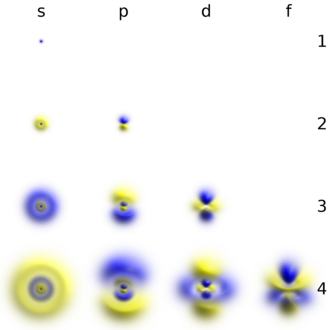
In chemistry and atomic physics, an electron shell, or principal energy level, can be thought of as the path one or more electrons take around an atom's nucleus. The shell closest to the nucleus is called the "1 shell" (or "K shell"), followed by the "2 shell" (or "L shell"), then the "3 shell" (or "M shell"), and so on. Each shell can hold only a certain number of electrons: the first shell can hold up to two, the second up to eight, the third up to eighteen, and so on. The general rule is that the n_th shell can hold up to 2_n2 electrons. Electrons are pulled toward the nucleus, so they usually fill the inner shells before moving to outer shells. But this isn't always strict—atoms can sometimes have incomplete outer shells.
If an atom, ion, or molecule is at the lowest possible energy level, it is in the ground state. If it is at a higher energy level, it is said to be excited. An energy level is called degenerate if there is more than one quantum mechanical state linked to it.
Explanation
Particles can only have certain specific amounts of energy when they are trapped, like an electron inside an atom. This happens because particles act like waves, and only certain wave patterns fit perfectly inside the space. These special energy amounts are called energy levels.
When we measure the energy of such a particle, we find it has one specific energy level at a time. Studying these energy levels helps scientists understand how atoms and molecules behave, using a method called spectroscopy.
History
In the early 1800s, scientists noticed special lines in the light from the sun. This was the first clue that energy in atoms could only be certain values, not any value.
Later, in 1913, a scientist named Niels Bohr suggested that atoms have special energy levels. Then, in 1926, two more scientists, Erwin Schrödinger and Werner Heisenberg, used new ideas about how tiny parts of nature work to explain these energy levels.
Joseph von Fraunhofer William Hyde Wollaston Niels Bohr Bohr theory Schrödinger equation Erwin Schrödinger Werner Heisenberg
Atoms
Intrinsic energy levels
When an electron is part of an atom, it can only have certain specific amounts of energy, called energy levels. This is different from everyday objects, which can have almost any amount of energy. In an atom, the energy levels of electrons depend on how close they are to the center of the atom, called the nucleus. The closer the electron is to the nucleus, the lower (more negative) its energy is.
For a simple atom with just one electron, like hydrogen, the energy levels can be calculated using a special formula. This formula shows how the energy changes based on the electron’s distance from the nucleus and the atom’s type.
Energy levels due to external fields
Zeeman effect
When an atom is placed in a magnetic field, the energy levels of its electrons can change. This happens because the magnetic field interacts with the electron’s spin and movement. This effect is called the Zeeman effect.
Stark effect
Main article: Stark effect
Molecules
Chemical bonds form between atoms in a molecule because they create a more stable situation, usually meaning the total energy level is lower than if the atoms were separate. When atoms come together to covalently bond, their energy levels change and create new molecular orbitals. The energy level of bonding orbitals is lower, while the energy level of antibonding orbitals is higher. For the bond to stay stable, the bonding electrons sit in the lower energy bonding orbital, shown with symbols like σ or π. Anti-bonding orbitals are shown with an asterisk, like σ* or π*.
A non-bonding orbital is an orbital where electrons are in outer shells and don’t help form bonds. The energy level stays the same as in the single atom, and these electrons are often lone pairs. In bigger molecules, there are also energy levels for vibrations and rotations.
The energy of a molecule is the total of several parts: electronic, vibrational, rotational, nuclear, and movement energy. The specific energies depend on the molecule and its state.
Different diagrams help show these energy levels, such as molecular orbital diagrams, Jablonski diagrams, and Franck–Condon diagrams.
Energy level transitions
Further information: atomic electron transition and molecular electron transition
Electrons in atoms and molecules can change their energy levels by taking in or giving out energy in the form of light. This light must have just the right amount of energy to match the difference between the two levels.
Electrons can also be completely removed from an atom. When this happens, it is called ionization. The energy needed to remove an electron is called ionization energy. The opposite can also happen, where energy is released when electrons are added to positively charged ions. Molecules can also change their energy in ways other than just with light, such as through vibrations or rotations.
When an atom or molecule is at its lowest possible energy level, it is called the ground state. If it is at a higher energy level, it is called excited. An excited atom or molecule can return to its ground state by giving out a particle of light called a photon. The energy of this photon matches exactly the energy difference between the two levels. Scientists use tools called spectrometers to measure these photons and learn about the materials they are studying.
Crystalline materials
Crystalline solids have special areas called energy bands instead of, or in addition to, single energy levels. Electrons can have any energy inside an empty band, which might seem different from the usual energy levels. But band theory shows that these bands are actually made of many tiny energy levels packed very close together. Because there are so many levels, it looks like electrons can have a smooth range of energies.
The most important energy levels in a crystal are the top of the valence band, the bottom of the conduction band, the Fermi level, the vacuum level, and the energy levels of any special defect states in the crystal.
Images
Related articles



This article is a child-friendly adaptation of the Wikipedia article on Energy level, available under CC BY-SA 4.0.
Images from Wikimedia Commons. Tap any image to view credits and license.