 Safekipedia
European Parliament
Adapted from Wikipedia · Discoverer experience
The European Parliament (EP) is one of the two legislative bodies of the European Union (EU) and one of its seven institutions. Together with the Council of the European Union, it creates laws for the EU based on suggestions from the European Commission. After the elections in June 2024, the Parliament has 720 members, called MEPs, representing around 375 million voters across Europe.
Since 1979, people from EU countries have voted for their representatives in the European Parliament every five years. This makes it one of the largest democratic elections in the world. The Parliament must approve most EU laws, sharing this power with the Council. It also helps control the EU budget and can influence who leads the European Commission.
The main meeting place of the European Parliament is in Strasbourg, France, but it also works in Brussels, Belgium, where most of its meetings and offices are located. The Parliament includes many different political groups, with the largest being the European People's Party Group, the Progressive Alliance of Socialists and Democrats, Patriots for Europe, the European Conservatives and Reformists Group, and Renew Europe.
History
Further information: Barroso Commission
The European Parliament started in 1952 as a group of chosen leaders from member countries. It had no real power to make laws at first. Over time, it grew stronger and gained more say in how the European Union works.
In 1979, people across Europe voted for the first time to choose members of the Parliament. This made it more like a real parliament. Since then, it has kept getting more power, especially after changes in rules in 2009. Today, it shares many powers with another group called the Council, helping to make important decisions for Europe.
The Parliament meets in different places because of old agreements, with most work happening in Brussels and some meetings in Strasbourg. It has also made changes to become more modern and fair, like trying to include more women and addressing issues of fairness.
Powers and functions
The European Parliament and the Council work together to make laws for the European Union. They are often compared to two parts of a legislature, but they work a bit differently. Neither can create a new law on their own; they both need a proposal from the European Commission, which is like the executive branch.
The Parliament has a lot of influence in many ways. It can express opinions through statements and hearings, and it has a big platform to share ideas with many journalists in Brussels. The Parliament also plays a role in foreign policy by approving money for projects outside the EU, like aid for countries after wars or efforts to stop nuclear programs in places like Iran. It also had a say in agreements between the EU and the United States about sharing passenger data.
Legislative procedure
Over time, the European Parliament has gained more power in how laws are made. The main way laws are created now is called the "ordinary legislative procedure." In this process, the Commission suggests a law, and both the Parliament and the Council must agree on it. They discuss and change the proposal until they reach a deal, sometimes needing several rounds of talks. These discussions often happen in meetings called "trilogues," where the Commission helps find a middle ground.
There are also special rules for making laws in areas like justice, budgets, and taxes. In these cases, either the Council or the Parliament decides alone after talking with the other.
Budget
The Parliament and the Council share the job of managing the EU’s budget. They both have equal say in deciding how the money is spent. If they disagree, they meet to find a solution. The Parliament also checks how well the EU used money from past budgets and can refuse to approve the accounts if needed.
Control of the executive
The Parliament has a say in who leads the European Commission. After European elections, the European Council suggests a President, and the Parliament must approve this choice. The same happens for the rest of the Commission members, who face questions from Parliament before being approved.
Although the Parliament has never rejected a Commission President or the whole Commission, it has used the threat of rejection to influence decisions. For example, it once asked for changes to a proposed Commission before agreeing.
Supervisory and scrutiny powers
The Parliament can start special committees to investigate issues, like health crises or concerns about flights. It can also call on other EU institutions to explain their actions and can take them to court if they break EU rules.
The Parliament elects the European Ombudsman, who helps citizens with problems related to EU institutions. Any EU citizen can bring a petition to the Parliament about issues the EU handles. The Parliament’s Committee on Petitions listens to these cases and tries to help solve them, sometimes using legal actions if needed.
Members
Main article: Members of the European Parliament
The parliamentarians are called Members of the European Parliament (MEPs). They are chosen every five years by people all over Europe and sit together based on what they believe in. About 40 percent of them are women. Before 1979, they were chosen by their own countries' governments.
The Parliament has 720 members after elections in June 2024. Before that, there were 705 members. The number of seats each country gets depends on how many people live there, but no country can have more than 96 or fewer than 6 seats. This means smaller countries have more influence per person than larger ones. Germany, the biggest country, has 96 seats for about 81 million people, while Malta, a small country, has just 6 seats for about 400,000 people.
MEPs work in groups based on their political ideas. The two biggest groups are the European People's Party Group and the Socialists & Democrats. These groups often work together to make decisions, but sometimes they work with other groups depending on the issue.
Elections
Main article: Elections to the European Parliament
People in every country that is part of the European Union vote for their representatives in the European Parliament every five years. The first elections were in 1979, and as of 2019 there have been ten elections. When a new country joins the European Union during a term, it holds a special election to choose its representatives.
Elections happen over four days, from Thursday to Sunday, with each country choosing which day to vote. The number of seats each country gets depends on its population, with no country getting more than 96 or fewer than 6 seats. The most recent elections were in 2024.
Proceedings
The European Parliament holds an annual session, split into monthly parts. These include committee weeks, political group weeks, and session weeks. During session weeks, members meet in Strasbourg for three and a half days, with additional two-day sessions in Brussels throughout the year.
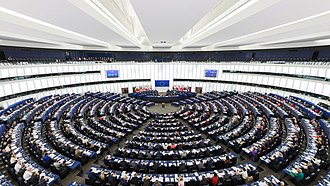
Members can speak during sittings after being called by the President. Voting is usually done by showing hands, but electronic voting may be used to check the result. Votes are recorded only for final legislation or when requested by a political group or 30 members. All recorded votes and minutes are available online. Members sit in a hemicycle based on their political groups, with desks equipped for speaking, listening to translations, and voting. The chamber layout balances different parliamentary traditions. Access is controlled, and ushers help with procedures and can remove disruptive members.
President and organisation
Main article: President of the European Parliament
The President acts as the speaker of the Parliament, leading sessions and representing the Parliament externally. The President is elected every two and a half years. The current President is Roberta Metsola, elected in January 2022. The President’s signature is needed for all EU laws, including the budget. The President also manages the Parliament’s rules and procedures.
The Parliament elects 14 Vice-Presidents to chair debates when the President is away. The Bureau, made up of the President and Vice-Presidents, handles budget and administration. The Conference of Presidents, including the President and leaders of political groups, guides the Parliament’s political decisions. There are also Quaestors to look after members' financial and administrative needs.
Committees and delegations
Main article: Committees of the European Parliament
The Parliament has 20 Standing Committees with sizes ranging from 25 to 88 members. These committees meet twice a month to discuss and prepare legislation. They include a chair, a bureau, and a secretariat. The Parliament can also create sub-committees and temporary committees for specific topics. Committee chairs coordinate their work through the Conference of Committee Chairmen.
Delegations of the Parliament handle relations with parliaments outside the EU. There are 44 delegations, most with around 15 members, but some are larger. These delegations include interparliamentary groups, joint parliamentary committees, and assemblies with other regions. MEPs also take part in international activities like election observation.
Intergroups
The Intergroups in the European Parliament are informal groups where MEPs from different political groups come together to discuss topics that affect multiple committees. They help address issues in a less formal way. Intergroups are supported by organizations, but any financial support must be clearly stated. To start an Intergroup, at least three political groups must agree, with the number of proposals each group can support depending on their size.
Translation and interpretation
Interpretation in the European Parliament
Speakers in the European Parliament can use any of the 24 official languages of the European Union. Simultaneous interpreting is provided in all sessions, and all official documents are translated. This makes the European Parliament the most multilingual parliament in the world, employing 350 full-time and 400 freelance interpreters when needed. Citizens can also speak in Basque, Catalan/Valencian, and Galician.
Interpreters must understand the political meaning behind speeches, not just the words, and prepare thoroughly. Challenges can arise from jokes, fast speaking, or complex topics. While speaking one’s native language is valued, the cost and complexity of interpretation have led to discussions about using fewer languages. The translated proceedings are used to create a multilingual database called Europarl, which helps improve computer translation systems.
See also: Languages of the European Union
Corruption scandals
Qatar related
The European Parliament is dealing with a big problem called Qatargate. This problem involves claims that some officials and their families may have been influenced by the governments of Qatar, Morocco, and Mauritania. The goal was to improve these countries' images in the EU and stop certain decisions about Qatar's human rights record. Law enforcement in Belgium, Italy, and Greece found a lot of cash and charged several people with wrongdoings.
Azerbaijan related
Azerbaijan has faced strong criticism for possibly offering gifts or trips to foreign officials to support its causes. In 2023, reports showed that some members of the European Parliament took free trips to Azerbaijan, which made people question the rules about ethics in the Parliament.
French National Front assistants affair
In 2023, Marine Le Pen, a leader in France, was charged with using money meant for her staff for other purposes. In 2025, she and others were found guilty of misusing EU funds. She received a prison sentence, part of which was suspended, and was fined. She was also banned from running for political office for five years.
Russia related
A former member of the European Parliament from the UK admitted in 2025 to taking money to support Russian interests, especially regarding Ukraine.
Other
A report in January 2024 found that many EU lawmakers have been involved in legal cases or scandals, though only a few resulted in convictions. There are also concerns about possible influence from Russia on members of the European Parliament.
Anti-corruption policies
The European Parliament has faced criticism for not being careful enough about conflicts of interest. In September 2023, it updated its rules to require members to declare their interests, income, and assets, and to avoid certain activities that could create conflicts.
Annual costs
The European Parliament’s budget for 2021 was €2.064 billion, which is 1.2% of the EU budget. The biggest spending areas were staff, operational costs like buildings and IT, political activities, and communications.
Studies show that having the Parliament in two places, including Strasbourg, adds extra costs each year. For comparison, other national parliaments like the Bundestag and the British House of Commons spend less overall. In 2018, members of the European Parliament chose not to make rules stricter for a monthly payment they receive to cover office expenses.
Seats
The European Parliament has offices in three cities: Brussels, Luxembourg City, and Strasbourg. Strasbourg is called the official seat, but most of the work happens in Brussels. Many people think it would be better to have just one main place, mainly Brussels, because it’s where most other EU groups meet too. However, changing this needs agreement from all EU countries, and France wants to keep the seat in Strasbourg. The buildings in Brussels need a lot of repairs, which could cost a lot of money.
Channels of dialogue, information, and communication with European civil society
Members of the European Parliament (MEPs) are the main way for people to connect with the Parliament. They usually have an office in their area and travel back each week to meet with people, businesses, unions, local leaders, and the media.
The Parliament has a detailed website that gets about one million visitors each year. It also makes sure that its debates and meetings are easy to follow. European institutions work hard to be open and clear about what they do. This helps make sure that decisions are made as close as possible to the people they affect. The treaties that guide the European Union say that everyone should be able to take part in how the Union works.
Dialogue with religious and non-confessional organisations
Rules in the European Union allow for talks between European institutions and churches, as well as other groups that are not based on religion. This helps different groups share ideas and work together on important issues.
European Parliament Mediator for International Parental Child Abduction
There is a special helper in the European Parliament whose job is to assist families when a child is taken by one parent after the parents separate. This helper works to find solutions that are best for the child, helping parents agree on what should happen next. This is done through talks instead of going to court, and the agreement is supported by the Parliament to make sure it is fair and legal.
Liaison Offices (EPLOs) & Antennas
The European Parliament has offices in all its member countries, and also in important cities like London and Washington, D.C. It also has smaller offices, called antennas, in places like New York, Addis Ababa, Jakarta, Tirana, and Chișinău. These offices help the Parliament stay connected with other important groups around the world.
European Parliamentary Research Service
The European Parliamentary Research Service (EPRS) is the research department of the European Parliament. It helps members of the Parliament and committees by giving them clear and fair information about important issues in the European Union. This helps them do their jobs better and watch over other important groups in the EU.
The EPRS offers many services and information to support the Parliament’s work. It also helps share ideas with people and groups connected to the EU. All of its reports and materials can be found on the EP Think Tank website for everyone to see.
Eurobarometer of the European Parliament
The European Parliament regularly asks people questions to learn what citizens think about its work and the European Union. These questions cover many topics, such as how people see the Parliament’s role, what they know about it, and how they feel about being part of the European Union. People also share their thoughts on important issues like climate change, the economy, and politics. The answers help show different views from various places and groups.
Prizes
Sakharov Prize
The European Parliament gives out the Sakharov Prize to honor people who help protect human rights around the world. This prize was started in 1988 and focuses on important issues like freedom of speech, protecting minority groups, following international laws, and building strong democracies.
European Charlemagne Youth Prize
The European Charlemagne Youth Prize is given to young people and their projects that help bring Europeans closer together. It is awarded by the European Parliament and supports efforts to build a shared European identity.
European Citizens' Prize
The European Citizens' Prize is awarded for projects that help people from different EU countries work together and cooperate on common goals.
LUX Prize
Since 2007, the LUX Prize has been given by the European Parliament to films that discuss important issues facing Europe today. This prize helps support European filmmakers and encourages people to think about Europe’s future.
Daphne Caruana Galizia Journalism Prize
Starting in 2021, this prize honors excellent journalism that shows the values of the European Union. It is named after a brave journalist from Malta and includes a reward of 20,000 euros.
Images
Related articles




This article is a child-friendly adaptation of the Wikipedia article on European Parliament, available under CC BY-SA 4.0.
Images from Wikimedia Commons. Tap any image to view credits and license.