
Euthyphro
Euthyphro is a philosophical work by Plato written in the form of a Socratic dialogue. It takes place during the weeks before the trial of Socrates in 399 BC. In this dialogue, Socrates meets a man named Euthyphro and they talk about what it means to be pious or holy.
They try to agree on a definition of piety, but they cannot find a clear answer. This leads to a big question: Is something pious because the gods like it, or do the gods like it because it is pious? This question has been discussed by many people over a very long time.
The dialogue ends without a clear answer, which has made it famous for starting important talks about religion and what is right or wrong. This work is one of the earliest examples of deep thinking about these ideas.
Characters
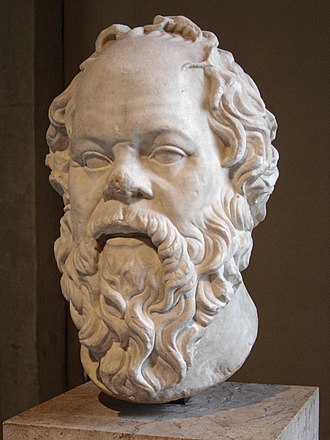
- Socrates, an important thinker from Athens, was waiting at the Porch of the King Archon for a meeting about some questions he had about what is right and good.
- Euthyphro from Prospalta was also at the court. He was a man who knew a lot about the gods and was there because he had made a serious claim against his own father. Euthyphro's father had land on the island of Naxos, and they worked together there. People also talked about Euthyphro in another story called the Cratylus, which happened many years before.
Background
Socrates was waiting for a hearing before his trial for being disrespectful to the gods. This trial is the same one he talks about in another dialogue called the Apology. The story happens in 399 BC, a few weeks before Socrates' trial.
In this story, Socrates meets a man named Euthyphro, who is taking his own father to court. Euthyphro believes his father did something wrong, but many of his family members disagree. The two try to discuss what it means to be pious or respectful to the gods, but they cannot agree on a clear answer.
At the time, Athenian religion focused on rituals and practices rather than written rules like in some later religions. Different priests might honor different gods, and Euthyphro uses one god, Zeus, to support his ideas while ignoring others.
Summary
In this dialogue, Euthyphro meets Socrates outside the court where Socrates is waiting to defend himself against charges of not respecting the gods. Euthyphro tells Socrates that he is going to court to bring charges against his own father, believing it is the right thing to do even though it is unusual for a son to do this. Socrates, facing his own trial, asks Euthyphro to help him understand what piety means.
Euthyphro tries several ways to explain piety. He says it is about punishing wrongdoers, but Socrates points out this is just one example, not a true definition. Euthyphro then says piety is what the gods like, but Socrates questions this because the gods sometimes disagree. Euthyphro tries again, saying piety is what all the gods love, but Socrates asks if something is loved by the gods because it is pious, or if it is pious because the gods love it. They cannot agree. Finally, Euthyphro says piety is knowing how to make the gods happy through gifts and prayers, but Socrates says this just brings them back to the start. In the end, they do not reach a clear answer, and Euthyphro leaves before they can continue.
Reception
Plato's dialogue Euthyphro has been studied and discussed for many years. In ancient times, writers like Metrodorus of Lampsacus wrote about it, even though their works are now lost. Later, Thrasyllus of Mendes listed it among Plato's important works, and some teachers used it as a good starting point for learning about Plato's ideas.
During the Middle Ages and the Renaissance, copies of the dialogue were made and translated into different languages. Scholars like Manuel Chrysoloras and Marsilio Ficino helped bring Plato's works to more people. The first printed version of the Greek text appeared in Venice in 1513.
In modern times, many thinkers have explored the questions raised in Euthyphro. Some, like Peter Geach, have discussed the ideas about what makes something right or holy. These discussions show how Plato's work continues to influence our thinking today.
Texts and translations
Here are some places where you can find the original Greek text of the Euthyphro and different translations into English:
- Greek text at Perseus
- Plato: Euthyphro, Apology, Crito, Phaedo, Phaedrus. Greek with translation by Harold N. Fowler. Loeb Classical Library 36. Harvard Univ. Press (originally published 1914).
- Fowler translation at Perseus
- Plato: Euthyphro, Apology, Crito, Phaedo. Greek with translation by Chris Emlyn-Jones and William Preddy. Loeb Classical Library 36. Harvard Univ. Press, 2017. ISBN 9780674996878 HUP listing
- Plato. Opera, volume I. Oxford Classical Texts. ISBN 978-0198145691
- Translated by Woods & Pack, 2007
- Bundled with Socrates' Defense (aka Apology), Crito, and the death scene from Phaedo
- Translated by Jowett, 1891 at the Classics Archive
- G. Theodoridis, 2017: full-text translation
- Cooper, John M.; Hutchinson, D. S., eds. (1997). "Euthyphro". Plato: Complete works. Translated by Grube, G.M.A. Indianapolis, Ind: Hackett Pub. ISBN 9780872203495.
- The Last Days of Socrates, translation of Euthyphro, Apology, Crito, Phaedo. Hugh Tredennick, 1954. ISBN 978-0140440379.
- "Four Texts on Socrates: Plato's Euthyphro, Apology, and Crito, and Aristophanes' Clouds." Translated by Thomas G. West and Grace Starry West. Cornell University Press, 1998. ISBN 978-0801485749
- The Last Days of Socrates: Euthyphro, Apology, Crito, Phaedo. Translated by Christopher Rowe. Penguin Classics, 2010. ISBN 978-0141965888
Pictures
Keep exploring


This article is a child-friendly adaptation of the Wikipedia article on Euthyphro, available under CC BY-SA 4.0.
Images from Wikimedia Commons. Tap any image to view credits and license.