 Safekipedia
Food energy
Adapted from Wikipedia · Discoverer experience
Food energy is the chemical energy that animals get from food to keep their bodies working and to move. We usually measure this energy in Calories or joules. Most animals get their energy by mixing carbohydrates, fats, and proteins from their food with oxygen from the air or water. This process is called aerobic respiration.
Other things we eat, like organic acids, polyols, and ethanol (which is drinking alcohol), can also give us some energy. But some parts of our diet, such as water, minerals, vitamins, cholesterol, and fiber, don’t give much energy. They are still important for staying healthy.
We measure the energy in food using joules or calories. Fats and ethanol give the most energy, while proteins and most carbohydrates give about half as much. Different types of carbohydrates, like glucose, sucrose, and starch, have slightly different amounts of energy. The amount of energy in food depends on how much carbon, hydrogen, and oxygen it contains. Some carbohydrates, like fiber, and lactose for people who can’t digest it well, give less energy. Polyols and organic acids also give us energy, but not as much as fats or proteins.
History and methods of measurement
The first way people measured food energy was by burning dried food in a special machine called a bomb calorimeter and watching how much the water around it heated up. This is called direct calorimetry.
But this method counted energy from parts of food we can't digest, like fiber. So, scientists developed a better way. They analyze the food to find out how much protein, carbohydrates, and fats it has, and then add up the energy from those parts. This method, improved by Wilbur Atwater and others, gives a more accurate measure of the energy we can actually get from food.
Dietary sources of energy
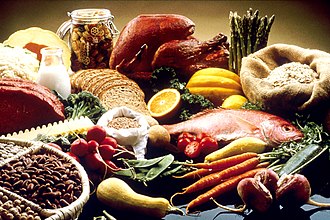
The food we eat gives our bodies energy to work and move. Most of the food humans eat is made up of carbohydrates, fats, proteins, water, and things like bones, seeds, and fibre. Carbohydrates, fats, and proteins make up about ninety percent of the dry weight of our food. Some animals, like cows, can get energy from fibre because of special bacteria in their stomachs that break it down.
There are also smaller parts of our food that help give us energy, like certain acids and sugar-like substances. Some nutrients, like a special kind of fat called essential fatty acids, help our bodies in other ways besides giving energy. They are important for many body processes and cannot be made by our bodies, so we need to get them from food.
Different foods have different amounts of energy, and there are tables that show this information, used for things like food labels in some countries. Some organizations, like the United Nations Food and Agriculture Organization, have published detailed lists of energy content for many foods. Other parts of our diet either do not give energy or are eaten in such small amounts that they do not matter much.
| Food component | Energy density | |
|---|---|---|
| kJ/g | kcal/g | |
| Fat | 37 | 9 |
| Ethanol | 29 | 7 |
| Proteins | 17 | 4 |
| Carbohydrates | 17 | 4 |
| Organic acids | 13 | 3 |
| Polyols (sugar alcohols, sweeteners) (1) | 10 | 2.4 |
| Fiber (2) | 8 | 2 |
Energy usage in the human body
Main articles: Bioenergetics and Energy balance (biology)
The energy we get from food helps our bodies do many things. It keeps our organs working, helps maintain our body temperature, and gives us the strength to move and stay standing. A big part of this energy, about 20%, is used by the brain.
Our muscles aren't very efficient at turning the energy from food into movement. Only about 18 to 26% of the energy we breathe in becomes actual physical power. This is because there are losses in turning the energy into a special power source inside our cells and then into movement. The exact amount depends on the kind of exercise and the type of muscle fibers we use. For example, it can take a lot of time doing light activities, like walking, to use up extra energy from food.
Recommended daily intake
Different countries and health groups suggest how much food energy people should eat each day to stay healthy. For example, in the United States, women aged 26 to 45 need about 8,400 to 10,900 kJ (2,000 to 2,600 kcal), and men need a bit more. These numbers are for people who walk about 2.5 to 5 km (1.5 to 3 miles) each day, in addition to normal daily activities.
The Food and Agriculture Organization of the United Nations says that everyone needs at least about 7,500 kJ (1,800 kcal) each day. Older people and those who don’t move much need less energy, while children and active people need more. In Australia, different age and gender groups have different recommendations, but food labels usually show an average of 8,800 kJ (2,100 kcal). Being in cold places or thinking a lot can also change how much energy your body uses.
Nutrition labels
Many governments require food manufacturers to label how much energy their products have. This helps people choose what to eat and keep their energy levels just right. Food energy numbers are usually shown for a typical serving size, like "calories per serving" or "kcal per 100 g", so it’s easy to understand. Different countries use different units to show this information.
| Country | Mandatory unit (symbol) | Second unit (symbol) | Common usage |
|---|---|---|---|
| United States | Calorie (Cal) | kilojoule (kJ), optional | calorie (cal) |
| Canada | Calorie (Cal) | kilojoule (kJ), optional | calorie (cal) |
| Australia and New Zealand | kilojoule (kJ) | kilocalorie (kcal), optional | AU: kilocalorie (kcal) |
| United Kingdom | kJ | kcal, mandatory | |
| European Union | kilojoule (kJ) | kilocalorie (kcal), mandatory | |
| Brazil | caloria or quilocaloria (kcal) | caloria |
Images
Related articles


This article is a child-friendly adaptation of the Wikipedia article on Food energy, available under CC BY-SA 4.0.
Images from Wikimedia Commons. Tap any image to view credits and license.