 Safekipedia
Garibaldi Volcanic Belt
Adapted from Wikipedia · Discoverer experience
The Garibaldi Volcanic Belt is a line of volcanoes that stretches northwest to southeast through the Pacific Ranges of the Coast Mountains in southwestern British Columbia, Canada. It reaches from Watts Point in the south all the way up to the Ha-Iltzuk Icefield in the north. This volcanic chain is the northernmost part of the Cascade Volcanic Arc, which also includes famous volcanoes like Mount St. Helens and Mount Baker.
Most of the volcanoes in the Garibaldi Volcanic Belt are dormant, meaning they are not currently erupting. They are mainly types called stratovolcanoes and subglacial volcanoes, shaped by glacial ice over time. Other kinds of volcanic features found here include cinder cones, volcanic plugs, lava domes, and calderas. These different landforms were created by various kinds of volcanic activity, such as Peléan and Plinian eruptions.
Eruptions along the Garibaldi Volcanic Belt have formed at least three major volcanic areas. The first began around 4 million years ago near the Powder Mountain Icefield, including the formation of Mount Cayley. Later, between 2.2 million and 2,350 years ago, eruptions built up the Mount Meager massif. Between 1.3 million and 9,300 years ago, Mount Garibaldi and other volcanoes near Garibaldi Lake were formed. These major volcanic zones are arranged in three segments: northern, central, and southern.
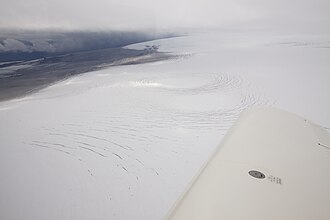
At the northern end of the Pacific Ranges, there are two large and less-studied volcanic areas: Silverthrone Caldera and the Franklin Glacier Complex. Though they are part of the Garibaldi Volcanic Belt, scientists do not fully understand how they relate to the other volcanoes because they have not been studied much.
Geology
Background
Before the Garibaldi Volcanic Belt formed, older volcanic belts were created along the Southern Coast of British Columbia. This includes the Alert Bay Volcanic Belt on northern Vancouver Island and the Pemberton Volcanic Belt along the coastal mainland. The Pemberton Belt began forming when the Farallon Plate was subducting under the British Columbia Coast about 29 million years ago. Later, between 18 and five million years ago, the northern part of the Farallon Plate broke into the Gorda and Juan de Fuca plates. This change might have started volcanic activity in the Alert Bay Belt. Evidence suggests that volcanism in the Alert Bay Belt likely ended a few million years ago.
The bedrock under the Garibaldi chain is made of granitic and dioritic rocks from the Coast Plutonic Complex, a large formation created when ancient plates were subducting along the western edge of North America.
Formation
The Garibaldi Belt formed because of the ongoing subduction of the Juan de Fuca Plate under the North American Plate at the Cascadia subduction zone. This zone is a long fault running off the Pacific Northwest, capable of producing large earthquakes. Unlike many subduction zones, Cascadia lacks a deep ocean trench due to sediment deposits from rivers and ancient floods.
Scientists have recorded at least 13 significant earthquakes in the past 6,000 years along this zone, with the most recent one happening in 1700. This earthquake caused shaking, landslides, and a tsunami that affected coastal areas.
Volcanic activity in the Garibaldi Belt happens infrequently, with thousands of years between major eruptions. One theory suggests that compression in the terrain might affect magma movement. Another idea links higher volcanic activity to periods when glaciers covered the land, though evidence for this is limited.
Glaciovolcanism
Many volcanoes in the Garibaldi chain formed during periods of intense glaciation. These include flat-topped volcanic mountains called tuyas, steep-sided lava domes, and lava flows that poured out near glacial ice. The Barrier, a lava dam near Garibaldi Lake, is a good example of an ice-marginal lava flow.
Southern segment
The southern part of the Garibaldi Belt includes the Watts Point volcanic centre, a small outcrop of volcanic rock. Mount Garibaldi is one of the larger volcanoes here, formed when volcanic material erupted onto a glacier during the ice age. Later activity created a long lava flow from Opal Cone.
Mount Price is a stratovolcano near Garibaldi Lake, built in stages over millions of years. Recent activity around 13,000 years ago created lava flows that were blocked by glacial ice, forming thick deposits.
Cinder Cone, near Garibaldi Lake, is a small volcanic cone that may have erupted within the last 1,000 years. The Black Tusk, a prominent landmark, is the eroded remains of an ancient volcano.
Central segment
Mount Fee is an eroded volcano in the central Garibaldi Belt, showing signs of explosive past activity. Ember Ridge consists of several lava domes formed between 25,000 and 10,000 years ago under glacial ice.
Mount Cayley is the largest volcano in this area, made of layers of lava and pyroclastic rock formed over millions of years. Pali Dome and Cauldron Dome are subglacial volcanoes nearby, with activity occurring mainly about 10,000 years ago.
Northern segment
The Mount Meager massif is the largest and most active volcano in the Garibaldi Belt, with its most recent eruption about 2,350 years ago. This eruption was powerful, sending ash high into the sky and causing floods when a dam of volcanic material broke.
The Bridge River Cones include several small volcanoes with rock types that differ from others in the Garibaldi Belt. The Franklin Glacier Complex is an older volcanic area with activity happening millions of years ago.
Silverthrone Caldera is a large, well-preserved volcanic crater in the northern part of the Garibaldi Belt. Its volcanic activity occurred in stages over hundreds of thousands of years.
Geothermal and seismic activity
Several volcanoes in the Garibaldi Belt, including Mount Garibaldi, Mount Cayley, Mount Meager, and Silverthrone Caldera, have shown seismic activity since 1985. This suggests they might still have molten rock beneath the surface and could be active.
There are hot springs near some of these volcanoes, possibly indicating shallow magma chambers. However, not all volcanoes in the area have known hot springs.
History
People have used resources in and around the Garibaldi Volcanic Belt for many years. The Squamish Nation collected obsidian, a type of glass-like rock, to make tools like knives and chisels long ago. They also used lava from Opal Cone to cook food because it could hold heat well without breaking.
The Squamish Nation has special names and stories for the volcanoes. For example, they call Mount Garibaldi Nch'kay, meaning "Dirty Place", because of the rough volcanic rocks there. They believe this mountain was one of only two that stuck out of a big flood in their stories.
Some areas in the Garibaldi Belt are protected in provincial parks, like Garibaldi Provincial Park, which was created in 1927 to safeguard the region's natural beauty and geological features. These parks help keep the special landscapes safe for everyone to enjoy.
The Garibaldi Volcanic Belt is not watched very closely by scientists to see how active it might be. This is because the volcanoes are in remote areas and there haven’t been any big eruptions in Canada for a long time. Even so, scientists still expect more volcanic activity someday, which could affect the people living nearby.
Volcanic hazards
The volcanoes in the Garibaldi chain are close to many people living in southwest British Columbia. Unlike other parts of the Cascade Arc, these volcanoes usually form groups called volcanic fields instead of big mountains called stratovolcanoes. They are not very active, with much less erupted material compared to areas in the U.S. states. While the risk of eruptions is low, there has been some recent activity, like an explosion at Mount Meager massif about 2,350 years ago.
The biggest danger from these volcanoes would be tephra, which is material thrown into the air during eruptions. Mount Meager could send tephra far, affecting places in southern British Columbia and Alberta. Even though big cities are west of the volcanoes, towns like Squamish and Whistler could be in danger. Tephra could also melt ice and cause floods, affecting water supplies and fisheries.
There have also been landslides and lahars—fast-moving mixtures of mud and rock—in the Garibaldi Belt. Big landslides at Mount Meager could cause dangerous lahars in river valleys. Landslides from Mount Cayley have blocked rivers and damaged roads, but luckily, no one was hurt recently. Lava flows are usually not a big threat unless they happen near snow or ice, which could cause floods or big explosions.
Images
Related articles




This article is a child-friendly adaptation of the Wikipedia article on Garibaldi Volcanic Belt, available under CC BY-SA 4.0.
Images from Wikimedia Commons. Tap any image to view credits and license.