 Safekipedia
Geocentrism
Adapted from Wikipedia · Discoverer experience
Geocentrism is an old way of thinking about space where Earth is at the center of everything. In this idea, the Sun, Moon, stars, and planets all move around Earth. Many ancient people, like those in Greece and Egypt, believed this was true.
Two main reasons made people think Earth was the center. First, the Sun seems to go around Earth once every day. The Moon and planets also seem to move around us each day, and the stars look like they are fixed on a big spinning sphere above us. Second, standing on Earth, it always feels solid and still, like we are not moving at all.
Even though some ancient thinkers, like Aristarchus, suggested that the Sun might be at the center instead, most people stuck with the Earth-centered view for a long time. It was only much later, in the 16th and 17th centuries, that scientists like Copernicus, Galileo, and Kepler showed that everything actually moves around the Sun. This new idea took time to be accepted because the old Earth-centered model worked well for making predictions about the sky. Universe Sun Moon stars planets orbit Aristotle Islamic Golden Age once per day fixed celestial sphere an axis geographical poles Ancient Greek ancient Roman medieval spherical Earth flat-Earth mythology Aristarchus of Samos heliocentric model circular Western culture Johannes Kepler elliptical Kepler's first law of planetary motion Isaac Newton Ptolemy's geocentric model astrological astronomical charts early modern Copernicus Galileo consensus
Ancient Greece
In the 6th century BC, Anaximander thought Earth was like a pillar in the middle of everything. He believed the Sun, Moon, and planets were holes in wheels around Earth, letting us see hidden fire. Around the same time, Pythagoras thought Earth was a sphere but not in the center; it moved around an unseen fire.
Later, Plato and Aristotle taught that Earth was a still sphere in the middle of the universe. They said stars and planets moved around Earth on invisible spheres. Eudoxus of Cnidus helped make these ideas more mathematical. Aristotle imagined many clear, moving spheres around Earth, holding up the stars and planets. He thought Earth was made of heavy elements that stayed in the center, while lighter elements moved away.
People believed Earth was still because the shapes of stars in the sky never seemed to change. They thought if Earth moved, we would see stars shift, but they didn’t. Also, the way the planet Venus looked stayed mostly the same, which fit better with Earth being still. Later, new ideas helped explain the movements better, but the old Earth-centered view was still widely believed.
Ancient Indian
Before around 1500, Indian astronomy mainly tried to predict the movements of the Sun and planets, rather than describing the whole universe. Early astronomers created different methods for the inner planets like Mercury and Venus, and for the outer planets like Mars, Jupiter, and Saturn. These methods were similar to a later system called the Ptolemaic system but were better at calculating the planets' positions.
By 1500, an astronomer named Nilakantha Somayaji developed one method that worked for all the planets. Some Indian astronomers, like Aryabhata, believed the Earth rotated, but their overall view still placed Earth at the center of the universe.
Kerala astronomers Nilakantha Somayaji Aryabhata
Ptolemaic model
Long ago, a wise thinker named Claudius Ptolemaeus wrote about how he thought the universe worked. He believed that Earth sat right in the middle of everything, like a ball in the center of a big round room. The sun, the moon, and all the stars and planets went around Earth in big circles.
Ptolemaeus used special ideas to explain how the planets moved. He thought each planet moved in a small circle called an epicycle while also going around a bigger circle called a deferent. This helped him explain why planets sometimes seemed to move backward in their paths across the sky, a thing we call retrograde motion. Even though his ideas were very clever, they didn’t always match exactly what we see in the sky. But for a long time, many people thought his way of understanding the universe was right.
Main articles: Maragheh observatory, Astronomy in medieval Islam, and Islamic cosmology
After Ptolemaeus wrote his ideas, people in many lands thought about them too. In places far away, thinkers used and changed his ideas. Some wondered if Earth moved instead of staying still. Others tried new ways to explain the paths of the planets without using all the same circles Ptolemaeus used.
One group of thinkers, called the Maragha school, tried very hard to make better explanations. They found ways to explain the planets’ movements that were closer to what we actually see. But even they still thought Earth was the center of everything. Much later, a new idea came that Earth wasn’t the center after all — but that’s a story for another time.
The Ptolemaic order of spheres from Earth outward is:
- Moon
- Mercury
- Venus
- Sun
- Mars
- Jupiter
- Saturn
- Fixed Stars
- Primum Mobile ("First Moved")
| Object(s) | Observation | Modeling mechanism |
|---|---|---|
| Stars | Westward motion of entire sky in ~24 hrs ("first motion") | Stars: Daily westward motion of sphere of stars, carrying all other spheres with it; normally ignored; other spheres have additional motions |
| Sun | Eastward motion yearly along ecliptic | Eastward motion of Sun's sphere in one year |
| Sun | Non-uniform rate along ecliptic (uneven seasons) | Eccentric orbit (Sun's deferent center off Earth) |
| Moon | Monthly eastward motion compared to stars | Monthly eastward motion of Moon's sphere |
| The 5 planets | General eastward motion through zodiac | Eastward motion of deferents; period set by observation of planet going around the ecliptic |
| Planets | Retrograde motion | Motion of epicycle in same direction as deferent. Period of epicycle is time between retrograde motions (synodic period). |
| Planets | Variations in speed through the zodiac | Eccentric per planet |
| Planets | Variations in retrograde timing | Equants per planet (Copernicus used a pair of epicycles instead) |
| Planets | Size of deferents, epicycles | Only ratio between radius of deferent and associated epicycle determined; absolute distances not determined in theory |
| Interior planets | Average greatest elongations of 23° (Mercury) and 46° (Venus) | Size of epicycles set by these angles, proportional to distances |
| Interior planets | Limited to movement near the Sun | Center their deferent centers along the Sun–Earth line |
| Exterior planets | Retrograde only at opposition, when brightest | Radii of epicycles aligned to the Sun–Earth line |
Ptolemaic and rival systems
Not all Greeks agreed with the geocentric model. Some believed the Earth was one of several planets going around a central fire. Others thought the Earth rotated on its axis but stayed at the center of the universe. These ideas still kept the Earth at the center.
Aristarchus of Samos wrote about a idea where the Sun was at the center, and the Earth and other planets revolved around it. But this idea was not popular at the time.
Copernican system
In 1543, the geocentric system was challenged by the publication of a book by Copernicus. This book suggested that the Earth and other planets revolved around the Sun instead. For many years, the geocentric system was still widely accepted because the new system did not offer better predictions at the time.
Tychonic system
Tycho Brahe made more accurate measurements of the positions of planets and stars. He introduced a new system where the Earth stayed at the center, the Sun revolved around the Earth, and all other planets revolved around the Sun.
Observation by Galileo and abandonment of the Ptolemaic model
With the invention of the telescope in 1609, Galileo made observations that questioned some ideas of geocentrism. He saw moons orbiting Jupiter, which meant not everything revolved around the Earth. He also observed phases of Venus that showed it orbited the Sun, further supporting the idea that the Earth was not the center of everything.
Historical positions of the Roman Catholic hierarchy
The geocentric model was debated with claims made by Galileo. Two Popes explained that scientific observations and Scripture could coexist. They taught that Scripture used language that made sense to people at the time, and did not aim to explain the detailed nature of the universe.
Gravitation
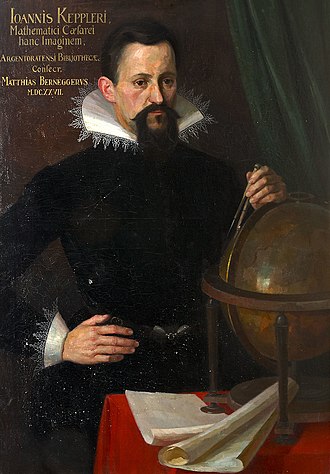
Johannes Kepler studied the careful observations made by Tycho Brahe. He used these to create three important rules about how planets move in 1609 and 1619. These rules helped him predict when Venus would pass in front of the Sun.
Later, Isaac Newton explained the law of universal gravitation in 1687. He showed how the force of gravity keeps planets moving and holds the atmosphere close to Earth. His work helped prove that the Sun, not Earth, is at the center of our solar system. Over time, many tests supported Newton’s ideas about gravity.
Relativity
Albert Einstein and Leopold Infeld wrote that we can describe the laws of nature using any viewpoint, not just ones that move smoothly. This means that whether we say "the Sun is still and the Earth moves" or "the Sun moves and the Earth is still," both statements are just different ways of describing the same thing.
Relativity does not support the old idea that Earth is the center of everything. Instead, it says that we could pick the Sun, the Earth, the Moon, Jupiter, or any other point as the center of our solar system, and each choice would be equally valid. However, when we look at how the planets move, they travel in paths that are mostly oval-shaped around the Sun, not around the Earth. This is because the Sun is much more massive and its gravity strongly affects the planets' orbits.
The important idea from relativity is that we can make accurate predictions about how objects move, no matter which point we choose as our starting point. Choosing the Sun as the center may make calculations easier, but it is not required. A geocentric view can be useful when we are only interested in objects close to Earth, like the Moon or satellites.
Religious and contemporary adherence to geocentrism
See also: Geocentric creationism
The Ptolemaic model was used until the early modern age when it was replaced by the heliocentric model. Even so, some people still hold onto geocentrism as a religious belief. For example, in the United States between 1870 and 1920, some members of the Lutheran Church–Missouri Synod wrote articles supporting geocentrism. However, the church did not officially support it.
Today, some religious leaders and scholars still talk about geocentrism. For example, Robert Sungenis has written books and films about it. Some Orthodox Jewish leaders and a few Sunni scholars, like Ahmed Raza Khan Barelvi from the Indian subcontinent, also support geocentrism. Surveys show that some people in different countries still believe the Sun moves around the Earth rather than the Earth moving around the Sun.
Planetariums
Many planetariums can show the universe in two different ways: one where Earth is at the center and one where the Sun is at the center. The model with Earth at the center is still used in schools to help teach about the sky and the phases of the Moon.
Ephemerides
Ephemerides are tables that show where the sun is located. These tables help us understand the sun’s position for studying space and for guiding ships and planes. They are made easier to calculate by assuming the Earth is at the center of everything.
Images
Related articles


This article is a child-friendly adaptation of the Wikipedia article on Geocentrism, available under CC BY-SA 4.0.
Images from Wikimedia Commons. Tap any image to view credits and license.