 Safekipedia
George Mallory
Adapted from Wikipedia · Discoverer experience
George Herbert Leigh-Mallory (18 June 1886 – 8 or 9 June 1924) was an English mountaineer famous for his attempts to climb Mount Everest, the world's highest mountain. He joined the first three British expeditions to Everest in the early to mid-1920s. During the 1924 expedition, Mallory and his climbing partner Andrew "Sandy" Irvine were last seen moving upward near Everest's summit, and people still wonder if they reached the top before they died.
Born in Cheshire, England, Mallory started climbing in the Alps after a teacher took him on a school trip. He later studied at Magdalene College, Cambridge and taught at Charterhouse School, where he kept improving his climbing skills. He created new paths up mountains and became well-known in the climbing world.
Mallory paused his climbing during the First World War but returned even more determined after the war ended. In 1921, he helped find a good route to Everest's top called the North Col-North Ridge. In 1922, his team reached an amazing height of 27,300 feet (8,321 metres) using extra oxygen and even won Olympic gold medals for alpinism.
In 1924, Mallory and Irvine vanished near the top of Everest. Mallory's body was found in 1999, but we still don't know for sure if they made it to the summit. When someone asked Mallory why he wanted to climb Everest, he famously said, "Because it's there."
Early life and teaching career
George Herbert Leigh Mallory was born on 18 June 1886 in Mobberley, Cheshire, England. He was the son of the Reverend Herbert Leigh Mallory and Annie Beridge Leigh-Mallory. Mallory had two sisters, Mary Henrietta and Annie Victoria, and a younger brother named Trafford.
Mallory attended Winchester College, where a teacher introduced him to climbing during an excursion in the Alps. He became very skilled at climbing and enjoyed it greatly. Later, he studied history at Magdalene College, Cambridge, and made many friends there. After completing his studies, Mallory began teaching at Charterhouse School in 1910. His friendly and informal teaching style was appreciated by his students, though some colleagues found it challenging. Mallory loved to share his passion for climbing and art with his students, taking them on trips and discussing great works of art.
Climbing in Europe
The Alps
George Mallory climbed many mountains in the Alps. He went on eight trips there and reached the top of mountains four times for the first time ever. One of his first climbs was on August 5, 1904, when he and two friends climbed Mont Vélan but had to stop before the very top because they felt sick from the thin air. A few days later, they made it to the top of Dufourspitze, one of the biggest peaks in Western Europe. Later, they climbed Mont Blanc, the highest mountain in Western Europe.
In 1909, Mallory climbed a tough new path up Nesthorn with two friends. In 1911, he and his friends reached the top of Herbétet and Mont Maudit. In 1912, Mallory and two others found a new way up Dent Blanche. In 1919, he and a friend made new paths up Aiguille des Grands Charmoz and Aiguille du Midi.
Scotland
In 1906, Mallory and two friends climbed Ben Nevis, the highest mountain in Britain, through difficult snow-covered paths. They also climbed Stob Bàn and Càrn Mòr Dearg. In 1918, Mallory and two others made new paths up mountains on the Isle of Skye.
Wales
In 1907, Mallory climbed two new paths on a mountain called Tryfan. In 1908, he climbed alone up a difficult path on Lliwedd called Mallory's Slab. In 1911, Mallory and a friend made a very hard new path up Y Garn called Mallory's Ridge.
England
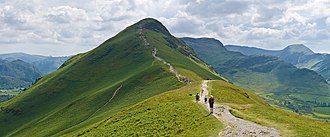
In 1908, Mallory and three friends climbed several paths in the Lake District, including Great Gable. They made new paths on Ennerdale face of Great Gable. In 1913, Mallory made new paths on mountains in Cornwall and on Great Gable.
Marriage and the First World War
Christiana Ruth Turner came from a family of an architect father and an embroiderer mother. George Mallory became close friends with her family and often visited them. In April 1914, during a holiday in Venice, Mallory and Ruth fell in love. They got engaged on May 1, 1914, and married on July 29, 1914, just before World War I began. They had three children: Frances Clare, Beridge Ruth (called Berry), and John.
When the war started, Mallory joined the army and began training in January 1916. He fought in important battles and sometimes worked closer to home between deployments. In 1917, he was promoted to lieutenant and continued training other officers. Mallory celebrated the end of the war in November 1918 and finally returned to England in January 1919.
The lure of Everest
After returning from France, George Mallory and his family went back to live in Godalming, Surrey. He went back to teaching at Charterhouse but felt this wasn’t enough. He spent more time thinking about climbing, world politics, and education.
In January 1921, a group called the Mount Everest Committee was formed to plan an expedition to Mount Everest. They wanted to find the best way to climb the mountain. In February 1921, Mallory got a letter asking if he wanted to join the expedition. At first, he wasn’t sure because it would take him away from his family. But after talking with a friend, he decided it was a special chance and agreed to go. He left England in April 1921 to join the expedition.
Everest expeditions
1921 British Mount Everest reconnaissance expedition
The first Everest expedition in 1921 aimed to explore the mountain and its paths to find the easiest route to the top. Expedition members, including Henry Morshead and Oliver Wheeler, created the first detailed maps of the area. On August 18, Mallory, Guy Bullock, Morshead, and a porter started from their high camp at about 20,000 feet. They climbed to the Lhakpa La pass at 22,470 feet, discovering a route to Everest’s North Col at 23,030 feet. This marked the start of the path to the summit. By late September, severe winds forced them to end the expedition early.
1922 British Mount Everest expedition
In 1922, the goal was to reach Everest’s summit. Mallory joined the team, which sailed from Marseille to Bombay and then marched to the Rongbuk Monastery. They set up Base Camp at 16,500 feet. In May, Mallory and others tried to climb higher but faced harsh weather and difficult conditions. During one attempt, an avalanche struck, and several porters were lost. The expedition ended in June due to these challenges.
1924 British Mount Everest expedition
The third expedition in 1924 aimed again for the summit. Mallory and Andrew Irvine made a final attempt. On June 8, support climber Noel Odell saw them near the summit but then lost sight of them in the clouds. They were never seen alive again. A memorial was later built at Base Camp to honor those who had died in the expeditions.
Lost on Everest for 75 years
Discovery of the ice axe, 1933
In 1933, climbers Percy Wyn-Harris and Lawrence Wager found an ice axe on Mount Everest. They believed it belonged to either George Mallory or Andrew Irvine, two climbers who had gone missing years earlier. The axe was left where it was found.
Smythe's sighting, 1936
In 1936, climber Frank Smythe thought he saw something unusual on the mountain that might have been related to Mallory or Irvine. He decided not to tell anyone at the time.
Holzel, Everest historian
Historian Tom Holzel thought Mallory and Irvine might have split up during their climb. He believed Irvine might have fallen while descending, and Mallory might have tried to reach the top alone.
1986 Mount Everest North Face Research Expedition
In 1986, a team tried to find clues about Mallory and Irvine. They wanted to see if they could find any cameras that might show if the climbers reached the summit. Bad weather made it difficult.
1999 Mallory and Irvine Research Expedition
In 1999, a team found Mallory’s body on Everest. They searched for a camera that might prove if he and Irvine reached the top, but the camera was not found. The discovery suggested Mallory might have reached the summit before dying.
Timeline
- 1893: At age 7, George Mallory climbed the roof of a church.
- 1904: At age 18, he climbed Mont Blanc, the highest peak in Western Europe.
- 1909: He climbed the Southeast Ridge of Nesthorn for the first time.
- 1911: He climbed the Western Ridge of Herbétet and the Southeast Ridge of Mont Maudit for the third time.
- 1912: Mallory created a new route on the West Face of Dent Blanche.
- 1915–18: He served as an officer during the First World War.
- 1919: Mallory made a new route on the Aiguille des Grands Charmoz and Aiguille du Midi, later called the "Rectified Mallory-Porter Route."
- 1920: He reached the top of the Matterhorn and Zinalrothorn.
- 1921: Mallory joined the first British expedition to Everest to explore possible routes to the summit.
- 1922: During the second British Everest expedition, his team set a world record for climbing high using extra oxygen.
- 1924: Mallory and his climbing partner Andrew "Sandy" Irvine disappeared near the top of Everest, creating a famous mystery.
- 1953: Edmund Hillary and Tenzing Norgay became the first people known to reach the summit of Everest, which brought new interest in what happened to Mallory and Irvine.
- 1975: A Chinese climber reported finding an old climber’s dead body on Everest, which was likely Mallory or Irvine.
- 1999: Mallory’s body and belongings were found, but it is still unknown if he reached the summit.
- 2007: Climber Conrad Anker repeated Mallory’s climb using the same kind of old equipment.
- 2010: The film The Wildest Dream showed Mallory’s life and modern efforts to solve the mystery.
- 2024: A team found some of Irvine’s remains on a glacier far below where Mallory’s body was found.
Theories
Mallory and Irvine faced a very hard part of their climb called the Second Step. It was a steep, shaky rock wall about 100 feet high, very hard to climb, especially without extra air. Later climbers managed to climb it using special techniques, and they think Mallory and Irvine might have been able to do it too.
Some scientists think that bad weather might have played a big role in what happened to Mallory and Irvine. They found old weather records that showed there was a big drop in air pressure and temperature around the time of their climb. This kind of weather change, called a western disturbance, can bring strong winds and snow. The bad weather and thin air high up could have made it very hard for them to keep going.
Legacy
At Winchester College there is a memorial to him in the cloister near the college chapel. Mallory was honored by naming a court after him at Magdalene College, with a stone above a doorway remembering him. The Friends of Magdalene Boat Club changed their name to the Mallory Club in his honor. There is also a plaque remembering him in the South African Cloisters at Charterhouse. A special stained-glass window at St Wilfrid's Church, Mobberley, Cheshire, shows figures from stories and has writings about Mallory. Two tall mountains in California's Sierra Nevada, Mount Mallory and Mount Irvine, are named after him and his climbing partner.
Mallory was filmed during an expedition, and this footage was used in later films about climbing. His story inspired books and animations, including a novel and a film released in 2021. In 1962, President John F. Kennedy mentioned Mallory in a famous speech, using his famous words, "Because it is there," to describe the challenge of space exploration.
Images
Related articles


This article is a child-friendly adaptation of the Wikipedia article on George Mallory, available under CC BY-SA 4.0.
Images from Wikimedia Commons. Tap any image to view credits and license.