
Glenn Research Center
NASA John H. Glenn Research Center at Lewis Field is one of ten major NASA facilities. It is located in the cities of Brook Park and Cleveland, between Cleveland Hopkins International Airport and the Rocky River Reservation of Cleveland Metroparks. The center also has a smaller facility in Sandusky, Ohio.
The main job of Glenn Research Center is to create new science and technology for use in air travel and space exploration. As of May 2012, it had about 1,650 civil servants and 1,850 support contractors working on or near the site.
In 2010, the NASA Visitors Center that used to be on the Glenn Research Center property moved to the Great Lakes Science Center in the North Coast Harbor area of downtown Cleveland.
History
The Glenn Research Center was created in 1942 as part of the National Advisory Committee for Aeronautics. Later, it became a lab for airplane engine research under the National Aeronautics and Space Administration.
It started as the Aircraft Engine Research Laboratory. Over the years, it was renamed several times: to the Flight Propulsion Research Laboratory in 1947, the Lewis Flight Propulsion Laboratory in 1948 (after George W. Lewis), and the NASA Lewis Research Center in 1958. In 1999, it was named the NASA John H. Glenn Research Center at Lewis Field to honor John Glenn, the first American to orbit the Earth. By 1951, scientists there were already studying how rocket engines work with liquid fuel liquid rocket.
Facilities
Neil A. Armstrong Test Facility
The NASA John H. Glenn Research Center at the Neil A. Armstrong Test Facility, located near Sandusky in southern Erie County, Ohio, is a big testing site. It is about 50 miles from the main center and is used for large tests that are not safe to do at the main location.
As of 2025, the facility includes five main areas for testing:
- Space Environments Complex
- In-Space Propulsion Facility
- Combined Effects Chamber
- Hypersonic Tunnel Facility
- NASA Electric Aircraft Testbed
In 2019, Ohio’s senators Rob Portman and Sherrod Brown suggested naming the site after Neil Armstrong. This change became official law on December 30, 2020.
B-2 Spacecraft Propulsion Research Facility
Main article: Space Power Facility
The B-2 Spacecraft Propulsion Research Facility is special because it can test large rocket engines and parts under conditions that copy high altitudes. It has the world’s largest vacuum chamber for space tests.
Icing Research Tunnel
The Icing Research Tunnel is a wind tunnel that can copy conditions where ice forms in the air. It helps scientists test how ice affects airplane wings and bodies, and how to prevent ice build-up.
Zero Gravity Research Facility
Main article: Zero Gravity Research Facility
The Zero Gravity Research Facility uses a tall vacuum chamber to let experiment packages fall, helping scientists study how things behave without gravity.
The facility has a big concrete shaft, 28 feet wide, that goes 510 feet deep. Inside is an aluminum vacuum chamber, 20 feet wide and 470 feet tall. Before use, the air pressure inside is lowered to a very low level.
There is also a smaller tower where things can fall for 2.2 seconds, used for special educational programs like Dropping in a Microgravity Environment and What if No Gravity.
This facility became a National Historic Landmark in 1985 and has been the world’s largest place for zero-gravity research since 2003.
See also: Spacecraft Propulsion Research Facility and Rocket Engine Test Facility
Developments
NASA Glenn works on new ideas for airplanes and space travel. They study how to make jet engines use less energy, create less pollution, and make less noise. You can see their noise-reducing designs, called chevrons, on many airplane engines today, like those on the Boeing 787 Dreamliner.
Glenn Research Center also helped create important technologies for space. These include the liquid hydrogen rocket engine, which was key to the Apollo Moon landings, and a special engine called the Centaur upper-stage rocket. They also made a very efficient engine for space called the gridded ion thruster, used on the NASA probe Deep Space 1. Glenn also provided the power system for the International Space Station and helped design an adapter for a new version of the Space Launch System (SLS).
Contributions
The Glenn Research Center focuses on important areas like air-breathing engines, communication technology, space engines, storing and moving special fluids, and creating power and energy solutions. They also study materials that can survive in extreme conditions.
The center offers special programs for students and teachers. High school and college students, as well as teachers, can join internships to learn about science and technology by working with NASA experts. There is also a yearly contest called the Dropping In Microgravity Environment where high school teams design experiments to test in a special tower.
Future
After 2004, NASA began focusing more on space exploration, which made some people think that centers like Glenn, which work on research and technology, might get fewer resources. But in 2006, Glenn got to manage the service module for the Crew Exploration Vehicle, which brought more money and jobs to the center. This helped secure its future and shifted its focus more toward space exploration.
In 2010, there was more uncertainty when President Obama and Congress changed NASA's plans for space flights. However, NASA's budget in 2015 increased funding for projects that Glenn works on, including aeronautics research, planetary science, and space technology, which also helped the center.
Vision for Space Exploration Crew Exploration Vehicle President Obama Congress
Center directors
These people have been the directors of the Glenn Research Center:
| No. | Image | Director | Start | End |
|---|---|---|---|---|
| 1 |  | Edward R. Sharp | May 1942 | June 1947 |
| June 1947 | September 1948 | |||
| September 1948 | September 1958 | |||
| October 1, 1958 | December 31, 1960 | |||
| Acting |  | Eugene J. Manganiello | January 1, 1961 | October 31, 1961 |
| 2 | 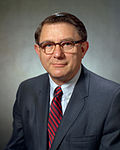 | Abe Silverstein | November 1, 1961 | October 31, 1969 |
| 3 |  | Bruce T. Lundin | November 1, 1969 | August 26, 1977 |
| Acting |  | Bernard Lubarsky | August 27, 1977 | September 30, 1978 |
| 4 |  | John F. McCarthy Jr. | October 1, 1978 | June 21, 1982 |
| 5 |  | Andrew J. Stofan | June 22, 1982 | June 29, 1986 |
| Acting |  | John M. Klineberg | June 30, 1986 | May 28, 1987 |
| 6 | May 29, 1987 | June 30, 1990 | ||
| 7 |  | Lawrence J. Ross | July 1, 1990 | February 28, 1994 |
| 8 |  | Donald J. Campbell | March 1, 1994 | September 30, 2003 |
| 9 |  | Julian M. Earls | October 1, 2003 | December 25, 2005 |
| 10 |  | Woodrow Whitlow Jr. | December 25, 2005 | February 2010 |
| Acting | 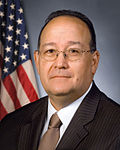 | Ramon Lugo III | March 1, 2010 | July 17, 2010 |
| 11 | July 18, 2010 | January 3, 2013 | ||
| 12 |  | James M. Free | January 4, 2013 | March 13, 2016 |
| 13 |  | Janet L. Kavandi | March 14, 2016 | September 31, 2019 |
| Acting |  | Marla E. Perez-Davis | October 1, 2019 | January 23, 2020 |
| 14 | January 24, 2020 | June 17, 2022 | ||
| Acting |  | James A. Kenyon | June 17, 2022 | November 6, 2022 |
| 15 | November 7, 2022 | present | ||
NASA Glenn Visitor Center
In September 2009, the Glenn Research Center closed its Visitor Center and moved many displays to the Great Lakes Science Center. This change helped save money, made it easier for more people to visit, and gave the center more attention by placing the displays at a busier science center in Cleveland. Before the move, about 60,000 people visited each year, but after the move, the new visitor area welcomed 330,000 people in just one year.
The Glenn Research Center still offers public tours of its research facilities. These tours happen on the first Saturday of each month, but you need to reserve a spot ahead of time.
Pictures
Keep exploring


This article is a child-friendly adaptation of the Wikipedia article on Glenn Research Center, available under CC BY-SA 4.0.
Images from Wikimedia Commons. Tap any image to view credits and license.