
Greenlandian
The Greenlandian is a very important part of Earth's history. It is the earliest time period in what we call the Holocene Epoch. This time began around 11,650 years ago and lasted until about 8,200 years ago. Scientists officially decided on this time period in June 2018.
During the Greenlandian, Earth was warming up after a very cold time called the Late Pleistocene. The warming happened quickly at first and then continued more slowly. Near the end of this time, there was a short but noticeable cool period called the 8.2-kiloyear event.
As the planet warmed, sea levels rose fast. This caused many lands to become covered by water. Places like the British Isles, the islands of Indonesia, New Guinea, and Tasmania became separate from the lands around them. The water also covered the land bridge that once connected Asia and the Americas, creating what we now call the Bering Strait.
Paleofauna
Many large animals went extinct during the Greenlandian time. This continued a pattern of animals disappearing that started at the end of a past time period called the Late Pleistocene. These disappearances are known as the Late Pleistocene extinction event.
Prehistory
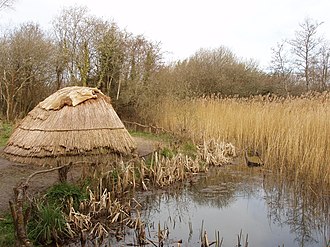
In the Eurasian continent, the start of the Greenlandian age led to the Mesolithic period, which lasted until the beginning of the Northgrippian age. In the Near East, farming and raising animals began during this time, starting the Neolithic period.
Keep exploring


This article is a child-friendly adaptation of the Wikipedia article on Greenlandian, available under CC BY-SA 4.0.
Images from Wikimedia Commons. Tap any image to view credits and license.