 Safekipedia
Hendecagon
Adapted from Wikipedia · Discoverer experience
In geometry, a hendecagon (also called an undecagon or endecagon) is a special type of shape known as an eleven-sided polygon. The word hendecagon comes from ancient Greek, where hendeka means "eleven" and –gon means "corner." This name is often used instead of undecagon, which mixes Latin and Greek words.
Hendecagons are interesting shapes that mathematicians and artists study. While regular hendecagons have all sides and angles the same, irregular hendecagons can have sides and angles of different lengths and measures. Understanding shapes like hendecagons helps us learn more about the world around us and how different forms fit together.
Regular hendecagon
A regular hendecagon is a special type of shape with eleven equal sides and angles. It is shown using a special symbol called the Schläfli symbol {11}.
Each internal angle of a regular hendecagon measures about 147.27 degrees. The space inside this shape, called its area, depends on the length of one side, called a. There is a special math formula to find this area.
Because of the number 11, this shape cannot be drawn perfectly using just a compass and straightedge. However, ancient mathematicians found ways to get very close to the correct shape. There are also special methods, like using a tool called neusis construction or folding paper twice, to draw a perfect hendecagon.
Approximate construction
A hendecagon is an eleven-sided shape. You can draw it inside a circle using a special method from the year 1800.
The method says to draw a line from one point to another, then find the middle. Using this middle point and the first point as centers, draw small arcs. Then connect these arcs with more lines to make one side of the hendecagon. This method works well for drawing the shape by hand.
Symmetry
The regular hendecagon has a special kind of balance called Dih11 symmetry, which has an order of 22. Because 11 is a prime number, there is one smaller group with dihedral symmetry: Dih1, and two cyclic group symmetries: Z11, and Z1.
These four symmetries can be seen in four different ways on the hendecagon. John Conway used letters and group orders to name these symmetries. The full symmetry is called r22, and having no symmetry is called a1. The dihedral symmetries are named depending on whether they go through vertices (d for diagonal) or edges (p for perpendiculars), and i when the reflection lines go through both edges and vertices. The cyclic symmetries are named g for their central gyration orders.
Each subgroup symmetry allows some flexibility for irregular shapes. Only the g11 subgroup has no flexibility but can be seen as directed edges.
Use in coinage
Some coins around the world have shapes that are close to an eleven-sided figure. For example, Canada’s loonie coin and India’s 2-rupee coin are almost like a regular eleven-sided shape. The inside edge of the United States’ Susan B. Anthony dollar also has this kind of outline. The loonie’s shape is actually a special kind of eleven-sided figure called a Reuleaux hendecagon.
Related figures
A hendecagon has 11 points, just like four special shapes called hendecagrams.
 {11/2} |  {11/3} |  {11/4} | 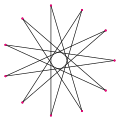 {11/5} |
Images
Related articles




This article is a child-friendly adaptation of the Wikipedia article on Hendecagon, available under CC BY-SA 4.0.
Images from Wikimedia Commons. Tap any image to view credits and license.