
History of the papacy
Within Catholicism, the pope is the head of the Catholic Church, a role that began with Saint Peter and continues today. In the early years of the Christian faith, many popes faced hard times, often sharing the suffering of their followers during tough periods for the church.
After the fall of the Western Roman Empire around 476, the popes in Rome began to grow in power and influence, especially in the middle ages. They slowly gained control over a region called the Papal States. Over time, the popes became important players in the politics and culture of Europe.
During the Renaissance, popes were famous for supporting artists and building grand structures. Later, during times of big changes like the Protestant Reformation and the French Revolution, the popes led the church through many challenges. These events changed the church's history and led to the creation of Vatican City as the popes' home today.
During the Roman Empire (until 493)
Early Christianity
Main article: Papacy in early Christianity
Further information: Primacy of Simon Peter and Persecution of Christians in the Roman Empire
Roman Catholics believe the pope is the successor to Peter and the first bishop of Rome. Early popes, like Pope Clement I, wrote important letters to guide other Christian communities. Many early popes and their followers faced hard times and were treated unfairly during tough periods for Christians.
From Constantine (312–493)
Main articles: Bishops of Rome under Constantine the Great and Papacy in late antiquity
When Constantine I became a powerful leader, he helped make Christianity more accepted. He supported the building of important places for Christians, like the first St. Peter's Basilica. Over time, the role of the pope grew more important, and by the time of Pope Leo I, the word "pope" began to mean specifically the Bishop of Rome.
Middle Ages (493–1417)
Ostrogothic Papacy (493–537)
Main article: Ostrogothic Papacy
The Ostrogothic Papacy lasted from 493 to 537. This was the first time a pope was chosen without a Western Roman emperor. The Ostrogothic Kingdom had a strong influence, though the Ostrogothic King did not directly choose the popes. Kings like Theodoric the Great, Athalaric, and Theodahad shaped the selection and work of the popes. This period ended when Justinian I took back Italy, starting the Byzantine Papacy from 537 to 752.
Byzantine Papacy (537–752)
Main articles: Byzantine Papacy and Papal States
The Byzantine Papacy lasted from 537 to 752. During this time, popes needed approval from the Byzantine Emperors to become bishops of Rome. Many popes came from places like Byzantine Greece, Syria, or Sicily. Justinian I brought back Roman rule in Italy after the Gothic War and chose the next three popes.
Pope Gregory I, who served from 590 to 604, was important for supporting missionary work in northern Europe, including England. He believed the Roman church had special duties but did not think any bishop had complete power over all others.
Frankish influence (756–857)
Main article: Frankish Papacy
In 751, Aistulf threatened Rome, so Pope Stephen II traveled to ask the Frankish king, Pepin III, for help. Pepin invaded Italy and gave land to the pope, creating the Papal States. This land made the pope a leader with power over territory.
After being attacked in Rome, Pope Leo III went to meet Charlemagne. In 800, Leo placed a crown on Charlemagne’s head, making him emperor. Charlemagne’s son Louis the Pious later required popes to promise loyalty to the Frankish Emperor.
Influence of powerful Roman families (904–1048)
Main articles: Saeculum obscurum, Crescentii, and Tusculan Papacy
From 904 to 964, powerful families in Rome controlled the popes. This time is sometimes called the "dark age" because the popes had little freedom.
Conflicts with the emperor and East (1048–1257)
From 1048 to 1257, popes often fought with the Holy Roman Emperor over who could choose church leaders. This conflict is known as the Investiture Controversy. In 1077, Emperor Henry IV traveled to meet Pope Gregory VII to try to solve their disagreements.
Differences between the Eastern and Western parts of the Christian Church grew, leading to the East–West Schism. In 1095, Pope Urban II asked Christians to help the Eastern Church, which began the First Crusade.
Wandering popes (1257–1309)
Main articles: Viterbo Papacy, Orvieto Papacy, and Perugia Papacy
Because of unrest in Rome, popes moved to cities like Viterbo, Orvieto, and Perugia. The popes brought their court with them, and elections for new popes happened wherever the last pope died.
Avignon Papacy (1309–1377)
Main article: Avignon Papacy
From 1309 to 1377, seven popes lived in Avignon. All were from France, and the French king had much control over them. In 1378, Pope Gregory XI returned to Rome and died there.
Western Schism (1378–1417)
Main article: Western Schism
From 1378 to 1417, different groups in the Catholic Church supported different popes. This is called the Western Schism. In 1417, a council chose Pope Martin V to end the disagreement.
Early modern and modern era (1417–present)
Renaissance papacy (1417–1534)
Main article: Papacy during the Renaissance
From 1417 to the Reformation, the Catholic Church was stable with no major splits. Pope Martin V returned the papacy to Rome in 1420. Even though there were disagreements about the church’s direction, they were settled through special meetings of church leaders.
Popes didn’t pass down power within families like kings did, so they supported their relatives in other ways. This created a group of powerful church leaders connected to pope families. The popes and these leaders became big supporters of art and building projects, helping shape Rome’s famous landmarks.
Reformation and Counter-Reformation (1517–1580)
Main article: Reformation Papacy
The Reformation challenged the Catholic Church. In response, the church started the Counter-Reformation. This effort, led by Pope Paul III and others, reaffirmed church teachings and made changes to address problems.
Baroque papacy (1585–1689)
Pope Sixtus V focused on making Rome a beautiful and important city, showing the strength of the Catholic Church.
During the Age of Revolution (1775–1848)
Main article: Popes during the Age of Revolution
The Roman question (1870–1929)
Main article: Roman question
Pope Pius IX spent many years unable to leave the Vatican. Despite this, he worked to organize the church. Pope Leo XIII improved relations with many countries but still faced challenges in Italy.
He spoke about fair treatment for workers and the importance of social justice, influencing future church teachings.
From the creation of Vatican City (1929)
Further information: Vatican City
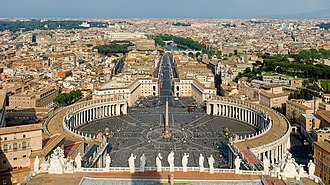
Pope Pius XI worked hard on diplomacy and issued many important messages. He negotiated the Lateran Treaty, which created Vatican City and settled disputes between Italy and the church.
Negotiations began in 1926 and finished in 1929 with agreements known as the Lateran Pacts.
The Lateran Treaty created Vatican City as an independent state. It also established Catholicism as Italy’s religion and settled financial claims from when the church lost power in 1870.
In the 1930s, efforts were made to agree on a treaty with Germany, though many issues remained unresolved.
Between 1933 and 1939, protests were made against violations of agreements with Germany.
World War II (1939–1945)
Main articles: Vatican City during World War II and Pope Pius XII and the Holocaust
When Germany invaded Poland in 1939, the Vatican stayed neutral. After the war, Pope Pius XII focused on helping war-torn Europe and expanding the church’s global reach.
From Vatican II (1962–1965) to the present
Further information: Second Vatican Council
In 1962, Pope John XXIII started the Second Vatican Council. This meeting brought major changes to church practices. In 1965, a joint statement lifted old punishments between Catholic and Orthodox leaders.
Bishops agreed the pope has supreme authority but also share power with all bishops. Local bishops have equal importance within the church.
Pope Paul VI continued efforts to connect with other Christian groups. He traveled to all five continents, making the church more global. He opened church leadership to bishops worldwide.
After Pope John Paul I’s short time as pope, Pope John Paul II became the first non-Italian pope since the 1500s. He is credited with helping end communism in Eastern Europe. He also spoke about the dangers of certain economic systems.
Pope Benedict XVI was elected in 2005. In 2013, he became the first pope to step down in many years. Pope Francis followed him and served until his passing in 2025.
On May 8, 2025, Pope Leo XIV, the first American and an Augustinian, was elected.
Pictures
Keep exploring



This article is a child-friendly adaptation of the Wikipedia article on History of the papacy, available under CC BY-SA 4.0.
Images from Wikimedia Commons. Tap any image to view credits and license.