
House of Kamehameha
The House of Kamehameha (Hale O Kamehameha), also called the Kamehameha dynasty, was the royal family that ruled the Kingdom of Hawaiʻi. It began when Kamehameha I started ruling in 1795 and lasted until the deaths of Kamehameha V in 1872 and Lunalilo in 1874. After that, the kingdom continued for another 21 years, ending when it was overthrown in 1893 with the fall of the House of Kalakaua. This family played a very important role in the history of Hawaiʻi.
Origins of the Kamehameha dynasty
Originating lines
The House of Kamehameha began with Keōua Kalanikupuapaʻikalaninui, who was considered the sacred father of Kamehameha I. Keōua's brother, Kalaniʻōpuʻu, became king and gave his war god Kuka'ilimoku to Kamehameha I. Both Keōua and Kalaniʻōpuʻu had the same mother, Kamakaʻīmoku, and their fathers were brothers. They both served Alapaʻinui, the king of Hawaiʻi island at the time.
Kamehameha I's mother was Kekuʻiapoiwa II. His exact birth date is not known for sure, but it is believed he was born around the winter month of ikuwā, possibly between 1736 and 1740. After his father's death, he was raised by his uncle, Kalaniʻōpuʻu. When some chiefs planned to harm the young Kamehameha, Kalaniʻōpuʻu advised him to return to Kohala for safety.
Cook's arrival and death
Main article: Death of James Cook
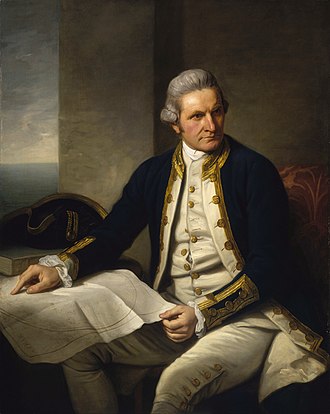
In 1778, Captain James Cook visited the Hawaiian Islands and returned in 1779. When his ship, Resolution, had trouble leaving, he was forced to return to Kealakekua Bay. Tensions rose when some tools were taken, leading to a confrontation. Cook tried to take King Kalaniʻōpuʻu but was stopped by his wife, Kānekapōlei, and two chiefs. During the struggle, Cook was attacked and killed. Kamehameha later received some of Cook's hair.
Kamehameha I, founder of the Kingdom of Hawaii
After Kalaniʻōpuʻu's death, his son Kīwalaʻō took over, while Kamehameha held religious authority. With support from some chiefs, Kamehameha began a war to take control. After several battles, Kīwalaʻō was killed. By 1795, Kamehameha had united most of the Hawaiian Islands under his rule, and by 1810, he controlled all of them.
Kamehameha built the first western-style house in the Hawaiian Islands, called the "Brick Palace", in Lahaina, Maui. It was finished in 1802. Though it was meant for his favorite advisor Kaʻahumanu, she chose to live in a traditional Hawaiian home nearby.
Kamehameha I had many wives, but two were very important to him: Keōpūolani, mother of his sons Liholiho and Kauikeaouli, and Kaʻahumanu, his favorite. Kamehameha I died in 1819, and his son Liholiho became the next king.
New king and form of government
Kamehameha II, and the new office of Kuhina Nui
After Kamehameha I passed away, his firstborn son Liholiho returned and was crowned king. During the ceremony, Kaʻahumanu, a key leader, announced that she and the new king would share power together. This started a special system where the king and another leader ruled side by side. Kamehameha II shared his rule with his stepmother, Kaʻahumanu. She changed some old traditions, which led to big shifts in the way people lived.
Kamehameha II and his wife, Queen Kamāmalu, passed away in 1824 while visiting England. They were only young and had ruled for just five years.
When Kamehameha II and his queen died, their bodies were brought back to Hawaii by Boki. During the journey, Boki's wife Liliha and Kekūanaōʻa became Christians, as did Kaʻahumanu, who became a strong influence in Hawaiian society.
Kaʻahumanu
Kaʻahumanu was born on Maui around 1777. She became one of Kamehameha’s partners when she was young. Before Kamehameha passed away, he chose her to help rule with his son. Kaʻahumanu was very powerful and respected, and she played a major role in shaping Hawaii’s history.
Kamehameha III, Kaʻahumanu II, III, moi kuʻi, au-puni kuʻi and the Great Māhele
When Kamehameha III became king at the age of twelve after his brother Liholiho passed away, he faced many changes. After the death of Kaʻahumanu, the young king wanted to take control of his full inheritance. He stood up against the Christian church and lifted bans on certain activities, including alcohol and the Hula. He chose a close friend, Kaomi, a half-Tahitian man, to help rule with him. However, under pressure from the church, Kamehameha III later chose another leader, Kinau, to be the Kuhina Nui instead.
Kīnaʻu was later succeeded by Kekāuluohi, who acted for the true heir, Victoria Kamāmalu, Kīnaʻu's young daughter. After Kekāuluohi passed away in 1845, Keoni Ana, the son of John Young, one of Kamehameha I’s important advisors, became the next Kuhina Nui. Kamehameha III named his nephew, Alexander ʻIolani Liholiho, as his heir. When he became king, he was known as Kamehameha IV in 1855. During his rule, Kamehameha III carried out the Great Mahele, which changed how land was owned in the kingdom. He also had two sons with Jane Lahilahi, though one passed away at a young age.
Kamehameha IV and Queen Emma
Alexander ʻIolani Liholiho, known as Kamehameha IV, was the nephew of Kamehameha II and the grandson of Kamehameha I. He became king at the age of 21. He was tall and often described as handsome. His wife, Queen Emma, was the granddaughter of John Young. Together, they founded the Queen's Medical Center to help people stay healthy.
The couple had one son named Albert Edward Kauikeaouli, but sadly, he passed away when he was only four years old. Because of this, the throne would later pass to Kamehameha IV's uncle.
Kamehameha V and the last Kamehameha king
Lot Kapuāiwa became king in 1863 and was known as Kamehameha V. He never married and died in 1872, marking the end of the Kamehameha Dynasty. Before he passed, he asked Elizabeth Keka'aniau and Bernice Pauahi Bishop to take the throne, but they both said no. Kamehameha V said, "The throne belongs to Lunalilo, but I think he is not right for the job. The rules say if I don’t choose someone, the next king will be elected. So, let it be an election." He died the next morning, leading to a choice among the princes and chiefs who had been prepared to rule.
Lunalilo
William Charles Lunalilo was an important chief in the Hawaiian Kingdom. He was chosen by people to be their leader, making him the first elected monarch of Hawaii. He was also the last ruler from the Kamehameha family. Lunalilo's parents were Charles Kanaʻina and Miriam Auhea Kekauluohi. His mother was connected to Kamehameha I, the first ruler of Hawaii, through her father. Lunalilo was also part of the House of Keōua and the House of Moana.
Family tree
The House of Kamehameha was the royal family that ruled the Kingdom of Hawaiʻi. It began with Kamehameha I in 1795 and ended with the deaths of Kamehameha V in 1872 and Lunalilo in 1874. The kingdom continued until it was overthrown in 1893, ending the rule of the House of Kalakaua.
Legacy
The name "Hawaiʻi" replaced the British name "Sandwich Islands" because of the House of Kamehameha.
Much of the Kamehameha family's legacy is tied to Bernice Pauahi Bishop. After she passed away in 1884, her husband, Charles Bishop, helped create the Kamehameha Schools in 1887. Charles Bishop led the group managing her estate and gave back all the land he had been given. He also helped pay for the school's first buildings. In 1889, he started the Bernice Pauahi Bishop Museum to protect important Hawaiian items from Bernice's family. Princess Ruth Ke'elikōlani was Bernice's daughter and helped care for the Big Island of Hawaiʻi.
Pictures
Keep exploring



This article is a child-friendly adaptation of the Wikipedia article on House of Kamehameha, available under CC BY-SA 4.0.
Images from Wikimedia Commons. Tap any image to view credits and license.