 Safekipedia
Influence of Arabic on Spanish
Adapted from Wikipedia · Discoverer experience
The Spanish language has been shaped by many different cultures over time, and one of the most important influences came from the Muslim era of the Iberian Peninsula between 711 and 1492. During this long period, many people who spoke Arabic lived and worked in what we now call Spain. Because of this, a large number of words from Arabic found their way into Spanish.
Today, if you look closely at Spanish, you can still see many words that came from Arabic. These are called loanwords, and they are a big part of what makes Spanish unique. Words for everyday things, foods, and even some common expressions have roots in Arabic, showing how much the two cultures mixed together during those years. This influence continues to be felt in Spanish even now.
History
The Spanish language, also called Castilian, is a Romance language that grew from the dialects of Roman Vulgar Latin spoken in the Iberian Peninsula. Early examples of Spanish can be found in documents from monasteries in areas like Burgos and La Rioja. Toledo, in central Spain, became important when it was the capital of the early Kingdom of Castile, and this is where Spanish began to appear in written form that looks like today’s Spanish. The local Mozarabic dialect spoken there may have also influenced modern Spanish.
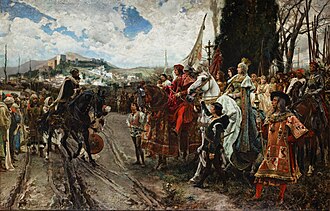
Arabic had a big effect on Spanish during the Christian Reconquista, especially when the Kingdom of Castile took over areas from Moorish rulers in the 11th, 12th, and 13th centuries. These areas had many Arabic speakers and others who spoke local dialects mixed with Arabic. This mixing added many Arabic words to Spanish. Spanish now often has two words for the same thing, one from Arabic and one from Latin, like aceituna and oliva (olive) or alacrán and escorpión (scorpion).
The Arabic influence is stronger in the southern parts of Spain where Moorish rule lasted longer. Northern dialects often use Romance words instead of Arabic ones. Because of this, words from Arabic are common in most varieties of Modern Spanish, including in the Canary Islands and all Hispanic American dialects. Some more recent words came from Moroccan Arabic and Hassaniya Arabic.
Lexical influence
The Spanish language has many words that came from Arabic, especially from the time when Muslims ruled parts of Spain. Experts think there are about one thousand Arabic roots and around three thousand words that come from these roots. This means about four thousand words, or 8% of the Spanish dictionary, have Arabic origins.
Many of these words are still used today in everyday Spanish. Most of these words are nouns, but there are also some verbs and adjectives that come from them. For example, the word alquilar (to rent) comes from the Arabic word for rent, alquiler. Arabic words often start with a- or al-, like the word hasta (until), which comes from the Arabic article al.
List of words of Arabic origin
This list shows Spanish words that came directly from Classical and Andalusi Arabic. It includes the Spanish meaning and the Arabic origin of each word. The list is not complete, and many words are only used in certain parts of Spain or are no longer common.
The list includes words like ababol (poppy) from Andalusian Arabic, aceituna (olive) from Arabic, and almohada (pillow) from Arabic. Many of these words are still part of Spanish today, though some are only used in specific regions.
The influence of Arabic on Spanish is seen in many everyday words, showing the rich history of language mixing in Spain.
| Prefix | Examples in Spanish | Examples in Arabic |
|---|---|---|
| A- | Aceite (oil) Aceituna (olive) Azúcar (sugar) | (az-zait) الزيت (az-zay-toon) الزيتون (as-suk-kar) السكر |
| Al- | Almohada (pillow) Algodón (cotton) Albahaca (Basil) | (al-ma-khad-dah) المخده (al-qut-tun) القطن (al-hab-baq) الحبق |
Other influences
Hypothesis of the Verb–subject–object (VSO) sentence structure
Spanish sentences can often switch the order of words. Some experts think this happened because of old Arabic influence. Studies show that older Spanish writing sometimes used this switched order, but later writing did not. Spanish allows more word order changes than Italian or French.
The suffix í
Arabic added a special ending to Spanish words. This ending, -í, helps create new words that show where something or someone is from. Examples include marbellí and andalusí.
Expressions
Some common Spanish sayings come from Arabic. For example, "¡Ole!" might come from wa'llah, and ojalá comes from law sha'a Allah. Other phrases like si Dios quiere may also have Arabic roots.
Idafa
An old way of building words used in Arab-influenced Spanish dialects still shows up in place names across Spain, like Ciudalcampo and Guadalmar.
Main article: Verb–subject–object
| Suffix | Examples | Examples in Arabic |
|---|---|---|
| -i | pakistaní iraní (Iranian) marroquí (Moroccan) | باكستاني إيراني مغربي |
Toponyms (place names) in Spain of Arabic origin
Many place names in Spain come from Arabic. This is because Spain was ruled by Muslim leaders for many years. You can find these names in cities, towns, mountains, rivers, and even streets. Some areas, like Galicia and parts of Asturias, Cantabria, and Basque country, don’t have many Arabic names because they were not ruled by Muslims for long.
Some well-known places with Arabic names include Alcalá de Henares, which means “fortress by the river,” and Almería, which means “watchtower.” Andalucía itself comes from the Arabic name for Muslim Iberia, Al Andalus. Other examples are Gibraltar, meaning “Mountain of Tariq,” and Granada, meaning “Hill of pilgrims.”
Major towns, cities and regions
- Albarracín
- Alcalá de Henares
- Alcántara (several places)
- Alcarria
- Axarquía
- Andalucía
- Albacete
- Algarve
- Algeciras
- Almería
- Alpujarras
- Calatayud
- Gibraltar
- Granada
- Guadalajara
- Jaén
- Medina-Sidonia
- Tarifa
- La Sagra
- Úbeda
- Sanlúcar de Barrameda
Geographical features
Given names and surnames
Almudena and Fátima are common Spanish names that come from places important in religious history, showing the influence of Arabic culture. Guadalupe, a name found all over the Spanish-speaking world, especially in Mexico, also has this background.
Some names from Arabic have become popular in Spain. This happened as Spain became more open to names from other cultures, especially after a time when non-Catholic names were not allowed. Names like Omar and Soraya have been used in Spain for many years. Zaida is another name used in Spain, possibly because of Zaida of Seville, who was linked to Alfonso VI of Castile in the 11th century. Many streets in Spain are named after her. Zahira and Zaira are also popular girls’ names that come from Arabic.
Some Spanish surnames have indirect links to Arabic, like Medina or Almunia, but they usually refer to places or jobs rather than Arabic origins. During the 15th and 16th centuries, people who were not Christian had to change their names, so few Spanish surnames clearly show Arabic roots today. One rare example is "Benjumea" or "Benjumeda", which shows descent from noble Arabic families. Very few people in Spain have this name today. Another less common surname with Arabic roots is "Muley", found in parts of southern Spain, and kept because of its noble history.
Related articles




This article is a child-friendly adaptation of the Wikipedia article on Influence of Arabic on Spanish, available under CC BY-SA 4.0.
Images from Wikimedia Commons. Tap any image to view credits and license.