 Safekipedia
Ionosphere
Adapted from Wikipedia · Discoverer experience
The ionosphere is a special part of Earth's upper atmosphere that stretches from about 48 kilometers (30 miles) to 965 kilometers (600 miles) above sea level. This area includes the thermosphere and parts of the mesosphere and exosphere. The ionosphere gets charged with electricity because of energy from the Sun, a process we call ionization.
This layer is very important for our planet. It helps control electrical activity in the atmosphere and forms the inner part of Earth's magnetic shield, called the magnetosphere. One of the most useful jobs of the ionosphere is that it helps radio waves travel far distances across the Earth. It also affects GPS signals, bending their paths slightly and causing small delays in when they reach us.
History of discovery
In 1839, a scientist named Carl Friedrich Gauss suggested that a special layer in Earth’s upper atmosphere could explain changes in Earth’s magnetic field. Later, in 1901, Guglielmo Marconi sent the first radio signal across the Atlantic Ocean to St. John's, Newfoundland, now part of Canada. This helped scientists understand how radio waves travel through the air.
More discoveries followed. In 1902, two scientists proposed the idea of a layer in the sky that helps radio waves bend around Earth. Over the years, many experiments and satellites, like Alouette 1 from Canada, helped learn more about this important part of our atmosphere, called the ionosphere.
Geophysics
The ionosphere is a layer of charged particles surrounding Earth. It stretches from about 50 km (30 mi) to over 1,000 km (600 mi) above us. This layer is created when sunlight, especially ultraviolet radiation, breaks apart atoms and molecules in the air, giving them an electric charge.
Scientists discovered that radio waves could travel long distances by bouncing off this charged layer. They found that the ionosphere has different layers, with the "E layer" about 80 to 90 km up, and a higher "F layer." These layers change with the amount of sunlight and the position of the Sun in the sky. The ionosphere is very important for letting radio signals travel around the world.
Layers of ionization
At night, only the F layer has a lot of ionization, while the E and D layers have very little. During the day, the D and E layers become much more ionized, and the F layer gets an extra, weaker part called the F1 layer. The F2 layer stays all day and night and is the main place where radio waves bend and reflect.
The D layer is the innermost layer, about 60 to 90 km above Earth. It has a lot of free electrons, which can block low-frequency radio waves. The E layer is in the middle, about 105 to 160 km up, and it can bend and reflect radio waves. The F layer is the top layer, starting around 160 km up and going much higher. It has the most free electrons and is very important for radio communication.
Main article: Kennelly–Heaviside layer
D layer
The D layer is the innermost layer, 60 to 90 km above the Earth with an electron density of 102 to 104 per cm3. Ionization here is due to Lyman series-alpha hydrogen radiation at a wavelength of 121.6 nanometre (nm) ionizing nitric oxide (NO). In addition, solar flares can generate hard X-rays.
Low frequency radio waves are weakened by the D layer, as they cause free electrons to vibrate, losing their energy. This stops low frequency radio signals from reaching the upper atmosphere, except when the D layer is not present, such as at night. Ionospheric absorption makes signals below 50 MHz weaker during busy sunspot cycles.
During solar proton events, ionization can become very strong in the D-layer over high and polar areas.
E layer
Air density is lower in the E and F layers, causing fewer electron collisions. Radio signals going upward meet more electrons, bending them back toward Earth. The amount of bending depends on the angle and frequency of the signal. Higher frequency signals may pass through the D layer but get bent back by the E layer, or even higher layers.
The E layer is the middle layer, 105 to 160 km above the Earth with an electron density several times 105 per cm3. Ionization is caused by ultraviolet (UV) solar radiation and X-rays from solar flares. The lowest ionization happens just before sunrise, increasing to a peak at noon.
This region is also called the Kennelly–Heaviside layer or the Heaviside layer. It was predicted in 1902 by the American engineer Arthur Edwin Kennelly and the British physicist Oliver Heaviside. In 1924, it was detected by Edward V. Appleton and Miles Barnett.
Es layer
The Es layer has more electrons than normal in the E layer, allowing it to reflect radio waves up to 100 MHz. These events can last from a few minutes to many hours and can be up to 2 km thick and hundreds of km long. They are common during the day near the equator and more often happen in summer at mid-latitudes.
Sporadic E propagation makes VHF communication very exciting for radio amateurs when long-distance paths open up for two-way communication.
F layer
Main article: F region
The F layer includes the F1 from 160 km to 180 km with an electron density several times 105 to 106 per cm3, due to extreme ultraviolet (UV, 20–900 nm) radiation ionizing atomic oxygen. The F1 layer merges into the F2 layer at night or during winter months at solar maximum. The F2 layer extends from 200 km to over 800 km. Peak electron density happens at 300 km during the day, several times 106 per cm3. Above 700 km, ionized hydrogen is more common than ionized oxygen.
From 1972 to 1975 NASA launched the AEROS and AEROS B satellites to study the F region.
Ionospheric model
An ionospheric model is a way to describe the ionosphere using math. It looks at where you are, how high you are, what time of year it is, and how active the sun is. The model uses four main things to describe the ionosphere: how many tiny particles called electrons are there, how hot the electrons and ions are, and what kinds of ions are present.
These models are usually made as computer programs. They can be based on the basic science of how ions and electrons act with the air and sunlight. Or, they can use lots of observations to make a statistical description. One popular model is the International Reference Ionosphere (IRI). This model is updated every year and helps us understand how the ionosphere changes. It is especially good at showing how the number of electrons changes from the bottom of the ionosphere up to where there are the most electrons.
Persistent anomalies to the idealized model
Special tools called ionograms help us understand the true shape of the layers in the ionosphere. Sometimes, the structure of tiny charged particles looks rough in these tools, especially at night, in places far from the equator, and during busy space weather.
Winter anomaly
In places around the middle of the Earth, we might expect more charged particles in the ionosphere during summer because the Sun shines more directly. But because of changes in the air around us, the loss of these particles happens even faster in summer. This means that, surprisingly, there are actually fewer charged particles in the summer months than in winter. This surprising pattern is called the winter anomaly. It always happens in the northern part of the Earth but is usually not seen in the southern part when the Sun is less active.
Equatorial anomaly
Close to the Earth’s magnetic equator, within about ± 20 degrees, there is a special pattern called the equatorial anomaly. In this area, there is less ionization directly at the equator but more ionization about 17 degrees away from it in either direction. The Earth’s magnetic field is flat at the magnetic equator. Heat from the Sun and movements in the lower ionosphere push charged particles upward and sideways along these magnetic field lines. This creates a thin layer of electric current in a lower part of the ionosphere, which, together with the flat magnetic field, pushes ionization higher up, focusing it about ± 20 degrees from the magnetic equator. This movement is known as the equatorial fountain.
Equatorial electrojet
All around the world, winds driven by the Sun create a current system in the lower part of the ionosphere. This results in an electric field that goes from west to east during the day near the equator. At the exact magnetic equator, where the magnetic field is flat, this electric field causes an extra strong current to flow eastwards within about ± 3 degrees of the magnetic equator, known as the equatorial electrojet.
Ephemeral ionospheric perturbations
X-rays: sudden ionospheric disturbances (SID)
Main article: Sudden ionospheric disturbance
When the Sun is very active, powerful solar flares can send strong X-rays to Earth. These X-rays reach the lower part of the ionosphere and release particles that can block some radio signals for many hours. During this time, certain low-frequency radio waves will bounce off a different layer of the atmosphere instead of their usual one. Once the X-rays stop, the ionosphere slowly returns to normal.
Protons: polar cap absorption (PCA)
Further information: Solar particle event § Polar cap absorption events
Solar flares can also release high-energy particles called protons. These protons can reach Earth within minutes to a couple of hours and affect the atmosphere near the magnetic poles, increasing ionization in certain layers. These effects can last from an hour to several days, usually around a day and a half. Coronal mass ejections can also release protons that affect the polar regions.
Storms
Main articles: Geomagnetic storm and Ionospheric storm
Geomagnetic storms and ionospheric storms are strong, temporary disturbances in Earth's magnetosphere and ionosphere.
During a geomagnetic storm, a layer of the ionosphere can become unstable, break apart, or even vanish. In the northern and southern parts of Earth, aurorae can be seen in the night sky.
Lightning
Further information: Lightning
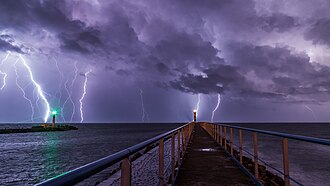
Lightning can affect the ionosphere in two ways. One way is through very low frequency radio waves that can cause more particles to enter the ionosphere. Another way is through the direct energy from lightning strikes, which can also add ionization. Scientists have studied how lightning can enhance certain layers of the ionosphere.
Applications
Radio communication
The ionosphere can bend radio waves back to Earth, allowing communication over long distances. This happens because the ionosphere contains charged particles that interact with radio waves. By sending radio waves into the sky at an angle, they can curve back to Earth beyond what we can normally see, a process called "skip" or "skywave" propagation. This method has been used since the 1920s for international communication, like telephone and telegraph services across oceans. Though it can be unreliable due to changes in time of day, seasons, and solar activity, it is still useful for areas where satellites are not available. Hobbyists and emergency services also use it, as well as armed forces and stock traders who need quick, independent communication.
Mechanism of refraction
When radio waves reach the ionosphere, the electric field in the wave makes electrons vibrate at the same frequency. These vibrating electrons can either lose energy or re-radiate the wave. The bending of the wave depends on the electron density and the wave's frequency. If the wave's frequency is too high, the electrons cannot respond quickly enough, and the wave passes through instead of bending back.
GPS/GNSS ionospheric correction
The ionosphere can affect GPS signals, so models are used to correct for these effects. The Klobuchar model is used for GPS, developed by John Klobuchar in the 1970s. The Galileo system uses the NeQuick model, which receives coefficients from the system to adjust for ionization levels and calculate delays in the signals.
Other applications
Researchers are studying electrodynamic tethers, which use the ionosphere and Earth's magnetic field to generate energy through electromagnetic induction. These tethers use plasma contactors and the ionosphere as part of a circuit.
Measurements
Scientists study the ionosphere in many ways. They watch light and radio waves from the ionosphere, send radio waves to bounce off it, and use special radars like EISCAT, Millstone Hill, and Jicamarca. These tools help them learn about the ionosphere's behavior.
Experiments such as HAARP (High Frequency Active Auroral Research Program) use strong radio transmitters to change the ionosphere's properties. This helps scientists understand how to improve communications and surveillance systems. The SuperDARN radar project studies areas near the poles using radio waves. Scientists also look at how radio waves from satellites and stars change when they pass through the ionosphere. The Arecibo Telescope in Puerto Rico was built to study Earth's ionosphere.
Indices of the ionosphere
In models that study the ionosphere, scientists use special numbers to understand how the ionosphere is behaving.
Solar intensity
Two important numbers, F10.7 and R12, help scientists learn about the Sun. F10.7 measures the Sun’s radio waves using a ground radio telescope. R12 looks at the average number of dark spots on the Sun, called sunspot numbers, over 12 months. These numbers have been collected for many years.
Geomagnetic disturbances
Scientists also watch Earth’s magnetic field to see how it moves. The A and K-indices measure this movement. The K-index uses numbers from 0 to 9 to show how strong the changes are. These measurements come from places like the Boulder Geomagnetic Observatory. The Earth’s magnetic field is measured in units called teslas or gauss. Special numbers, like the Ap-index, help show the overall activity of Earth’s magnetic field.
Ionospheres of other planets and natural satellites
Many objects in our Solar System, like the big planets and some larger moons, have atmospheres that create ionospheres. Planets with known ionospheres include Venus, Mars, Jupiter, Saturn, Uranus, and Neptune.
The moon Titan, which orbits Saturn, has an ionosphere that stretches from about 880 to 1,300 kilometers above its surface and contains carbon compounds. We have also found ionospheres on moons like Io, Europa, Ganymede, Triton, and even Pluto.
Images
Related articles




This article is a child-friendly adaptation of the Wikipedia article on Ionosphere, available under CC BY-SA 4.0.
Images from Wikimedia Commons. Tap any image to view credits and license.