
Iñupiat
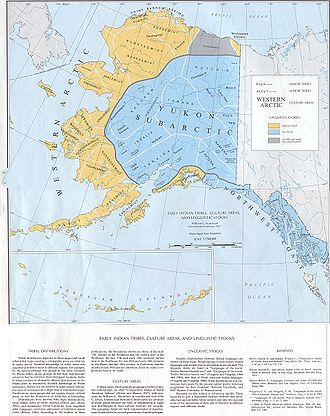
The Inupiat (singular: Iñupiaq), also known as Alaskan Inuit, are a group of Alaska Natives. Their traditional territory stretches from northeast Norton Sound on the Bering Sea to the northernmost part of the Canada–United States border. Today, they live in 34 villages across Iñupiat Nunaat (Iñupiaq lands).
These communities include seven Alaskan villages in the North Slope Borough, eleven villages in Northwest Arctic Borough, and sixteen villages linked with the Bering Straits Regional Corporation. Many Inupiat people consider themselves the first inhabitants of the Kauwerak region. Their culture and traditions remain strong and important today.
Name
The Inupiat is the plural name for this group of people, while Iñupiaq is the singular form and can also refer to their language. In English, both words are used to describe things related to this group, like an Inupiat librarian or Inupiat songs. Their language is called Iñupiatun. The word comes from two roots meaning "real people".
Groups
Ethnic groups
The Inupiat are made up of several communities including the Bering Strait Inupiat, South Seward Peninsula Inupiat, Nunamiut, Northwest Arctic Inupiat, and North Alaska Coast Iñupiat. These groups have their own unique traditions and ways of life, but they all share a common heritage.
Regional corporations
In 1971, a law called the Alaskan Native Claims Settlement Act created thirteen groups to help Native Alaskans. These groups offer services to their members, who are like shareholders. Three of these groups are in the lands of the Iñupiat:
Tribal governments
Before colonization, the Iñupiat had their own ways of governing themselves through complex social structures. Even after Alaska became part of the United States, the Iñupiat continued to express their sovereignty in different ways. Federal Indian Law acknowledges a limited form of self-determination for tribal governments. In 1993, the federal government officially recognized Alaskan Native tribes.
Tribal governments help manage programs that benefit Native communities. They provide services such as education, housing, and support for healthy families and cultural connections. There are many regional and village tribal governments across Iñupiat lands, each with their own structures and services.
The following Alaska Native tribal entities for the Iñupiat are recognized by the United States Bureau of Indian Affairs:
| Community | Native tribal entities | Native village corporation | Native regional corporation |
|---|---|---|---|
| Alatna (Alaasuq) | Alatna Village | None | Doyon, Limited |
| Ambler (Ivisaappaat) | Native Village of Ambler | None | NANA Corporation |
| Anaktuvuk Pass (Anaqtuuvak/Naqsraq) | Village of Anaktuvuk Pass | Nunamiut Corporation | Arctic Slope Regional Corporation |
| Atqasuk (Atqasuk) | Native Village of Atqasuk | Atqasuk Corporation | Arctic Slope Regional Corporation |
| Brevig Mission (Sitaisaq/Sinauraq) | Native Village of Brevig Mission | None | Bering Straits Native Corporation |
| Buckland (Nunatchiaq/Kaŋiq) | Native Village of Buckland | None | NANA Corporation |
| Council (Akauchak/Kaułiq) | Native Village of Council | None | Bering Straits Native Corporation |
| Deering (Ipnatchiaq) | Native Village of Deering | None | NANA Corporation |
| Diomede (Iŋaliq) | Native Village of Diomede | None | Bering Straits Native Corporation |
| Elim (Nivviaqhchauġluq) | Native Village of Elim | None | Bering Straits Native Corporation |
| Golovin (Siŋik/Chiŋik) | Chinik Eskimo Community | None | Bering Straits Native Corporation |
| Kaktovik (Qaaktuġvik) | Kaktovik Village | Kaktovik Inupiat Corporation | Arctic Slope Regional Corporation |
| Kiana (Katyaaq) | Native Village of Kiana | None | NANA Corporation |
| King Island (Ugiuvak) | King Island Native Community | King Island Native Corporation | Bering Straits Regional Corporation |
| Kivalina (Kivalliñiq) | Native Village of Kivalina | None | NANA Corporation |
| Kobuk (Laugviik) | Native Village of Kobuk | None | NANA Corporation |
| Kotzebue (Qikiqtaġruk) | Native Village of Kotzebue | Kikiktagruk Corporation | NANA Corporation |
| Koyuk (Kuuyuk) | Native Village of Koyuk | None | Bering Straits Native Corporation |
| Mary's Igloo (Qawiaraq/Iglu) | Native Village of Mary's Igloo | None | Bering Straits Native Corporation |
| Noatak (Nuataaq) | Native Village of Noatak | None | NANA Corporation |
| Nome (Sitnasuaq) | Nome Eskimo Community | Sitnasuak Corporation | Bering Straits Native Corporation |
| Noorvik (Nuurvik) | Noorvik Native Community | None | NANA Corporation |
| Nuiqsut (Nuiqsat) | Native Village of Nuiqsut | Kuukpik | Arctic Slope Native Corporation |
| Point Hope (Tikiġaq) | Native Village of Point Hope | Tikiġaq Corporation | Arctic Slope Regional Corporation |
| Point Lay (Kali) | Native Village of Point Lay | Cully Corporation | Arctic Slope Regional Corporation |
| Selawik (Akuliġaq/Siiḷivik) | Native Village of Selawik | None | NANA Corporation |
| Shaktoolik (Saqtuliq) | Native Village of Shaktoolik | None | Bering Straits Native Corporation |
| Shishmaref (Qigiqtaq) | Native Village of Shishmaref | Shismaref Native Corporation | Bering Straits Native Corporation |
| Shungnak (Isiŋnaq) | Native Village of Shungnak | None | NANA Corporation |
| Solomon (Aaŋuutaq) | Village of Solomon | None | Bering Straits Native Corporation |
| Teller (Tala/Iġaluŋniaġvik) | Native Village of Teller | Teller Native Corporation | Bering Straits Native Corporation |
| Unalakleet (Uŋalaqłiq) | Native Village of Unalakleet | Unalakleet Native Corporation | Bering Straits Regional Corporation |
| Utqiaġvik | Native Village of Barrow Inupiat Traditional Government | Ukpeagvik Corporation | Arctic Slope Regional Corporation |
| Wainwright (Ulġuniq) | Village of Wainwright | Olgoonik Corporation | Arctic Slope Regional Corporation |
| Wales (Kiŋigin) | Native Village of Wales | None | Bering Straits Regional Corporation |
| White Mountain (Nachizrvik) | Native Village of White Mountain | None | Bering Straits Native Corporation |
Languages
The Inuit people and their language stretch across the northern parts of Alaska, Canada, and Greenland. In Northern Alaska, their language is called Iñupiatun. It has four main dialects: North Slope, Malimiut, Bering Straits, and Qawiaraq.
In the past, many Iñupiat were not allowed to speak their language in schools, which made it harder to keep the language alive. Today, there are efforts to teach and learn Iñupiatun again. Schools like Nikaitchuat Iḷisaġviat in Kotzebue and June Nelson Elementary school focus on teaching the Iñupiaq language and culture. Universities in Alaska, such as the University of Alaska Fairbanks and the University of Alaska Anchorage, also offer courses in the Iñupiaq language.
Since 2017, groups of Iñupiaq language learners have held events called Iḷisaqativut to learn the language together. In 2014, a special Iñupiaq-English dictionary was created with help from Edna Ahgeak MacLean. There are also special writing systems made by Iñupiat people using pictures.
History
The Iñupiat are related to other Inuit groups and originated from the Thule culture. Around 300 B.C., the Thule people moved from islands in the Bering Sea to what is now Alaska.
Some Iñupiaq groups, like the Nunamiut, are named with a word meaning "a people of." During tough times with little food and a sickness called influenza, many of these people moved to the coast or other places in Alaska between 1890 and 1910. Some returned to the mountains later. By 1950, many Nunamiut groups lived in a village called Anaktuvuk Pass in north-central Alaska. Some still moved around until the 1950s.
The paths used today in the Iditarod race were originally trails made by the Dena'ina, Deg Hit'an Athabaskan American Indians, and the Inupiat.
Subsistence
The Iñupiat are hunter-gatherers, like many Arctic peoples. They still rely a lot on hunting and fishing for their food. Depending on where they live, they hunt animals like walrus, seal, whale, polar bears, caribou, and fish. Both people living inland and near the coast depend heavily on fish. Throughout the year, they also eat ducks, geese, rabbits, berries, roots, and shoots when these are available.
Inland Iñupiat hunt caribou, Dall sheep, grizzly bear, and moose. Coastal Iñupiat hunt walrus, seals, beluga whales, and bowhead whales. They also hunt polar bears, but carefully.
When a whale is caught, it benefits everyone in the Iñupiat community. The whale's meat and blubber are shared according to traditional rules, even with relatives living far away. Maktak, the skin and blubber of whales, is rich in important vitamins. Because cooking destroys some vitamins in meat, eating raw foods helps keep them healthy, especially since they don't always have easy access to fruits and vegetables.
A big part of Iñupiat culture is using every part of the animals they hunt. They use hides to make clothing, such as parkas and boots, and fur from animals like rabbits to keep warm. They also collect qiviut, the soft underfur of muskox, to spin into wool for scarves and hats. Animal parts are also used to make tools and art, like walrus ivory and whale baleen.
Since the 1970s, oil and other resources have become important for the Iñupiat people's economy. The Alaska Pipeline connects oil wells at Prudhoe Bay to the port of Valdez. However, oil drilling has created challenges for their traditional way of life, especially whaling.
The Iñupiat also enjoy eating berries. They mix berries with tallow to make a traditional dessert and also make a syrup by boiling berries with rosehips and highbush cranberries.
Culture
The Iñupiat have a rich culture with traditions that have lasted thousands of years. One important celebration is the Nalukataq festival, which happens in the spring. This festival honors the whales that provide food for whole villages, with dances and songs performed by groups from all over the North.
The Iñupiat have a set of values called the Iñupiat Ilitqusiat, created by elders in Kotzebue, Alaska. These values guide how they live and include respect for elders, hard work, caring for family, and sharing with others. There is a special college called Iḷisaġvik College in Utqiaġvik that teaches about Iñupiaq culture.
Current issues
The Iñupiat people are facing big changes because of climate change. The warming Arctic is making it harder for them to live as they have for generations. Thinner sea ice makes it difficult to hunt important animals like bowhead whales, seals, and walrus. Warmer winters bring more storms, making travel riskier. Coastal villages are also at risk from flooding and erosion because the ice that usually protects them is forming later.
Health challenges have also grown. Diseases like diabetes and heart disease, which were not common before, are now affecting many Iñupiat. Many people are also dealing with health issues related to weight. According to the 2000 U.S. Census, there are more than 19,000 Iñupiat people in the United States, most of whom live in Alaska.
Iñupiat Nunaŋat (Iñupiat territories)
The North Slope Borough includes cities like Anaktuvuk Pass, Atqasuk, Utqiaġvik, Kaktovik, Nuiqsut, Point Hope, Point Lay, and Wainwright.
The Northwest Arctic Borough has cities such as Ambler, Buckland, Deering, Kiana, Kivalina, Kobuk, Kotzebue, Noatak, Noorvik, Selawik, and Shungnak.
The Nome Census Area includes cities like Brevig Mission, Diomede, Golovin, Koyuk, Nome, Shaktoolik, Shishmaref, Teller, Wales, White Mountain, and Unalakleet.
Notable Inupiat
Further information: List of American Inuit
The Inupiat people have produced many well-known individuals across various fields. Eddie Ahyakak is a marathon runner and mountaineer who appeared on the show Ultimate Survival Alaska. John Baker is a famous dog musher, pilot, and speaker. Irene Bedard is an actress, and Ada Blackjack famously survived two years alone on Wrangel Island north of Siberia. Other notable Inupiat include athletes, artists, writers, and leaders who have made significant contributions to their communities and beyond.
Pictures
Keep exploring



This article is a child-friendly adaptation of the Wikipedia article on Iñupiat, available under CC BY-SA 4.0.
Images from Wikimedia Commons. Tap any image to view credits and license.