 Safekipedia
King of the Romans
Adapted from Wikipedia · Discoverer experience
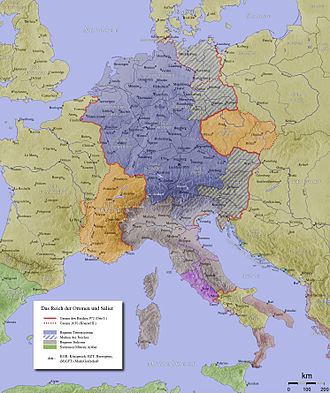
The title King of the Romans was used in the Holy Roman Empire. It started with the king of East Francia after he was chosen by special leaders called princes. This began during the time of Henry II, who ruled from 1002 to 1024.
At first, this title described a German king who had been chosen but not yet officially made Holy Roman Emperor by the Pope. It was also used for someone picked to be the next ruler while the current emperor was still alive. Later, from the 16th century on, German kings began calling themselves Emperor-elect and did not need the Pope’s ceremony anymore. After that, the title King of the Romans was only for the chosen successor while the current emperor was still ruling.
The exact name of this title changed over time. In the early days, it was called King of the Franks. Later, it became King of the Romans, and in more recent times, King in Germania. Today, we often call this role the Roman-German King, to make it clear it’s different from the old Roman emperors and the later German emperors.
Ruling kings
Main article: History of Germany
Further information: Frankish Empire and Germanic peoples
The area of East Francia was not called the Kingdom of Germany until the 1000s. During this time, the king’s right to become emperor was often questioned by the papacy. After the young Henry IV became king in 1056, he used the title “King of the Romans” to show his right to become emperor. Some leaders, like Pope Gregory VII, called him only “King of the Germans” to suggest his power was limited. Henry and later kings kept using “King of the Romans” until they became emperors.
Over time, the kings were chosen from leaders of smaller areas. To be a king, a person needed to be an adult male, a Catholic Christian, and not a priest. The kings were chosen by important leaders, often in the city of Frankfurt. Later, only seven special leaders, called prince-electors, had the right to choose the king. After being chosen, a new king would be crowned as “King of the Romans” in Aachen Cathedral. Some kings later traveled to Rome to be crowned emperor by the pope, but this did not always happen right away. The title “King of the Romans” showed that the king had the right to become emperor in the future.
The title “King of the Romans” was used until around 1508. After that, rulers called themselves “elected Emperor of the Romans” instead. Starting with Ferdinand I, Holy Roman Emperor, rulers called themselves emperors right after being crowned in Germany, without waiting for the pope’s approval.
Heirs designate
The Holy Roman Empire was an elective monarchy. This means that no one automatically became the next ruler just because they were related to the current Emperor. However, the Emperor often had a relative, usually a son, chosen to be the next ruler before he died. This chosen person was called the "King of the Romans".
During the Middle Ages, a younger King of the Romans was usually only chosen when the main ruler was already an Emperor. This was to prevent having two kings who were considered equal. There was only one time (1147–1150) when there was both a ruling King of the Romans, King Conrad III, and a King of the Romans who was the heir, Henry Berengar. Later, from the 16th century on, the rulers took the title "Emperor elect" without being crowned by the Pope. After that, the title "King of the Romans" was used only for the person chosen to be the next ruler while the current ruler was still alive.
King of Rome
When Napoleon I, Emperor of the French, had a son and heir, Napoleon II (1811–32), he gave his son the title King of Rome (Roi de Rome) when he was born. People often called the boy by this title. However, starting in 1818, he was officially called the Duke of Reichstadt by his grandfather, Emperor Francis I of Austria, who had been the last Holy Roman Emperor before 1806.
List
Further information: List of German monarchs and List of Holy Roman Emperors
The list below shows all the people who held the title "King of the Romans." The dates shown are from when they were elected as King of the Romans until they became Emperor or their time as king ended. Some kings are shown in yellow because they actually ruled. Others are shown in pink because they did not get enough support to be the true king. Those shown in silver were heirs waiting to become king but never did. An asterisk '*' means the king was chosen while the previous king was still alive.
| King | Kingship begins | Kingship ends | |
|---|---|---|---|
| Henry II | 1002 | 1014 | crowned Emperor |
| Conrad II | 1024 | 1027 | crowned Emperor |
| Henry III | 1028* | 1046 | crowned Emperor |
| Henry IV | 17 July 1054* | 1084 | crowned Emperor |
| Rudolf of Rheinfelden | 25 May 1077 | 15 October 1080 | killed in battle |
| Hermann of Salm | 6 August 1081 | 28 September 1088 | killed in battle |
| Conrad (III) | 30 May 1087* | 1098 | deposed |
| Henry V | 6 January 1099* | 13 April 1111 | crowned Emperor |
| Lothair III | 13 September 1125 | 4 June 1133 | crowned Emperor |
| Conrad III | 1127 | 1135 | renounced claim |
| 7 March 1138 | 15 February 1152 | died | |
| Henry Berengar | 30 March 1147 | 1150 | died |
| Frederick I Barbarossa | 4 March 1152 | 18 June 1155 | crowned Emperor |
| Henry VI | 15 August 1169* | 15 April 1191 | crowned Emperor |
| Frederick II | 1196* | 28 September 1197 | claim ignored; crowned Emperor |
| Philip of Swabia | 8 March 1198 | 21 June 1208 | murdered |
| Otto IV | 9 June 1198 | 21 October 1209 | crowned Emperor |
| Frederick II | 5 December 1212 | 22 November 1220 | crowned Emperor |
| Henry (VII) | April 1220* | 2 July 1235 | deposed |
| Conrad IV | February 1237* | 21 May 1254 | died |
| Henry Raspe | 22 May 1246 | 16 February 1247 | died |
| William of Holland | 3 October 1247 | 28 January 1256 | died |
| Richard of Cornwall | 13 January 1257 | 2 April 1272 | died |
| Alfonso X of Castile | 1 April 1257 | 1275 | renounced claim |
| Rudolf I | 29 September 1273 | 15 July 1291 | died |
| Adolph of Nassau | 5 May 1292 | 2 July 1298 | killed in battle |
| Albert I | 24 June 1298 | 1 May 1308 | murdered |
| Henry VII | 27 November 1308 | 29 June 1312 | crowned Emperor |
| Louis IV | 20 October 1314 | 17 January 1328 | crowned Emperor |
| Frederick the Fair | 19 October 1314 | 28 September 1322 | captured |
| 5 September 1325 | 3 January 1330 | died | |
| Charles IV | 11 July 1346 | 5 April 1355 | crowned Emperor |
| Günther von Schwarzburg | 30 January 1349 | 24 May 1349 | died |
| Wenceslaus | 10 June 1376* | 20 August 1400 | deposed |
| Rupert of the Palatinate | 21 August 1400 | 18 May 1410 | died |
| Sigismund | 10 September 1410 21 July 1411 | 3 May 1433 | crowned Emperor |
| Jobst of Moravia | 1 October 1410 | 8 January 1411 | died |
| Albert II | 18 March 1438 | 27 October 1439 | died |
| Frederick III | 2 February 1440 | 16 March 1452 | crowned Emperor |
| Maximilian I | 16 February 1486* | 4 February 1508 | assumed title of Emperor elect |
| Ferdinand I | 5 January 1531* | 27 August 1556 | succeeded as Emperor elect |
| Maximilian II | 28 November 1562* | 25 July 1564 | succeeded as Emperor elect |
| Rudolph II | 27 October 1575* | 12 October 1576 | succeeded as Emperor elect |
| Ferdinand III | 22 December 1636* | 15 February 1637 | succeeded as Emperor elect |
| Ferdinand IV | 31 May 1653 | 9 July 1654 | died |
| Joseph I | 23 January 1690 | 5 May 1705 | succeeded as Emperor elect |
| Joseph II | 27 March 1764 | 18 August 1765 | succeeded as Emperor elect |
Images
Related articles



This article is a child-friendly adaptation of the Wikipedia article on King of the Romans, available under CC BY-SA 4.0.
Images from Wikimedia Commons. Tap any image to view credits and license.