
List of minor-planet groups
A minor-planet group is a collection of minor planets that move around the Sun in paths that look quite similar. These objects usually aren’t connected to each other, unlike members of an asteroid family, which often come from one big asteroid that broke apart. When scientists find a group like this, they often give it the name of the first object they discovered in that group, which is usually the biggest one.
Groups out to the orbit of Earth
There are only a few asteroids that orbit close to the Sun. Some groups of these asteroids are still only ideas, because no actual asteroids in these groups have been found yet.
- Vulcanoid asteroids are thought to orbit closer to the Sun than the planet Mercury, but none have been found so far.
- ꞌAylóꞌchaxnim asteroids orbit closer to the Sun than the planet Venus, and one has been found: 594913 ꞌAylóꞌchaxnim.
- Atira asteroids orbit closer to the Sun than Earth. The group is named after 163693 Atira, and there are 36 known asteroids in this group.
- Mercury-crosser asteroids have orbits that come close to Mercury.
- Venus-crosser asteroids have orbits that come close to Venus.
- Earth-crosser asteroids have orbits that come close to Earth. These include:
- Aten asteroids which orbit close to Earth and are named after 2062 Aten.
- Apollo asteroids which also orbit close to Earth and are named after 1862 Apollo.
- Arjuna asteroids have orbits similar to Earth's.
- Earth trojans are asteroids that stay near Earth and the Sun in special places called Lagrangian points. The known ones are 2010 TK7 and 2020 XL5.
- Near-Earth asteroids is a general name for asteroids that come close to Earth's orbit, including most of the groups listed above.
Groups out to the orbit of Mars
The Amor asteroids, named after 1221 Amor, are near-Earth asteroids that come close to Earth but do not cross its path. Their orbits are just outside Earth's orbit.
Mars-crosser asteroids have paths that cross Mars' orbit but may not come close to Earth. Mars trojans travel along Mars' path, staying either ahead or behind the planet at special points called Lagrangian points. As of November 2020, nine of these have been found, with the largest being 5261 Eureka. Many asteroids that cross the paths of Earth, Venus, or Mercury have their farthest points from the Sun beyond a certain distance.
The asteroid belt
Main article: Asteroid belt
Most known asteroids move between the orbits of Mars and Jupiter, at distances of about 2 to 4 AU. They are found in a region called the asteroid belt. This area is mostly empty because of Jupiter's strong gravity, which creates gaps called Kirkwood gaps.
The asteroid belt can be divided into three parts. The inner part is closest to the Sun and includes the largest asteroid, 4 Vesta. The middle part is home to Ceres, another big asteroid. The outer part includes 10 Hygiea, which is also quite large. Each part has its own group of asteroids with slightly different paths around the Sun.
Groups beyond the orbit of Jupiter
Most minor planets beyond Jupiter are thought to be made of ices and other materials that turn easily into gas. Many look like comets, but their paths around the Sun are too far to create a visible tail.
The Damocloid asteroids, also called the "Oort cloud group," are named after 5335 Damocles. These objects come from a distant area called the Oort cloud. They have very stretched-out paths and can move in unusual ways around the Sun.
The Centaurs travel between about 5.4 and 30 times the distance from the Earth to the Sun. Scientists think they were once farther out but moved closer after getting close to big planets. The first one found was 2060 Chiron.
Groups at or beyond the orbit of Neptune
The Neptune trojans are special objects that share similar paths with the planet Neptune. As of February 2020, 29 of these objects were known, with 2001 QR322 being the first discovered.
Trans-Neptunian objects (TNOs) are objects that orbit the Sun farther out than Neptune, beyond 30 AU (astronomical units). This group includes several types:
-
Kuiper-belt objects (KBOs): These stretch from about 30 AU to 50 AU and include:
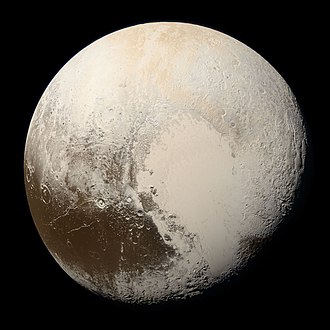
- Resonant objects: These have orbits that match up with Neptune's in certain patterns. The most common are Plutinos, like Pluto, which follow a 2:3 pattern with Neptune. Other resonances exist too, such as the 1:2 resonance called twotinos.
- Classical Kuiper-belt objects: Also called cubewanos, these objects, like Makemake, have orbits between about 40.5 AU and 47 AU and do not follow Neptune's pattern closely.
-
Scattered disc objects (SDOs): These have more tilted and stretched-out orbits, likely due to past interactions with Neptune. The largest known dwarf planet, Eris, is in this group.
-
Detached objects: These have very stretched-out orbits that keep them far from Neptune. An example is (148209) 2000 CR105.
-
Sednoids: Named after 90377 Sedna, these objects have orbits that stay very far from Neptune. Only a few have been found so far.
The Oort cloud is a theoretical group of icy objects thought to exist very far out, between about 50,000 AU and 100,000 AU. We haven't seen any Oort-cloud objects directly, but their existence is guessed based on clues. Some think 90377 Sedna might be part of the inner Oort cloud.
Pictures
Keep exploring


This article is a child-friendly adaptation of the Wikipedia article on List of minor-planet groups, available under CC BY-SA 4.0.
Images from Wikimedia Commons. Tap any image to view credits and license.