 Safekipedia
List of natural phenomena
Adapted from Wikipedia · Discoverer experience
A natural phenomenon is something we can see or experience that happens in nature, not because of humans. These events are all around us and help shape the world we live in. For example, we see beautiful things like a sunrise or hear the rumble of thunder during a storm. There are also powerful events such as tornadoes and volcanic eruptions that can change landscapes dramatically.
Natural phenomena include many different kinds of processes. Some are part of living things, like germination, where seeds grow into plants. Others are physical changes, like wave propagation in the ocean or erosion, which wears away soil and rock. These processes help create the world’s rivers, beaches, and mountains.
Understanding natural phenomena is important because they affect our daily lives. Weather decides if we need an umbrella or can play outside, while larger events like hurricanes or earthquakes can impact whole communities. Learning about these events helps us appreciate nature and stay safe.
History
Natural phenomena are events that happen because of nature, not because people made them. Throughout history, people have watched many of these events, like the weather changing or the ground shaking. These happenings are all part of the world around us.
Physical phenomena
Some amazing things happen in nature without any help from people. These include freezing, boiling, gravity, and magnetism. These are all physical phenomena, meaning they are parts of the world we can see and feel.
Crystal in VCGS furnace
Liquid hydrogen bubble chamber photograph of an anti-proton colliding with a proton
Children notice an effect of static electricity
Chemical phenomena
Chemical phenomena are things that happen in nature because of chemical changes. One example is oxidation, which includes processes like fire and rusting. These are important ways that materials change over time in the natural world.
Biological phenomena
Biological phenomena are natural events that happen in living things. Some examples include metabolism, which is how our bodies get and use energy. This includes processes like catabolism (breaking down substances) and anabolism (building up substances). Another process is decomposition, where organic materials break down into simpler forms. Fermentation is when sugar changes into acids, gases, or alcohol.
Other biological phenomena include growth, birth, and death, as well as times when populations of living things decrease.
Gallery
Astronomical phenomena
Astronomical phenomena are amazing events that happen in space. Some examples include supernovas, which are huge explosions of stars, gamma ray bursts that send out powerful energy, quasars that are very bright objects, blazars that spin and shine brightly, pulsars which are fast-spinning stars, and the cosmic microwave background radiation, the leftover heat from the beginning of the universe.
These events help scientists learn more about the universe and how it works.
Geological phenomena
See also: List of geological phenomena
Geological phenomena are natural events that shape the Earth. They include processes that happen deep inside the Earth, like the movement of plates that cause earthquakes, and processes that happen on the surface, like erosion and glaciation.
Some geological phenomena are linked to volcanic activity, such as geysers and hot springs. Others include the formation of different types of rocks, like igneous rock, sedimentary rock, and metamorphic rock. These processes help create the landscape we see today.
Meteorological phenomena
See also: Atmospheric phenomenon, Glossary of meteorology, and List of severe weather phenomena
Weather events that happen in the air are called atmospheric phenomena. Big, powerful weather events are called storms. Some weather patterns happen regularly, like the seasons and the way air moves around the world, called atmospheric circulation. Climate change also follows patterns, though they may not always be exact.
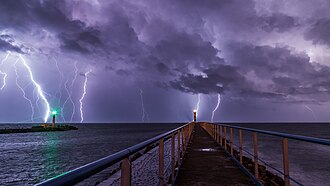
Some special weather events include lightning, tornadoes, and big waves in the ocean called tsunamis. The ocean also has currents and waves that break on the shore.
Atmospheric optical phenomena
Oceanographic
Oceanographic phenomena include tsunamis, ocean currents and breaking waves.
Gallery
Images
Related articles




This article is a child-friendly adaptation of the Wikipedia article on List of natural phenomena, available under CC BY-SA 4.0.
Images from Wikimedia Commons. Tap any image to view credits and license.