 Safekipedia
Littoral Banovina
Adapted from Wikipedia · Discoverer experience
The Littoral Banovina was a province of the Kingdom of Yugoslavia from 1929 to 1939. It covered much of the Croatian area known as Dalmatia, along with some parts of what is now Bosnia and Herzegovina. The name "Littoral Banovina" comes from its location near the coast, as "littoral" means related to the sea.
The main city and capital of this province was Split, a well-known and important place along the Adriatic coast. During this time, the area was organized as one of the banovinas, or provinces, of the Kingdom of Yugoslavia, which was a way the country was divided into different regions for government purposes.
Borders
According to the 1931 Constitution of the Kingdom of Yugoslavia, the Littoral Banovina had specific borders. To the north, it was bounded by the areas of the Sava and Vrbas Banovinas up to a point near the towns of Jajce, Bugojno, and Travnik. From there, the border followed the eastern edge of the Bugojno area and the northern edge of Konjic, continuing along the eastern edges of Konjic and Mostar. It also included the area of Stolac. Along the coast, the boundary passed through the Neretva and Pelješac channels to meet the country's maritime border.
History
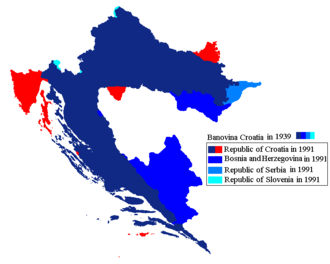
In 1939, the Littoral Banovina joined with the Sava Banovina and some nearby areas to form the Banovina of Croatia.
During World War II in 1941, the Axis powers took over the area. The coast from Split to Zadar became part of Fascist Italy, while the rest joined the Independent State of Croatia. After the war, the land was split between Croatia and Bosnia and Herzegovina in federal Communist Yugoslavia.
Bans
The Littoral Banovina had three leaders during its time. Their names were Ivo Tartaglia, who served from 1929 to 1932, Josip Jablanović from 1932 to 1935, and Mirko Buić from 1935 to 1939. Each of them helped govern this area during their years in charge.
Images
Related articles



This article is a child-friendly adaptation of the Wikipedia article on Littoral Banovina, available under CC BY-SA 4.0.
Images from Wikimedia Commons. Tap any image to view credits and license.