
Maarten van Heemskerck
Maarten van Heemskerck (born Maerten Jacobsz van Veen; 1 June 1498 – 1 October 1574), also known as Marten Jacobsz Heemskerk van Veen, was a Dutch portrait and religious painter, who spent most of his career in Haarlem. He was a pupil of Jan van Scorel, and adopted his teacher's Italian-influenced style.
During his time, van Heemskerck became well known for his artwork. He traveled to Italy between 1532 and 1536, where he gained more experience and inspiration.
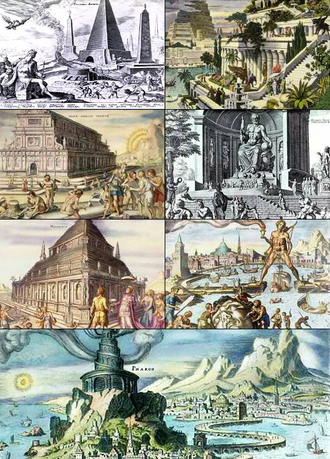
One of his most famous works includes paintings of the Wonders of the World. He also created many designs for engravers, helping to share his artistic vision with many people. His paintings and designs have remained important examples of Dutch art from the 16th century.
Biography
Maarten van Heemskerck was born in the village of Heemskerk, North Holland, in 1498. He learned to paint from Jan van Scorel and later traveled to Italy from 1532 to 1536. There, he made many drawings of classical buildings and statues that he used in his paintings for the rest of his life.
After returning to the Netherlands, Heemskerck became a leader in the artists' group in Haarlem and painted many important religious artworks. His time in Italy changed his style, but some people thought his paintings were not as good as before. Later, he worked in Delft and Amsterdam, where he stayed until he passed away in 1574.
Engravings
Maarten van Heemskerck was one of the first artists from the Netherlands to create drawings meant for printers to copy. He used special lines and dots to help the printers make clear pictures.
He designed a set of pictures showing eight wonders of the ancient world, adding the Colosseum in Rome to the usual seven. The Colosseum was shown in ruins, just like it looked in his time, with a giant statue of Jupiter in the middle. These pictures were carved into metal by Philip Galle and published in 1572. Some of the wonders he showed include the Colossus of Rhodes, the Hanging Gardens of Babylon, the Temple of Artemis, the Statue of Zeus at Olympia, the Lighthouse of Alexandria, the Great Pyramid of Giza, and the Mausoleum of Halicarnassus. He even painted a picture of himself with the Colosseum in the background self-portrait with the Colosseum.
Paintings
Many works by Maarten van Heemskerck still exist today. One famous painting is Adam and Eve, and another is St. Luke painting the Likeness of the Virgin and Child, which shows a poet and a parrot in a cage. These works show his style before he traveled to Italy. After returning from Italy, his style changed, as seen in a large altar-piece he made for the St. Laurence Church in Alkmaar.
Van Heemskerck also painted scenes from the Bible, like a crucifixion scene and other altar-pieces for churches in Haarlem and Delft. His paintings show the influence of famous artists like Michelangelo and Raphael, but they also reflect his Dutch roots. His works can be found in many museums across Europe, including the Museum of Fine Arts in Ghent and the Frans Hals Museum.
Death
Maarten van Heemskerck made a will in Amsterdam that still exists today. He had lived a long and successful life, and he left money and land to help the orphanage in Haarlem. He wanted the interest from this money to help couples get married at his tomb in the cathedral of Haarlem. People at that time believed that getting married there would help keep the peace of those buried in the tomb.
Reputation
Maarten van Heemskerck was highly respected during his lifetime and greatly influenced painters in Haarlem. Together with his teacher Jan van Scorel, he helped bring Italian art styles to the Northern Netherlands. He created a famous series about the wonders of the world, which were later shared as prints. The artist Karel van Mander wrote six pages about his life in a book called Schilder-boeck.
Public collections
Maarten van Heemskerck's artwork can be found in many important museums around the world. Some of these museums include the Courtauld Institute of Art, the Museum Boijmans Van Beuningen in Rotterdam, and the National Gallery, London. Other notable collections holding his work are the Rijksmuseum Amsterdam, the Museum of New Zealand Te Papa Tongarewa, and the University of Michigan Museum of Art.
Pictures
Keep exploring


This article is a child-friendly adaptation of the Wikipedia article on Maarten van Heemskerck, available under CC BY-SA 4.0.
Images from Wikimedia Commons. Tap any image to view credits and license.