 Safekipedia
Minbar
Adapted from Wikipedia · Discoverer experience
A minbar (Arabic: منبر; sometimes romanized as mimber) is a special raised platform found in a mosque. It is used by the imam, who leads the prayers, when giving important talks called sermons (خطبة, khutbah). The minbar helps the speaker be seen and heard clearly by everyone gathered in the mosque.
Minbars are not just simple stands; they often have beautiful designs and steps that the imam climbs to reach the top. This tradition dates back many centuries and shows the importance of the messages shared during services. Similar platforms can also be found in places called a Husayniyya, where speakers share teachings with their listeners.
Etymology
The word "minbar" comes from an Arabic root called ن ب ر, which means "to raise" or "elevate." In Arabic, the plural form of "minbar" is manābir.
Function and form
The minbar is a special seat used by the imam, who leads prayers and gives talks in a mosque. Long ago, it was only for Muhammad and the leaders who came after him. Today, it is found in many mosques on Fridays, and it still shows the imam's importance.
A minbar looks a bit like a small tower with steps leading up to a seat or small room on top. It is placed to the right of the mihrab, a special part of the mosque that points toward Mecca, the direction Muslims face when they pray. Sometimes, there is a raised area opposite the minbar where the muezzin, who helps the imam, stands during prayers.
Origins
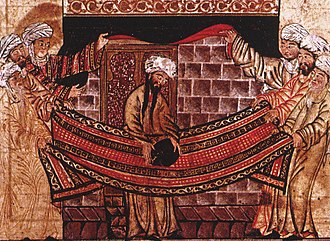
The first minbar was made for Muhammad in Medina around the year 629. It had just two steps and a seat, like a small throne. After Muhammad passed away, leaders called caliphs used this minbar to show their authority.
Later leaders, like Mu'awiya I of the Umayyad caliphs, added more steps to make the minbar taller and more important. Minbars became common in Friday mosques across many lands. They were used for important speeches and announcements.
One of the oldest minbars still around today is in the Great Mosque of Kairouan in Tunisia. It was made around the year 860 and has eleven steps made from special wood brought from India. It is a beautiful example of old Islamic art.
Wood minbars
Wood was the main material used to build minbars in much of the Middle East and North Africa until the Ottoman period. These wooden minbars were often beautifully decorated with geometric patterns and carved arabesques, which are plant and flower designs, along with Arabic calligraphic writings. Some minbars also had delicate work using ivory or mother-of-pearl. Many workshops made minbars from hundreds of pieces joined together with wooden pegs and special fitting techniques, without using glue or metal nails.
Some of the best-known minbars come from the Levant and Egypt, made between the 11th and 15th centuries. The oldest surviving example is the Minbar of the Ibrahimi Mosque in Hebron, made in 1091. It has geometric designs and Arabic writings. Another famous minbar is the Minbar of the al-Aqsa Mosque in Jerusalem, made in 1168-69. Before it was damaged in 1969, it was a wonderful example of Syrian woodworking, with geometric patterns and carved designs.
In Mamluk Egypt from the 13th to 16th centuries, minbars followed Syrian styles but used bone, ivory, ebony, or mother-of-pearl for decoration. The patterns became more complex with multi-pointed stars and detailed designs. The top of these minbars often had a rounded finial, similar to those on minarets. Notable examples include the minbar of the Mosque of Salih Tala'i from 1300 and the minbar in the Mosque of Sultan al-Muayyad from 1415–1420. The Minbar of al-Ghamri, made around 1451, uses curved lines in its geometric patterns.
In the Maghreb, many wooden minbars from the 10th to 15th centuries have survived. The Great Mosque of Cordoba once had a famous minbar made around 975, though it no longer exists. One of the oldest surviving minbars in this area is from the Mosque of the Andalusians in Fez, made in 980. Its woodwork has geometric designs. The minbar of the Great Mosque of Nedroma, from around 1086, has only fragments left. The minbar of the Great Mosque of Algiers, from around 1097, is better preserved and has square panels with plant and geometric designs.
The most famous minbar from this time is the Almoravid minbar in Marrakesh, made in 1137. It was moved during the Almohad period to the Kutubiyya Mosque and is now in the Badi Palace Museum. This minbar is richly decorated with geometric and plant designs using different wood techniques. Another important minbar is from the Qarawiyyin Mosque, finished in 1144. Later minbars in Morocco often copied the style of the Almoravid minbar.
Iranian minbars usually did not have a top canopy or dome, unlike minbars in other areas. Some wooden minbars from the 11th and 12th centuries in Iran, Mesopotomia, and Anatolia have plant designs carved in a special style. Many early minbars in Iran and Afghanistan were lost during the Mongol invasions of the 13th century.
From the Ilkhanid period (13th–14th centuries), important minbars include those in the Great Mosque of Na'in and the Great Mosque of Isfahan. Both are wooden, with the Na'in minbar having rectangular panels with beveled designs and the Isfahan one having octagonal geometric patterns. The Na'in minbar is one of the few Iranian minbars with a canopy.
From the Timurid period, the minbar of the Mosque of Gowhar Shad in Mashhad, made between 1336 and 1446, shares the shape of the Na'in minbar and also has a canopy. Its decoration features a carpet-like geometric pattern with carved tendrils.
Stone minbars
Stone or marble minbars were made in some places early on, like in Mamluk Cairo, but they became more common later during the Ottoman period. Unlike older wooden minbars, stone ones were usually simpler in design.
One early marble minbar from around 1347 can be found in the Aqsunqur Mosque in Cairo. It has beautiful patterns made from different colored stones. Another marble minbar made for the Mosque of Ulmas al-Hajib around 1329 to 1330 still has some pieces kept at the Museum of Islamic Art in Cairo. The stone minbar at the Mosque of Sultan Hasan in Cairo, from about 1360, is plain but has very fancy bronze doors. In 1483, Sultan Qaytbay gave a stone minbar to the Khanqah of Faraj ibn Barquq, which has designs carved to look like traditional wooden minbars.
During the Ottoman period, minbars often had a tall, cone-shaped top instead of a small dome. An early example is from the Ahmed Pasha Mosque in Amasya, which has detailed flower carvings. The minbar at the Selimiye Mosque in Edirne from around 1574 is a great example, with its cone-shaped top covered in tiles. Later Ottoman minbars used different styles inspired by European designs.
In the Indian subcontinent, minbars came in many styles and sizes, mostly made of stone. Some were simple steps, while others were very fancy. In places like the Bengal Sultanate and Gujarat Sultanate, minbars often had tops, but in the Jaunpur Sultanate and Mughal Empire, they usually did not. One beautiful example is the minbar in the Friday Mosque of Mandu in Malwa from 1454, which has a local-style dome supported by curved pieces. In some areas, the first step of the minbar had a small square platform, though its purpose is not clear.
In the Deccan, minbars were usually just three simple steps. In the Mughal Empire, some minbars also had three steps but might have special details like very shiny marble or decorative stone railings, especially under Shah Jahan.
Images
Related articles



This article is a child-friendly adaptation of the Wikipedia article on Minbar, available under CC BY-SA 4.0.
Images from Wikimedia Commons. Tap any image to view credits and license.