 Safekipedia
Music
Adapted from Wikipedia · Discoverer experience
Music is the arrangement of sound to create form, harmony, melody, rhythm, or expressive content. It is found in all human societies and is considered a cultural universal. While scholars agree that music has specific elements, they do not all agree on exactly what those elements are.
Music is a versatile way to express human creativity. It can be created through composition, improvisation, and performance, and often uses musical instruments or the human voice. Music can also be produced mechanically or electronically using devices like a music box, barrel organ, or digital audio workstation software.
Music plays important roles in social events and religious ceremonies. It is part of cultural traditions and is enjoyed in both public and private settings, such as at festivals and concerts. Music is also used in other media, like soundtracks for films, TV shows, operas, and video games.
Listening to music is a popular form of entertainment. The world of music includes academic study, journalism, philosophy, psychology, and even therapy. The music industry involves many people, including songwriters, performers, sound engineers, producers, and others who help create and share music using technology like microphones, phonographs, tape machines, MP3 players, CD players, and smartphones.
Etymology and terminology
The word music in English started being used in the 1630s. It comes from older words like musike in Middle English, musique in Old French, and mūsica in Latin. These all trace back to the Ancient Greek phrase mousiké technē, meaning "art of the Muses." The Muses were nine deities in Ancient Greek mythology who were linked to the arts and sciences.
Different cultures have their own ways of thinking about music. In many parts of the world, including places like East Asia and some parts of Africa, music is closely tied to dance and speech. Some languages don’t have one word that covers all types of music the way we often think of it today. For example, in Chinese, the word yue originally meant all the arts but later came to mean just music.
History
Main article: History of music
Music has a long and rich history that spans thousands of years. The origins of music are still debated, with theories suggesting it may have developed alongside language, as a result of natural selection, or as a tool for communication and community bonding. Early musical instruments, like bone flutes from Germany, date back over 40,000 years.
In ancient times, music was an important part of life in civilizations such as Egypt, Greece, and China. In Egypt, instruments like harps and flutes were common, while in Greece, music was taught to children and used in theater and religious ceremonies. Ancient Greek music theory influenced Western music for centuries.
During the Middle Ages in Europe, music was mainly religious, with monks singing chants. The Renaissance brought more focus on secular music and the printing press made sheet music more available. The Baroque period saw the creation of new forms like the fugue and concerto, with famous composers like Bach and Handel. The Classical period, led by composers like Mozart and Beethoven, emphasized balance and clarity.
The Romantic era, from the 1800s to around 1900, featured more emotional and expressive music. Composers like Wagner and Tchaikovsky explored new ways to convey feelings and stories through music. The 20th century brought huge changes with the invention of radio and recording, allowing people everywhere to enjoy music. New genres like jazz and rock emerged, changing how music was made and shared.
Creation
Main article: Performance
Music is created through composition, which means making a song or piece of music. This can include writing down notes on paper, called sheet music, or just making up the music in your mind. In some types of music, like jazz or blues, musicians often improvise, meaning they make up the music as they go along.
When music is performed, it can be played exactly as written or changed a little to give it a new feel. Some music is planned and practiced a lot, while other types are made up on the spot. Whether you’re playing alone or in a group, music can be a fun way to express yourself and share ideas with others.
Art and entertainment
Music is created and played for many reasons, such as enjoyment, for special events, or as a product to sell. In the past, people bought sheet music to play their favorite songs at home. Later, with the phonograph, people started using records. In the 1980s and 1990s, tape recorders and digital music let people make playlists to carry with them.
Professional musicians work for places like schools, radio stations, or movies. Some play for fun and earn money in other ways. Many amateur musicians learn from professionals and sometimes perform together in groups. Music can be played live for an audience or recorded in a studio to share with others. Live recordings are popular in many music types.
Elements
Main article: Elements of music
Music has many different building blocks or elements. These can include pitch, rhythm, melody, harmony, and more. Each country teaches these elements a little differently, but some, like pitch and rhythm, are common everywhere.
Pitch
Main article: Pitch (music)
Pitch is how high or low a sound seems. For example, a piano note sounds higher than a drum beat. In songs, pitch helps create melodies and chords.
Melody
Main article: Melody
A melody is a tune you hum or sing. It’s a series of notes played one after another, often going up and down. Simple songs use just a few notes, while jazz and modern music can use many different notes.
Harmony
Main article: Harmony
Harmony is when notes are played together to make chords. In most songs, chords stay the same, but some songs change keys or use many different chords.
Rhythm
Main article: Rhythm
Rhythm is the pattern of sounds and silences in time. Songs often group beats in twos, threes, or fours. Some songs have a strong beat on every other count, called backbeat.
Texture
Main article: Texture (music)
Texture is how music sounds overall—thick or thin. Thin textures have just one melody, like a lullaby. Thick textures have many layers, like an orchestra playing together.
Timbre
Main article: Timbre
Timbre is the color or quality of a sound. Even if two instruments play the same note, they sound different because of timbre. For example, a piano and a violin playing the same note sound very different.
Expression
Expressive qualities are those elements in music that create change in music without changing the main pitches or substantially changing the rhythms of the melody and its accompaniment. Performers, including singers and instrumentalists, can add musical expression to a song or piece by adding phrasing, by adding effects such as vibrato (with voice and some instruments, such as guitar, violin, brass instruments, and woodwinds), dynamics (the loudness or softness of piece or a section of it), tempo fluctuations (e.g., ritardando or accelerando, which are, respectively slowing down and speeding up the tempo), by adding pauses or fermatas on a cadence, and by changing the articulation of the notes (e.g., making notes more pronounced or accented, by making notes more legato, which means smoothly connected, or by making notes shorter).
Expression is achieved through the manipulation of pitch (such as inflection, vibrato, slides, etc.), volume (dynamics, accent, tremolo, etc.), duration (tempo fluctuations, rhythmic changes, changing note duration such as with legato and staccato, etc.), timbre (e.g. changing vocal timbre from a light to a resonant voice), and sometimes even texture (e.g. doubling the bass note for a richer effect in a piano piece). Expression therefore can be seen as a manipulation of all elements to convey "an indication of mood, spirit, character etc." and as such cannot be included as a unique perceptual element of music, although it can be considered an important rudimentary element of music.
Form
See also: Binary form, Ternary form, and Development (music)
Form is the overall shape or plan of a song. Older songs often repeat the same melody with changes, while modern pop songs usually have verses and choruses. Some classical pieces have very free forms without clear sections.
Philosophy
Main article: Philosophy of music
The philosophy of music explores big questions about what music is and how it works. It connects to ideas about the mind, feelings, and even the world around us. People have always wondered things like: What makes something music? How does music make us feel? And what can music tell us about life?
Long ago, thinkers like the Ancient Greeks studied how music relates to math and the universe. Later, in the 1700s, people began focusing more on how we experience music and enjoy it. Today, philosophers still explore these ideas, asking how music can express emotions and affect our thoughts. Important thinkers in the 20th century include Peter Kivy, Jerrold Levinson, Roger Scruton, and Stephen Davies. Music can make us feel better or stir strong emotions, a power that has fascinated people for thousands of years.
Psychology
Music psychology is the study of how people understand and experience music. Researchers look at how we hear, think about, and feel music. They use experiments and work with people to learn more about music. This helps us understand how music affects our feelings, learning, and even our health.
Main article: Neuroscience of music
Scientists also study how the brain works when we listen to, play, or enjoy music. They use special machines to see how different parts of the brain light up when we hear music. This helps us learn why music can make us feel so many different emotions.
Main article: Cognitive musicology
Cognitive musicology looks at how we think about music using computer models. These models help scientists understand how we learn, remember, and create music. They study how music might be connected to language in our brains.
Main article: Psychoacoustics
Psychoacoustics is the study of how we hear sounds, including music. It looks at how our minds and bodies react to different sounds and helps us understand why some sounds feel pleasant or uncomfortable.
Main article: Evolutionary musicology
Evolutionary musicology asks questions about why humans enjoy music. Some think music helped early humans communicate, while others believe it just makes us feel good, like tasty but useless food. Researchers are still exploring these ideas.
Main article: Culture in music cognition
Our culture and background affect how we experience music. People usually prefer music from their own cultural traditions and understand the emotions in that music better. This shows how music is connected to our identity and shared experiences.
Sociological aspects
Main article: Sociomusicology
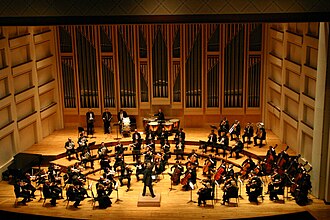
Music is a shared activity that brings people together in many different settings, from quiet listening to large concerts. It involves both professional and amateur participants who share common values and goals. The way music is viewed can differ greatly between cultures. For example, in Europe and North America, some types of music, like classical symphonies, are considered "high culture" and are usually performed in formal settings. Other types, such as jazz or rock, are often heard in more relaxed venues like bars or clubs.
When new styles of music appear, they sometimes face resistance from traditional listeners or experts. This has happened many times throughout history with various genres, showing how music can both reflect and challenge cultural norms.
Role of women
Main article: Women in music
Women have been important in music for centuries, working as composers, performers, teachers, and more. Even today, they make up a large part of singers and songwriters in both popular and classical music. However, there are still areas where women are less common, such as in conducting, music producing, and certain instrumental roles in rock and metal genres. Despite these challenges, women continue to play a vital role in creating and performing music across many different styles.
Media and technology
Since the 20th century, music can be heard over the radio, television, or the Internet, or played from devices like CD players and MP3 players. In the 1920s, when movies began to include recorded music, many musicians who used to play live in theaters lost their jobs. Some musicians protested this change.
Today, live performances sometimes use recorded music. For example, a disc jockey might use disc records for scratching, and some bands play along with recorded backing tracks. Computers and keyboards can create music using Musical Instrument Digital Interface (MIDI). People can also enjoy singing along with songs using karaoke, a popular activity that lets performers sing over instrumental tracks shown on screen.
The Internet has changed how we experience music. With sites like YouTube and Facebook, musicians can share their work with the world more easily. Platforms like Spotify and Apple Music let people listen to music online, changing how artists share their music with fans. New technology, including AI, is also being used to create music.
Education
Music is often included in schools from a very young age up through college. Learning music helps students improve their focus, counting skills, listening abilities, and teamwork. It also supports learning in other subjects. In elementary school, children might play simple instruments like the recorder, sing in small groups, and learn about different types of music. Older students can join groups such as choirs, marching bands, or orchestras. Some schools also offer lessons on how to play instruments.
At the college level, students can take music classes that cover the history of music or how to appreciate different styles. Many universities also have music groups for students to join. Music education is also growing in places outside of North America and Europe, with schools in countries like Indonesia, South Korea, Japan, and China offering programs in classical music. Universities are also expanding to include music from Africa and other parts of the world.
Academic study
Musicology is the study of music in schools and special music schools. It has several parts, like studying the history of music, the types of music around the world, and how music works. People also study how music affects our minds and feelings.
Music theory is another part of music study. It looks at how music is made and written, often using math and science ideas. It helps musicians understand how to create songs, especially in styles that have been popular for a long time.
Zoomusicology is the fun study of animal sounds that might sound like music. Scientists wonder if animals make music too, like birds singing.
Ethnomusicology looks at music from many cultures around the world. It includes music from Asia, Africa, and many other places. This kind of music can be for special events, ceremonies, or just for fun. As different cultures meet, their music sometimes mixes together to create new styles. For example, in the United States, many different musical traditions came together to create bluegrass music. Indian music is very old and still popular today, with many different styles and ways to play it.
Therapy
Music therapy is a special way that helps people feel better and stay healthy. A trained therapist uses music in many ways—like singing, playing instruments, or creating songs—to support people of all ages. This can help with many different needs, such as dealing with feelings, learning, building confidence, or even doing physical exercises.
For a long time, people have known that music can lift spirits and help with emotions. Ancient thinkers and leaders used music to comfort and heal, and today, music therapy continues to be a valuable tool for many.
Images
Related articles



This article is a child-friendly adaptation of the Wikipedia article on Music, available under CC BY-SA 4.0.
Images from Wikimedia Commons. Tap any image to view credits and license.