
Number (sports)
In team sports, each player wears a special number on their uniform to help everyone tell them apart. This number, sometimes called a jersey number or squad number, is usually on the back of the jersey and often shows the player’s name too. Sometimes it’s also on the front, sleeves, shorts, or even headgear. The number helps referees, other players, scorekeepers, and fans know who is who during the game. In some sports, the number can also show what position the player has.
The idea of using numbers on jerseys started a long time ago. A football team from New Zealand called the Nelson Football Club began wearing numbered jerseys in 1911. They did this so fans could easily see and remember the players, and to help the referee keep track of rules and mistakes.
Historians of football say the first recorded use of numbers was in a football match in Sydney in 1911. But there are pictures that show players wearing numbers as early as May 1903 in Australia, during a game between Fitzroy and Collingwood. Numbers were also used in a rugby match between Queensland and New Zealand on July 17, 1897, in Brisbane, Australia. team number uniform officials jersey International Federation of Football History and Statistics association football Fitzroy Collingwood rugby Brisbane Courier
Association football
Main article: Squad number (association football)
In association football, players started wearing numbers on their jerseys in 1911. Teams in Australia were the first to use them. Soon after, other places like Argentina, England, and North America began using numbers too.
Traditionally, numbers showed a player's position. The goalkeeper usually wore number 1, with other positions having their own numbers. Over time, players could keep the same number for many games, and today players often choose their favorite numbers. Some players even wear numbers that match their birth years if their favorite number is already taken.
Australian rules football
In Australian rules football, players wear numbers on their uniforms to help tell them apart. These numbers first appeared when clubs played in different states. Usually, players have their numbers on the back of their jerseys, but some teams also put smaller numbers on the front.
Sometimes, a special number is given to the team's captain. For example, Port Adelaide gives the number 1 to their captain, and Richmond gives the number 17 to honor a famous player. When a captain leaves, another player might take their number. Clubs often pass famous numbers to new players who show great promise.
Players’ families also share numbers. For example, some sons wear the same number as their fathers, while others choose different numbers to make their own mark. Very high numbers, like above 60, are rarely used. In 2017, some players wore the number 67 to celebrate a big event for Indigenous Australians.
Baseball
Main article: Uniform number (Major League Baseball)
In baseball, players and coaches wear big numbers on the back of their jerseys. Sometimes, smaller numbers appear on the sleeves, pants, or front of the shirt. These numbers help fans and teammates easily recognize each player. Some players become so linked to their numbers that the team officially stops using them, called “retiring” the number. The New York Yankees were the first team to retire a number, honoring Lou Gehrig’s number 4 in 1939.
Traditionally, single-digit numbers are used by position players, not pitchers, and numbers above 60 are uncommon. However, this is just a custom, not a rule, and many players now choose higher numbers. For example, stars like Kenley Jansen wear number 74, and Aaron Judge wears 99. In the early days of baseball, teams did not use uniform numbers. The New York Yankees and Cleveland Indians were the first to add numbers to jerseys in 1929, starting a trend that spread to all teams by 1937.
Players usually pick their own numbers for personal reasons. For instance, Bill Voiselle wore number 96 to honor his hometown, Ninety Six, South Carolina. The number 42 is retired across all of baseball to honor Jackie Robinson.
Basketball
In basketball, players wear numbers on their jerseys so we can tell them apart. In college and some amateur games, players can only wear numbers from 0 to 55. This makes it easier for referees to talk to scorers using hand signals.
In the professional NBA, players can wear any number from 0 to 99, but numbers 6 through 9 are less common because many players keep the numbers they used in college. Some players change numbers when they move teams if the number is already taken or retired by another player.
In women's basketball and international games, the rules have changed over time. Now players can usually wear any number from 0 to 99, though some groups still follow older rules.
Cricket
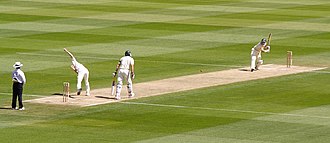
The International Cricket Council does not set rules for player numbers, so players pick their own jersey numbers.
In the 1995–96 World Series Cup in Australia, players first started using shirt numbers in international cricket. Most players were given a number, but some, like Shane Warne, chose their own—he wore 23 because that was his number when he played junior Australian rules football for St Kilda. Other countries quickly started using numbers too. At first, players often had different numbers in each tournament, but later they began to use the same number every year. Ricky Ponting (number 14) kept using the same number from that first season.
Numbers were first used in the 1999 Cricket World Cup. The captains wore number 1, and the rest of the team wore numbers from 2 to 15. One exception was South African captain Hansie Cronje, who kept his usual number 5, while opener Gary Kirsten wore number 1, as he had done before.
Today, numbers are not just for shorter cricket games anymore. Navy blue numbers are now used on white uniforms in the Sheffield Shield to help fans tell players apart. Some countries also give a special number to a player when they play their first Test match. This number shows how many players have made their Test debut before them, including the player themselves. If several players make their debut in the same match, they are given numbers based on the alphabet order of their last names. For example, Thomas Armitage was Test player number 1 for England because he made his debut in the very first Test Match, against Australia, on 15 March 1877, and his name was first in alphabetical order on England’s team. Mason Crane made his debut for England on 4 January 2018 against Australia; his number is 683. These special debut numbers are shown on a player’s Test uniform, but in small print on the front, not prominently displayed.
Gaelic games
Main article: Gaelic football, hurling and camogie positions
In Gaelic football and hurling, players are given numbers from 1 to 24 during big games. In camogie, there are no special rules for numbers. Usually, the goalkeeper wears the number 1, and the other starting players wear numbers from 2 to 15, going from right to left and from defense to attack. Substitute players start with number 16.
Gridiron football
American football
Main article: Uniform number (American football)
NFL
Main article: National Football League uniform numbers
The NFL has used numbers on player jerseys since it began. At first, teams could choose any numbers they liked. By the 1940s, teams started to follow a similar pattern to what we use today. When a different league joined the NFL in 1950, it caused confusion because they used different numbers. To fix this, the NFL made a rule in 1952 that all teams must use certain numbers for certain positions. This rule was updated in 1973 and changed a little after that. In 2021, the rules changed again to allow more flexibility. Today, numbers are shown on both the front and back of jerseys, and smaller numbers, called “TV numbers,” are on the sleeves or shoulders.
Some teams also put numbers on their helmets. Players sometimes ask to use numbers that are not allowed, but these requests are usually denied. The NFL has rules about which numbers can be used for which positions. For example, quarterbacks and running backs often wear numbers from 0 to 19, while offensive and defensive linemen usually wear numbers from 50 to 99.
College and high school
In college football and high school football, the rules for numbers are not as strict. The main rule is that offensive linemen must wear numbers from 50 to 79. Other players often follow similar number ranges as in the NFL, but they can choose almost any number. Sometimes, two players on the same team can wear the same number if they are not on the field at the same time.
For example, in some seasons, a quarterback and a defensive player wore the same number, like number 5. This confused the other team sometimes, but it was allowed as long as the players did not play together. Since 2020, teams can only have two players sharing a number, and players can now wear number 0. High schools also allow number 0 but do not allow numbers with leading zeroes, like 00 or 01.
Canadian football
Canadian football, played in places like the Canadian Football League (CFL) or university teams in U Sports, has rules similar to college football in the United States. In the past, offensive linemen wore numbers from 40 to 69, and receivers wore numbers from 70 to 79. A rule change in 2008 switched numbers 40 to 49 to be for receivers. Now, any player can wear any number that is allowed, and numbers 1 to 49 and 70 to 89 are eligible for any position. Numbers 50 to 69 are for players who are not eligible to receive passes. Numbers 90 to 99 are usually for defensive players, though they were sometimes used on offense in the past. The numbers 0 and 00 are allowed, but since 2023, a team cannot use both 0 and 00 at the same time. Defensive players do not have to follow specific number rules based on their positions.
Handball
According to the International Handball Federation, players can wear numbers from 1 to 99 on their uniforms.
Goalkeepers often choose the numbers 1 or 12, and sometimes 16. Field players usually wear numbers from 1 to 20, and some players even use the last two digits of their birth year as their number.
Field hockey
In field hockey, there are no strict rules about player numbers set by the International Hockey Federation. However, in the 2018 Men's and Women's World Cup, each team's 18 players were numbered from 1 to 32. Usually, the number "1" is given to the goalkeeper, but there are exceptions, like in Canada men's team where forward Floris van Son, or in the India women's team where midfielder Navjot Kaur wore this number.
Similar numbering from 1 to 32 was also used in other FIH-controlled competitions, including the 2016 Summer Olympics for both men’s and women’s teams, and it continued in the last men’s and women’s Champions Trophy events held in Breda and Changzhou respectively.
Ice hockey
The first group to use numbers on ice hockey uniforms is not fully known. The Pacific Coast Hockey Association is sometimes said to be the first, but the National Hockey Association, which came before the National Hockey League, required players to wear numbered armbands starting in the 1911–12 season.
The first jersey number retired in professional sports was that of an NHL player, Ace Bailey, whose number 6 was retired by the Toronto Maple Leafs in 1934 after a serious incident during a game. The NHL hosted a special game to help Bailey, and his number was retired by the team's owner, Conn Smythe.
Traditionally, NHL goaltenders wore the number 1, as they were thought to be the first player seen from the net. Over time, this changed, and now goalies choose different numbers. The number 99 was retired across the NHL in 2000 in honor of Wayne Gretzky.
Auto racing
In most auto racing leagues, cars have numbers. Stock cars show their numbers very clearly because of their design. Numbers often become linked with the drivers who use them. For example, Dale Earnhardt Sr. is known for number 3, Richard Petty for number 43, Wood Brothers Racing for number 21, and Jeff Gordon for number 24.
NASCAR
In NASCAR, numbers belong to the car owners, not the drivers. Drivers usually keep the same number if they stay with the same owner. When drivers switch teams, they take a new number from that team. For example, Jeff Burton drove four different numbers during his time with three teams from 1994 to 2013. Numbers can change teams when drivers move, and some numbers move between series. Unlike other racing leagues, anyone can use number 1 in NASCAR, and numbers with a leading zero, like 07 or 09, are allowed.
Formula One
Formula One began using fixed numbers for the whole season in 1974. From then until the mid-1990s, numbers 1 and 2 went to the reigning world champion and their teammate. Teams kept the same numbers each year unless the champion changed teams. This changed in 1996, and since then, numbers are given out each year based on the previous season's results. The reigning champion gets number 1, and their teammate gets number 2. Other teams get numbers based on their ranking.
Since 2014, drivers choose their numbers for their whole careers, from 2 to 99, with number 1 reserved for the reigning champion. Number 13 is allowed, and some drivers have used it. If a driver leaves the sport, their number is held for two seasons before it can be used again.
IndyCar
During the USAC era, the defending champion usually used number 1, except at the Indianapolis 500, where the previous year's winner used number 1. In the CART era, numbers 1–12 were given based on the previous season's standings. Number 13 was not allowed. In the current IndyCar era, number 1 is for the previous season's champion, but many choose to keep their team's number instead.
Others
In other types of auto racing, like sprint car racing or motorcycle racing, drivers may use three-digit numbers or numbers with a letter, such as 888 for Triple Eight Race Engineering or 911 for Porsche cars. Some numbers reference popular culture, like 007 for Aston Martin cars.
Rugby league
Further information: Rugby league positions
In rugby league, each player has a special number on their shirt to show their job on the field. For example, the player who stands at the very back is called the fullback and wears the number "1".
Sometimes, teams give each player a number for the whole season. At the start, the main players wear numbers from 1 to 13, but as players swap in and out or get hurt, the number on their shirt might not match their job anymore.
Here are the usual numbers and jobs:
- 1: Fullback
- 2: Right wing
- 3: Right centre
- 4: Left centre
- 5: Left wing
- 6: Five-eighth/Stand-off
- 7: Half-back/Scrum-half
- 8: Prop forward
- 9: Hooker
- 10: Prop forward
- 11: Left second row
- 12: Right second row
- 13: Lock/Loose forward
The extra players who can come off the bench are numbers 14 to 17. They can play any job on the field.
Some teams in Australia and England, like the South Sydney Rabbitohs and Warrington, give players special numbers based on when they first played for the team. These numbers are usually small and stitched near the team's logo on the shirt.
Rugby union
Further information: Rugby union numbering schemes and Rugby union positions
In rugby union, the number on a player's shirt usually shows which position they play. Numbers 1 to 8 are called 'forwards', and numbers 9 to 15 are called 'backs'. There is even a position named after the shirt number, called "Number 8". Some clubs used letters instead of numbers on their shirts, but now they all use numbers like the other clubs.
- 1- Loosehead prop
- 2- Hooker
- 3- Tighthead prop
- 4- Lock/second row
- 5- Lock/second row
- 6- Blindside flanker ("Openside" in South Africa)
- 7- Openside flanker ("Blindside" in South Africa)
- 8- Number 8
- 9- Scrum half
- 10- Fly-half
- 11- Left winger
- 12- Inside centre
- 13- Outside centre
- 14- Right winger
- 15- Full-back
Other sports
Other sports where players wear numbered shirts include:
In water polo, players wear swim caps with numbers. The starting goalkeeper wears Number 1, the substitute goalkeeper wears Number 13, and the other players wear numbers from 2 to 12. In road bicycle racing, race officials give numbers to cycling teams, and these numbers change for each race. Each team uses numbers in a group of ten, like 11 to 19 or 21 to 29. Usually, the rider with a number ending in 1 is the team's leader.
In floorball, all players must have numbers from 1 to 99 on their jersey, but only goalies can wear number 1.
In volleyball competitions organized by the FIVB, players must be numbered from 1 to 20.
Retired numbers
Main article: Retired number
When a team wants to honor a special player, they can "retire" that player's number. This means no one else on the team can use that number again, unless the honored player says it's okay. This usually happens after a player leaves the team, retires, or if they pass away suddenly. Sometimes, a number is retired even if the player couldn't continue because of a serious injury.
Teams might also retire a number to honor someone who wasn't a player, like a coach, the team's owner, or even the fans. For example, the Boston Celtics retired the number 1 to honor their original owner, Walter A. Brown.
In association football, retiring numbers became common in the 1990s, starting with clubs in Europe’s Premier League or Serie A, and later in South American leagues like the Argentine Primera División. However, some rules, like those from CONMEBOL, don’t allow numbers to be retired. Because of this, some South American teams, such as Universitario de Deportes or Flamengo, have had to reuse retired numbers for special competitions like the Copa Libertadores or Copa América.
In cricket, teams also sometimes retire numbers to honor great players. For example, in the Indian Premier League in India, the Royal Challengers Bangalore retired the jerseys of two famous players, AB de Villiers and Chris Gayle, who wore numbers 17 and 333.
Pictures
Keep exploring


This article is a child-friendly adaptation of the Wikipedia article on Number (sports), available under CC BY-SA 4.0.
Images from Wikimedia Commons. Tap any image to view credits and license.