
Old St. Peter's Basilica
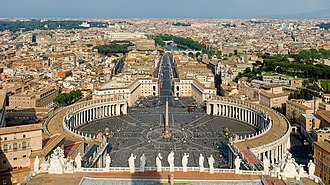
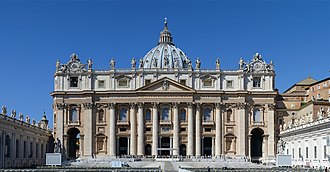
Old St. Peter's Basilica was the church that stood for many centuries where the current St. Peter's Basilica is today in Vatican City. It was built during the time when Constantine I was the ruler of the Roman Empire. The church was constructed over an old place called the Circus of Nero.
People have called it "Old St. Peter's Basilica" ever since the newer, bigger basilica was built. This old church was very important to many people for a long time, and it had a special place in history.
History
Construction of the first St. Peter's Basilica began by order of the Roman Emperor Constantine I between 318 and 322, after he converted to Christianity. It took about 40 years to finish. Over the next twelve centuries, the church grew in importance and became a major pilgrimage site in Rome.
Important events took place there, including papal coronations. In 800, Charlemagne was crowned emperor of the Carolingian Empire at this basilica. However, in 846, Saracens sacked and damaged the church. In response, Pope Leo IV built a wall and repaired the damaged parts.
By the 15th century, the old church was falling apart. Plans to fix it began after the pope's return from Avignon. Eventually, Pope Julius II decided to tear down the old building and build a new one. This decision surprised many people, as the old church had stood for over 1,000 years. The old church was slowly torn down over 100 years, with the last part removed in 1605. Construction on the new church started the next year.
Design
The old St. Peter's Basilica was built in the shape of a typical Roman basilica. It looked like other big halls from ancient Rome, such as the Basilica Ulpia and Constantine's Aula Palatina. The design might have also been inspired by descriptions of Solomon's Temple.
Emperor Constantine chose a special spot for the church, believing it was where Saint Peter was buried. The church was built on Vatican Hill, near the Tiber River, just outside the old city of Rome. Because of this location, the main altar faced west, allowing people to approach from Rome to the east. The building could hold thousands of people, with five aisles and a long, narrow central space. It was very long, over 350 feet, and shaped like a Latin cross. In later years, an entrance area called the "Garden of Paradise" with five doors was added.
The church had beautiful decorations, including mosaics and paintings. One famous mosaic showed Saint Peter walking on water and was made by the artist Giotto. Sadly, many of these artworks were lost when the new St. Peter's Basilica was built, but some pieces remain in other places.
Tombs
Main article: Papal tombs in Old St. Peter's Basilica
Since the time Saint Peter was buried there in 64 AD, people believed the spot held his tomb, marked by a small shrine. Over time, the church grew richer and more beautiful with statues, decorations, and many side tombs and altars added over the years.
The old church held many tombs and remains of saints and popes. Bones were still being found during building work as late as February 1544. Most of these tombs were lost when the old church was torn down in the 16th and 17th centuries, except for one that was destroyed long before in 846. The remaining tombs were moved, mostly just the stone boxes with their contents, to the current St. Peter's Basilica and a few other churches in Rome.
The only papal tombs that survived and were rebuilt properly in the present St. Peter's are two from the 1490s, made by a famous Florentine artist. They are special bronze works that were highly praised.
Stefaneschi Triptych
Main article: Stefaneschi Triptych
The Stefaneschi Altarpiece is a beautiful three-part painting made by the Italian artist Giotto. It was made around the year 1330 for one of the altars in Old St. Peter's Basilica in Rome. A church leader named Cardinal Giacomo Gaetani Stefaneschi asked Giotto to create this artwork.
This painting is special because we know for sure that Giotto made it, even though the exact year is not agreed upon by everyone. Some believe Giotto’s team helped with the work. The painting used to hang in the main part of the church, but newer research suggests it was placed near a big archway. Today, you can see this artwork in the Pinacoteca Vaticana in Rome.
Pictures
Keep exploring


This article is a child-friendly adaptation of the Wikipedia article on Old St. Peter's Basilica, available under CC BY-SA 4.0.
Images from Wikimedia Commons. Tap any image to view credits and license.