 Safekipedia
Organism
Adapted from Wikipedia · Discoverer experience
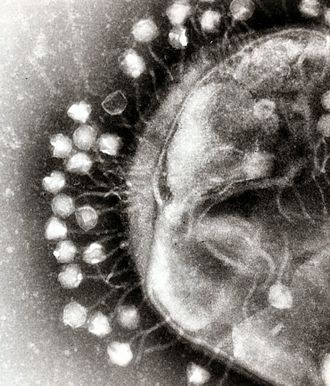
An organism is any living thing that works as an individual. Scientists use this word to describe creatures that can grow, feed themselves, and make new ones of their kind. But deciding exactly what counts as an organism can be tricky! For example, tiny things called viruses change over time like living things, but they don’t grow or feed themselves on their own, so they are usually not called organisms.
Some groups of animals work together in special ways. A colony of eusocial insects, like ants or bees, acts like one big organism. Some parts of the colony can have babies, while others help in different ways, almost like the different parts of one body. Similarly, a siphonophore is a long string of little pieces called zooids that work together, looking and acting like a single animal such as a jellyfish.
Scientists David Queller and Joan Strassmann suggest that what really makes an organism special is how its parts work together without fighting. They think that when different smaller parts, like cells or even different kinds of living things, start cooperating closely, they can act like one organism. This idea helps explain why some teams of different species, like a fungus and an alga living together in a lichen, or two fish that stay together forever like an anglerfish, can sometimes be thought of as a single organism.
Etymology
The word "organism" comes from an old Greek word that means "instrument" or "tool." It started being used in English in the 1660s to describe living structures. A famous thinker named Immanuel Kant described an organism as something that is organized and can organize itself.
Whether criteria exist, or are needed
Scientists have tried to figure out what makes something a living thing, or an organism. Some ideas they’ve suggested include things like being able to grow, reproduce on their own, and keep their body working properly. Another idea is that an organism should be able to tell itself apart from other things — like having a way to fight off what doesn’t belong.
But not everyone agrees that one simple definition works for everything. Some living things, like groups of insects or special partnerships between plants and fungi, make it even harder to decide what counts as one organism. Some scientists think we should look at different qualities separately instead of trying to make one list that every living thing must follow.
Organisms at differing levels of biological organisation
Living things can be organized in many different ways. A unicellular organism is a tiny living being made of just one cell, like a bacterium or a protist. A multicellular organism, such as an animal or a plant, is made of many cells that work together in special ways. Some living groups, like a colony of ants, act together as one big functioning unit, called a superorganism.
Scientists study how different living parts work together. For example, a lichen is a partnership between fungi and algae, helping both grow in tough places. Researchers suggest that working together without fighting is a key part of what makes any living thing an organism.
| Level | Example | Composition | Co-operation |
|---|---|---|---|
| Virus | Tobacco mosaic virus | Nucleic acid, protein | No metabolism, so not living, not an organism, say many biologists; but they evolve, their genes collaborating to manipulate the host |
| Unicellular organism | Paramecium | One cell, with organelles e.g. cilia for specific functions | Inter-cellular (inter-organismal) signalling |
| Swarming protistan | Dictyostelium (cellular slime mould) | Unicellular amoebae | Free-living unicellular amoebae for most of lifetime; swarm and aggregate to a multicellular slug, cells specialising to form a dead stalk and a fruiting body |
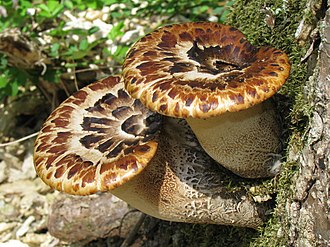
| Multicellular organism | Mushroom-forming fungus | Cells, grouped into organs for specific functions (e.g. reproduction) | Cell specialisation, communication |
| Permanent sexual partnership | Anglerfish | Male and female permanently fastened together | Male provides male gametes; female provides all other functions |
| Mutualism | Lichen | Organisms of different species | Fungus provides structure, absorbs water and minerals; alga photosynthesises |
| Joined colony | Siphonophore | Zooids joined together | Organism specialisation; inter-organism signalling |
| Superorganism | Ant colony | Individuals living together | Organism specialisation (many ants do not reproduce); inter-organism signalling |
Boundary cases
Viruses
Main article: Virus
Viruses are not usually considered to be organisms because they cannot grow, reproduce on their own, or maintain their own processes. They have some parts like genes and can change over time, but they need help from other cells to do these things. This makes it tricky to decide if viruses are alive or not.
Evolutionary emergence of organisms
Early forms of life may have been made of RNA, a type of molecule that could copy itself. These RNA molecules could pass on traits, change over time, and use resources, which are key parts of being an organism.
Organism-like colonies
Some groups of living things, like sponges, lichens, and colonies of ants, are sometimes hard to tell if they are single organisms or groups of many working together.
Synthetic organisms
Scientists are creating new types of life by mixing different species or adding electronic parts to living cells. These synthetic organisms can correct mistakes and work toward goals, much like natural organisms.
| Capability | Cellular organism | Virus |
|---|---|---|
| Metabolism | Yes | No, rely entirely on host cell |
| Growth | Yes | No, just self-assembly |
| Reproduction | Yes | No, rely entirely on host cell |
| Store genetic information about themselves | DNA | DNA or RNA |
| Able to evolve | Yes: mutation, recombination, natural selection | Yes: high mutation rate, natural selection |
| Function | Colonial siphonophore | Jellyfish |
|---|---|---|
| Buoyancy | Top of colony is gas-filled | Jelly |
| Propulsion | Nectophores co-ordinate to pump water | Body pulsates to pump water |
| Feeding | Palpons and gastrozooids ingest prey, feed other zooids | Tentacles trap prey, pass it to mouth |
| Functional structure | Single functional individual | Single functional individual |
| Composition | Many zooids, possibly individuals | Many cells |
Related articles


This article is a child-friendly adaptation of the Wikipedia article on Organism, available under CC BY-SA 4.0.
Images from Wikimedia Commons. Tap any image to view credits and license.