
Osama bin Laden
Osama bin Muhammad bin 'Awad bin Laden (10 March 1957 – 2 May 2011) was the founder and first leader of the group al-Qaeda from 1988 until his death in 2011. He was raised in a wealthy family in Saudi Arabia and later helped fighters in Afghanistan during a war against the Soviet Union.
Bin Laden believed that violent actions were needed to fight against Western countries. His group, al-Qaeda, was responsible for many attacks around the world, including the attacks on September 11, 2001, in the United States. These attacks caused many deaths and led to large changes in global security and wars in several countries.
After many years of hiding, U.S. forces found bin Laden hiding in a building in Pakistan in 2011. A team of U.S. Navy SEALs went to the building and he died during the operation. Today, many people around the world see him as a symbol of harmful and dangerous actions, while some groups still admire him.
Names
Further information: Romanization of Arabic and Arabic name
Osama bin Laden had several names and ways people called him. Most often, his name is written as Osama bin Laden, but it can also be spelled Usama or bin Ladin. In secret reports, U.S. intelligence called him Usama bin Laden, shortening it to "UBL". His full name was Osama bin Mohammed bin Awad bin Laden, meaning Osama, son of Mohammed, son of Awad, son of Laden.
He was also known by other names such as Shaykh Osama bin Laden, Mujahid Shaykh, the Prince, the Emir, Hajj, the Director, and Abu Abdallah. The word mujahid means someone who takes part in a struggle for Islam, and Hajj refers to the special journey Muslims make to the holy city of Mecca. Abu Abdallah was a special name based on one of his sons.
Early life
Osama bin Laden was born on 10 March 1957 in Saudi Arabia. His father was from Yemen, and his mother was from Syria. He grew up in a large family and attended school in Jeddah and later studied in Oxford, England. During his university years, he became very interested in learning about Islam and helping others through charity work.
Religious and political views
Further information: Political views of Osama bin Laden and Interviews of Osama bin Laden
Osama bin Laden grew up following Sunni Islam and believed strongly in following the Quran exactly. He disliked many modern activities and ideas, such as gambling, music, and drinking or other unwholesome activities on Sunday.
Bin Laden thought the Islamic world was in trouble because many people were not following Islamic rules strictly enough. He believed only by returning to strict Islamic law could problems be solved. He opposed democracy, feeling it went against Islamic teachings. He also felt that the United States was a major problem, especially because of its support for Israel and its military presence in Saudi Arabia. He believed that only through strong actions could these issues be addressed.
Militant and political career, 1979–2001
Main article: Militant career of Osama bin Laden
In 1979, a country called Afghanistan was invaded by another country. Bin Laden left college and went to help the local fighters resist the invasion. He used money from his family to support these fighters and built places for them to hide.
Later, bin Laden started a group with other leaders. This group wanted to defend Muslims around the world who were being treated unfairly. Over time, this group became known for planning attacks against other countries. These attacks caused many people to be hurt or lose their lives, leading to big problems around the world.
11 September 2001 attacks
Main article: September 11 attacks
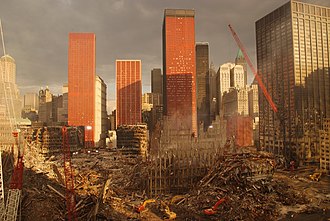
On September 11, 2001, members of a group called al-Qaeda took control of four airplanes in the United States. They crashed two planes into buildings called the Twin Towers in New York City, causing them to fall down. Another plane hit a building in Virginia called the Pentagon. The fourth plane was headed toward Washington, D.C., but the people on the plane fought back, and it crashed in a field in Pennsylvania instead. Many people were killed and injured in these attacks.
After the attacks, many countries worked together to prevent similar events from happening again. New safety rules were added at airports, and new groups were created to help keep people safe. The events led to big changes in how countries worked together to stop harmful acts.
Militant and political career, 2001–2011
Further information: Aftermath of the September 11 attacks and Prelude to the War in Afghanistan (2001–2021)
The United States began a global effort to stop a group called al-Qaeda after the attacks on September 11, 2001. This included searching for the group's leader. The U.S. worked with other countries to find and stop members of al-Qaeda. Many countries worked together to fight this group, which led to many operations and changes in different places around the world.
Al-Qaeda continued to plan attacks even after 2001. They worked with other groups in many countries, causing harm in many places. The U.S. and its partners kept searching for the leader of al-Qaeda for many years. In 2011, they found where he was hiding and took action to stop him. This showed how countries can work together to fight against groups that want to do harm to others.
Death
Main article: Killing of Osama bin Laden
On 2 May 2011, bin Laden was shot and killed at his compound in Abbottabad during a raid by a U.S. military special operations unit. The raid, called Operation Neptune Spear, was ordered by President Obama and carried out by U.S. Navy SEALs. They were supported by CIA operatives.
After the raid, bin Laden's body was taken and later buried at sea following Islamic customs. The news of his death led to celebrations in some places, while reactions varied in other regions. Ayman al-Zawahiri succeeded bin Laden as leader of al-Qaeda until he was killed in 2022.
Personal life
Main article: Personal life of Osama bin Laden
Osama bin Laden was known for being thin and tall, and he usually walked with a cane. He believed that eating honey could help heal many health problems. He enjoyed simple activities with his family, like going to the desert for picnics and playing sports such as football and volleyball with them.
Bin Laden married several women over the years and had many children. His family life included moments of both closeness and difficulty, as some of his marriages ended in separation or divorce.
Legacy
See also: Osama bin Laden in popular culture
Osama bin Laden was seen by many in the West as a dangerous person who led a group that caused harm around the world. Some people in certain Muslim countries once thought well of him, especially during a time of conflict. Over time, even many of those people changed their minds about him. After his death, opinions varied, with some leaders speaking about the event in different ways.
Pictures
Keep exploring


This article is a child-friendly adaptation of the Wikipedia article on Osama bin Laden, available under CC BY-SA 4.0.
Images from Wikimedia Commons. Tap any image to view credits and license.