 Safekipedia
PA-RISC
Adapted from Wikipedia · Discoverer experience
PA-RISC, which stands for Precision Architecture RISC, is a type of computer design used in many important computers made by Hewlett-Packard. It was created to help computers work faster and more efficiently by using a special way of giving instructions to the computer’s brain, called an instruction set architecture.
The first computers to use PA-RISC were introduced on February 26, 1986. These were the HP 3000 Series 930 and HP 9000 Model 840. Over the years, many powerful business computers used PA-RISC to handle big tasks and run complex programs.
Hewlett-Packard continued to make and sell PA-RISC computers until the end of 2008. They kept supporting these computers until 2013, helping people who still used them. After that, PA-RISC was replaced by a new design called Itanium, which was made together by HP and Intel. This change allowed computers to become even more powerful and better suited for modern needs.
History
In the late 1980s, Hewlett-Packard (HP) was making different kinds of computers, but they wanted to make them all use the same type of brain, or processor. This led to the creation of something called the Precision Architecture, which started as an internal HP project named Spectrum.
Work on this new way of designing computers began in 1982. By 1986, HP launched new computers like the HP 9000 Series 840 and HP 3000 Series 930 that used this new design. These computers could run different operating systems, like MPE-XL for HP 3000 machines and HP-UX and Unix for HP 9000 machines.
Over time, HP kept improving this design. In 1996, they updated it to support 64-bit processing, calling it PA-RISC 2.0. This made the computers even better at handling complex tasks. Many operating systems, such as Linux, OpenBSD, and NetBSD, were able to work with these computers too.
CPU specifications
PA-RISC, also known as Hewlett Packard Precision Architecture, was a type of computer instructions made by Hewlett-Packard from the 1980s to the 2000s. The first computers using this architecture were introduced on February 26, 1986, with the HP 3000 Series 930 and HP 9000 Model 840. Although HP stopped selling these computers in 2008, they continued to support servers using PA-RISC chips until 2013.
| Image | Model | Marketing name | Year | Frequency [MHz] | Memory Bus [MB/s] | Process [μm] | Transistors [millions] | Die size [mm2] | Power [W] | Dcache [KB] | Icache [KB] | L2 cache [MB] | ISA |
|---|---|---|---|---|---|---|---|---|---|---|---|---|---|
| TS-1 | ? | 1986 | 8 | ? | ? | — | — | ? | 64 | 64 | — | 1.0 | |
| CS-1 | ? | 1987 | 8 | ? | 1.6 | 0.164 | 72.93 | 1 | — | 0.25 | — | 1.0 | |
| NS-1 | ? | 1987 | 25/30 | ? | 1.7 | 0.144 | 70.56 | ? | 16-128 | 16-128 | — | 1.0 | |
 | NS-2 | ? | 1989 | 25/30 | ? | 1.5 | 0.183 | 196 | 27 | 512 | 512 | — | 1.0 |
| PCX | ? | 1990 | 50/60 | ? | 1.0 | 0.196 | ? | ? | ? | ? | ? | 1.0 | |
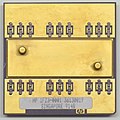 | PCX-S | PA-7000 | 1991 | 66 | ? | 1.0 | 0.58 | 201.6 | ? | 256 | 256 | — | 1.1a |
 | PCX-T | PA-7100 | 1992 | 33–100 | ? | 0.8 | 0.85 | 196 | ? | 2048 | 1024 | — | 1.1b |
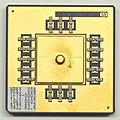 | PCX-T | PA-7150 | 1994 | 125 | ? | 0.8 | 0.85 | 196 | ? | 2048 | 1024 | — | 1.1b |
 | PCX-T' | PA-7200 | 1994 | 120 | 960 | 0.55 | 1.26 | 210 | 30 | 1024 | 2048 | — | 1.1c |
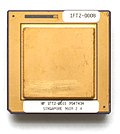 | PCX-L | PA-7100LC | 1994 | 60–100 | ? | 0.75 | 0.9 | 201.6 | 7–11 | — | 1 | 2 | 1.1d |
 | PCX-L2 | PA-7300LC | 1996 | 132–180 | ? | 0.5 | 9.2 | 260.1 | ? | 64 | 64 | 0–8 | 1.1e |
 | PCX-U | PA-8000 | 1996 | 160–180 | 960 | 0.5 | 3.8 | 337.68 | ? | 1024 | 1024 | — | 2.0 |
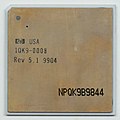 | PCX-U+ | PA-8200 | 1997 | 200–240 | 960 | 0.5 | 3.8 | 337.68 | ? | 2048 | 2048 | — | 2.0 |
 | PCX-W | PA-8500 | 1998 | 300–440 | 1920 | 0.25 | 140 | 467 | ? | 1024 | 512 | — | 2.0 |
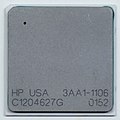 | PCX-W+ | PA-8600 | 2000 | 360–550 | 1920 | 0.25 | 140 | 467 | ? | 1024 | 512 | — | 2.0 |
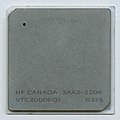 | PCX-W2 | PA-8700(+) | 2001 | 625–875 | 1920 | 0.18 | 186 | 304 | 1536 | 768 | — | 2.0 | |
 | Mako | PA-8800 | 2003 | 800–1000 | 6400 | 0.13 | 300 | 361 | ? | 768/core | 768/core | 0 or 32 | 2.0 |
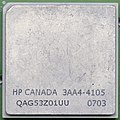 | Shortfin | PA-8900 | 2005 | 800–1100 | 6400 | 0.13 | ? | ? | ? | 768/core | 768/core | 0 or 64 | 2.0 |
Related articles


This article is a child-friendly adaptation of the Wikipedia article on PA-RISC, available under CC BY-SA 4.0.
Images from Wikimedia Commons. Tap any image to view credits and license.